Information Society Models: From Knowledge Industries to Network Capitalism
The transition of human civilization from an industrial base to one driven by data and knowledge has sparked decades of academic debate. What we now call the information society is not a single, agreed-upon concept, but a collection of theories exploring how the production, distribution, and use of information reshape our economic and social structures.
Early foundations were laid by economist Fritz Machlup, who began studying the impact of patents on research in 1933. His seminal 1962 work, The production and distribution of knowledge in the United States, introduced the concept of the knowledge industry. Machlup categorized this sector into five distinct areas: education, research and development, mass media, information technologies, and information services. By 1959, he estimated that these industries produced 29% of the USA's Gross National Product (GNP).
Key Facts
- Fritz Machlup pioneered the study of the knowledge industry, identifying five core sectors including R&D and education.
- The digital divide has evolved from a simple lack of hardware access to a three-tiered system of inequality involving material access, digital skills, and tangible outcomes.
- As of 2024, 68% of the global population (5.5 billion people) use the internet, though penetration is vastly higher in high-income countries (93%) than low-income ones (27%).
- The network society, popularized by Manuel Castells, suggests that social morphology is now organized around flexible, pervasive networks.
- Critical theorists argue that the "information society" is actually a continuation of capitalism, evolving from laissez-faire to corporate and now informational capitalism.
The Digital Divide and Global Inequality
A critical challenge within the information society is the digital divide—the unequal distribution of access to and benefits from information and communication technologies (ICTs). While the term emerged in the mid-1990s, scholar Jan van Dijk expanded it into three levels of inequality:
- Material Access: Physical availability of devices and connectivity.
- Digital Skills: Differences in the ability to use technology and patterns of usage.
- Tangible Outcomes: The actual social, economic, and political benefits derived from technology use.
Data from the International Telecommunication Union (ITU) highlights a stark disparity. While 5.5 billion people were online in 2024, 2.2 billion remain without access. This gap is most prominent between high-income and low-income nations, as well as between urban and rural areas. To combat this, the World Summit on the Information Society (WSIS) in 2003 and 2005 established frameworks for infrastructure and literacy, aligning with the United Nations Sustainable Development Goal 9.
Economic Transitions: Post-Industrialism and Knowledge
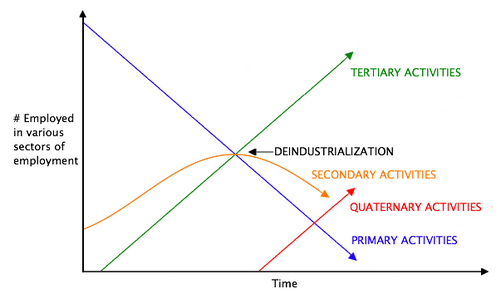
Economists and sociologists have used various indicators to define the shift toward an information-based economy. Some define an information society as one where more than half of the GNP and employment are tied to the information sector.
Post-Industrial and Postmodern Perspectives
Alain Touraine described the post-industrial society as a "programmed society" where investment shifts from material goods to symbolic goods that modify culture and values. Similarly, Jean-François Lyotard argued that knowledge has become a commodity, leading to a postmodern society where centralized "Grand Narratives" are broken down by the diffusion of information technology.
The Knowledge and Network Society
Other theorists, such as Nico Stehr and Alvin Toffler, emphasize actionable knowledge as the central resource of the modern economy. Stehr posits that in a knowledge society, science becomes an immediate productive force, and jobs requiring low cognitive skills decline.
By the end of the 20th century, Manuel Castells introduced the network society. He argued that "network logic"—characterized by flexibility and convergence—is the new social morphology. While Castells links this to a new technological paradigm called informationalism, Jan Van Dijk views networks as the "nervous system" of society, and Darin Barney emphasizes the institutionalization of digital networks as the primary form of human organization.
| Concept | Key Proponent | Primary Focus | Defining Characteristic |
|---|---|---|---|
| Knowledge Industry | Fritz Machlup | Economic Sectors | Education, R&D, and Media as GNP drivers |
| Post-Industrial Society | Alain Touraine | Cultural Production | Shift from material goods to symbolic goods |
| Network Society | Manuel Castells | Social Morphology | Organization around flexible digital networks |
| Informational Capitalism | Christian Fuchs / Castells | Capital Accumulation | Global coordination via cyberspace |
Critical Perspectives and Neo-Marxist Critiques
Not all scholars agree that we have entered a "new" type of society. Critics like Frank Webster argue that these theories overemphasize discontinuity. They suggest that contemporary society remains fundamentally capitalist, merely transitioning through different epochs: from 19th-century laissez-faire to 20th-century corporate, and finally to 21st-century informational capitalism.
Various terms have been proposed to describe this continuity:
- Transnational Network Capitalism: Christian Fuchs describes this as a regime of accumulation using cyberspace for global coordination, often maintaining structural inequalities.
- Digital/Virtual Capitalism: Scholars like Schiller and Foster argue that networks expand the reach of the capitalist economy and increase the concentration of capital.
- Immaterial Labour: Antonio Negri and Michael Hardt suggest that the global "Empire" is based on labour that produces knowledge, communication, or emotional responses (affective labour).
These neo-Marxist accounts warn that while technology enables globalization, it is often embedded in societal antagonisms that lead to structural unemployment, social exclusion, and the deregulation of labour rights.
Frequently Asked Questions
What is the difference between an information society and a knowledge society?
While often used interchangeably, an information society typically focuses on the technological infrastructure and the flow of data, whereas a knowledge society emphasizes the capacity for social action and the application of scientific and technological knowledge as a productive force.
What are the three levels of the digital divide?
According to Jan van Dijk, the first level is material access to hardware and connectivity; the second level is the possession of digital skills and usage patterns; and the third level is the actual social, economic, or political benefits gained from that use.
How does the "network society" differ from previous social structures?
The network society, as described by Manuel Castells, replaces traditional hierarchical or linear organizations with a "network logic." This means that power, production, and culture are organized around flexible, pervasive, and convergent digital networks.
What is "immaterial labour"?
Introduced by Negri and Hardt, immaterial labour refers to work that produces non-physical products, such as knowledge, information, emotional responses (affective labour), or cultural services.
Why do some critics reject the term "information society"?
Critics like Frank Webster argue that the term implies a radical break from the past. They believe it is more accurate to view current changes as an evolution of capitalism (informational capitalism) rather than the birth of an entirely new societal type.