Social Inequality: Structural Drivers and Global Impacts
Social inequality occurs when resources within a society are distributed unevenly. While often discussed in financial terms, these disparities extend far beyond bank accounts, intersecting with religion, kinship, race, ethnicity, gender, age, sexual orientation, and social class. This uneven distribution shapes not only a person's quality of life but also their access to fundamental rights and opportunities.
At its core, social inequality is closely linked to economic inequality—the unequal distribution of income and wealth. However, sociology and economics reveal that non-economic resources also play a critical role in determining social status. Norms of allocation often dictate who receives privileges, social power, and access to essential public goods, including education, the judicial system, adequate housing, transportation, and financial services like banking.
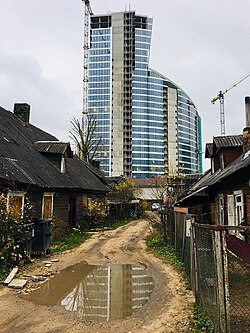
These inequalities are shaped by structural factors, such as citizenship status or geographical location. They are frequently reinforced by cultural discourses that categorize individuals—such as the poor—as either "deserving" or "undeserving," reflecting the biases and values a society holds toward its members.
Key Facts

- Wealth vs. Income: Wealth concentration is significantly higher than income concentration; the top 10% of the population typically holds 60% to 90% of all wealth.
- The Digital Loop: Digital inequality has evolved from a lack of access to a "third digital divide," where the benefits derived from the internet reinforce existing social stratification.
- Gender Disparity: As of 2007, 20% of women lived below the $1.25/day international poverty line.
- Age Trends: In the U.S., poverty has decreased for those 65 and older since the 1970s but has risen for children under 18.
- Economic Growth: Income equality has a more beneficial impact on the duration of economic growth than trade openness or foreign investment.
The Digital Divide and Digital Capital
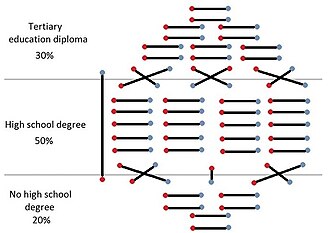
Modern scholarship has expanded the study of inequality into the digital realm. This progression is categorized into three levels: the first-level divide (access to hardware), the second-level divide (digital skills), and the third digital divide. Conceptualized by Massimo Ragnedda, the third divide focuses on the unequal distribution of tangible outcomes and benefits derived from internet use.
This framework introduces the concept of digital capital. In this "inequality loop," an individual's initial social position determines their level of digital capital, which in turn dictates the quality of their digital engagement. The resulting social, economic, and political benefits then feed back into the original social position, either mitigating or reinforcing existing inequalities.
![Social connectedness to people of higher income levels is a strong predictor of upward income mobility.[11] However, data shows substantial social segregation correlating with economic income groups.[11]](/images/1f/7a/1f7a8b243f91525e9f816ec5fa15f4f3b037bfc8bbd1908bc9cfc7c2b2aba04a.webp)
Demographic Dimensions of Inequality
Gender Inequality
Global issues such as poverty, illiteracy, and HIV/AIDS disproportionately affect women, yet are often marginalized as "women's issues." Lack of access to education limits women's economic contributions and their representation in political decision-making processes. Financial data from 2007 indicates that 40% of women lived below the $2/day mark, with over half of females under 25 living on less than $2/day.

Age Inequality
In technologically advanced societies, both the very young and the very old can be disadvantaged. In the United States, however, the trend has shifted toward the youth. While the elderly have had time to accumulate wealth and benefit from Social Security and Medicare, children under 18 have seen a steady rise in poverty levels.
Globally, youth income distribution is stark. As of 2007, approximately 1.5 billion people under the age of 24 (48.5% of the world's youth) were confined to the bottom two income brackets, sharing only 9% of global income. Conversely, the top 400 million youth have access to more than 60% of global income.
![Wealth inequality in the United States increased from 1989 to 2013.[31]](/images/1b/25/1b25bcc0b9e91c27fa5eb0c288ea2f7b3636e27dfa07f7d221dce0003a140914.png)
Global Economic Patterns and Wealth Concentration

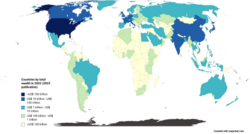
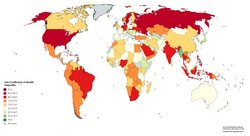
Economists Thomas Piketty and Emmanuel Saez highlight a critical distinction between income and wealth dynamics. Wealth is far more concentrated than income. While the bottom 50% of the population may earn 20% to 30% of total income, they typically own less than 5% of total wealth.
Piketty notes that in low-growth countries, wealth-income ratios are returning to levels seen in 19th-century "classic patrimonial" societies. In these systems, a small minority lives off accumulated wealth while the majority works for mere subsistence.
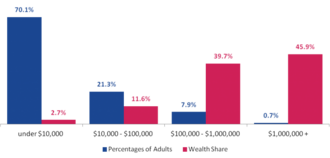
| Metric | Top 10% Share | Bottom 50% Share |
|---|---|---|
| Wealth | 60% to 90% | Less than 5% |
| Income | 30% to 50% | 20% to 30% |
Frequently Asked Questions
![Bust of Nelson Mandela erected on London's South Bank. Mandela is widely considered a global hero for his role in opposing the apartheid system and inaugurating a multiracial democracy.[83][84][85]](/images/c6/91/c691486dae54d25cc18ee84fff27523479ad79cd21788768466e809fe8f00dad.jpg)
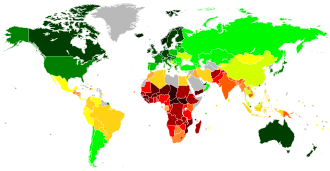
![Of the factors influencing the duration of economic growth in both developed and developing countries, income equality has a more beneficial impact than trade openness, sound political institutions, and foreign investment.[104]](/images/13/21/13217e70426b8599fd4a1049516ae189989091956ec58942af1f63bbf190cbd2.gif)
What is the difference between social and economic inequality?
Economic inequality refers specifically to the unequal distribution of income and wealth. Social inequality is a broader term that includes economic disparities but also encompasses the uneven distribution of rights, privileges, social power, and access to services like healthcare and education based on factors like race, gender, or age.
What is the "third digital divide"?
The third digital divide refers to the unequal distribution of tangible outcomes and benefits that people get from using the internet. It suggests that even if people have access and skills, their social position determines how effectively they can turn digital use into real-world economic or social advantages.
How does age affect poverty levels in the United States?
In the U.S., poverty among those aged 65 and older has been decreasing since the early 1970s, largely due to Social Security and Medicare. In contrast, the number of children under 18 living in poverty has steadily increased.
Why is wealth more concentrated than income?
Wealth consists of accumulated assets (capital), which tend to concentrate more aggressively over time than labor income. This often leads to a situation where a small percentage of the population owns the vast majority of a nation's assets, while the bottom half of the population owns almost nothing.
How does income equality affect economic growth?
Research indicates that income equality has a more beneficial impact on the long-term duration of economic growth in both developed and developing countries than other factors such as foreign investment, trade openness, or political institutions.