Broadband Technology: Evolution, Standards, and Global Impact
In the world of telecommunications, broadband refers to wide-bandwidth data transmission that utilizes a broad range of frequencies or multiple simultaneous frequencies. While the term was originally a technical description for analog services using wide-spread frequencies, it has evolved into a common marketing term for any high-speed Internet access that is "always on" and significantly faster than traditional dial-up services.
Modern broadband is the backbone of the digital age, enabling the transmission of data via various media, including optical fiber, coaxial cable, wireless radio, twisted pair cables, and satellites.
Key Facts
- Broadband vs. Dial-up: Dial-up was typically limited to 56 kbit/s; broadband provides significantly higher speeds and constant connectivity.
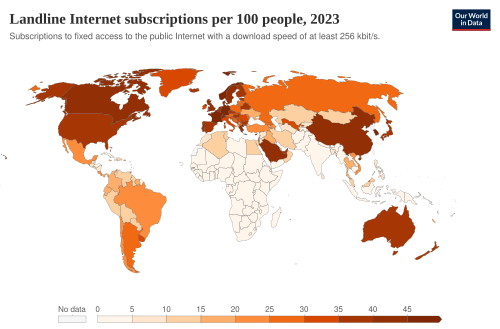
- Global Concentration: As of 2014, just three countries (China, the US, and Japan) hosted 50% of the world's installed telecommunication bandwidth potential.
- Digital Divide: The concept of "Meaningful Broadband" was introduced in 1999 to advocate for equitable distribution of high-speed access as a fundamental human right.
- Diverse Media: Broadband can be delivered through fiber optics, coaxial cables (DOCSIS), and digital subscriber lines (DSL).
The Evolution of Network Architecture
The transition from conventional telephony to modern broadband represents a fundamental shift in how data is moved. Traditional telephony was limited to voice media, connected only two parties per call, and relied on fixed bit-rates.
The Ideal Network
Engineers aim for a network that is multi-media, multi-point, multi-rate, and economical. To achieve this, the Broadband Integrated Services Digital Network (B-ISDN) was planned, with Asynchronous Transfer Mode (ATM) promoted as the primary technology to meet these requirements.
Integration and Economy
Integrating various communication services into a single network creates an "economy of sharing." This avoids the complexity of managing multiple overlaying networks and allows for greater flexibility when introducing new services. This integration became possible in the 1990s due to advances in high-speed information processing.
Broadband Technologies and Implementation
Telecommunications and DSL
In narrowband communications, such as a 56k modem, data is transmitted over a 4-kilohertz-wide telephone line. In contrast, Digital Subscriber Line (DSL) services are considered broadband because they send information over multiple channels at frequencies higher than the baseband voice channel. This allows a single pair of wires to support both telephone service and high-speed data. When converted to non-loaded twisted-pair wire, these lines can support Very High-bit Rate DSL (VDSL or VHDSL), reaching speeds up to 100 megabits per second.
Computer Networks and Cable
While many computer networks use baseband signaling (using the medium's full bandwidth for one signal), cable internet uses broadband signaling. By using cable television infrastructure, these systems employ different radio frequencies for each band, allowing multiple data users and television channels to coexist on the same cable. The DOCSIS standard, introduced in the late 1990s, formalized this for residential customers.
TV and Video Distribution
In analog video, broadband refers to systems like cable television where channels are modulated on fixed frequency carriers. This is the opposite of baseband, which refers to a single analog video channel. To increase efficiency, cable companies often use a hybrid system: fiber optics transmit signals to neighborhoods, and then the signal is converted to radio frequency for delivery via coaxial cable to individual homes.
Traffic Requirements and Performance
Different types of data have different needs regarding bandwidth, latency (the delay before a transfer of data begins), and cell-delay.
| Traffic Type | Example | Required Bandwidth | Cell-delay | Latency |
|---|---|---|---|---|
| Constant | Voice, guaranteed circuit emulation | Minimal | Low | Low |
| Variable | Compressed video | Guaranteed | Variable | Low |
| Available | Data | Not guaranteed | Widely variable | Variable |
Defining Broadband Speed
Because technology evolves, the definition of "broadband" changes over time. Various regulators have set different benchmarks for what constitutes high-speed access:
- FCC (2010): 4 Mbit/s downstream, 1 Mbit/s upstream.
- FCC (2015): 25 Mbit/s downstream, 3 Mbit/s upstream.
- CRTC (Canada): 50 Mbit/s downstream, 10 Mbit/s upstream.
- Ofcom (UK): Defines various tiers including "Superfast" (30 Mbit/s) and "Ultrafast" (300 Mbit/s).
Global Bandwidth Distribution
Bandwidth is not distributed equally across the globe. Historically, a small group of 10 countries controlled 70–75% of global telecommunication capacity. This concentration has intensified in the digital age.
By 2014, China, the United States, and Japan together hosted 50% of the world's installed bandwidth potential. Notably, China surpassed the U.S. in 2011, hosting more than twice the national bandwidth potential of the U.S. by 2014 (29% compared to 13%).
![Global bandwidth concentration: 3 countries have almost 50% between them; 10 countries almost 75%.[45]](/images/e2/d5/e2d58f6119be3e925b2c68c5265bfb12a54efd81f83b7a1fbdf32ae36951e310.jpg)
Frequently Asked Questions
What is the difference between broadband and baseband?
Broadband uses a wide range of frequencies to transmit multiple signals simultaneously, whereas baseband uses the entire bandwidth of the medium to transmit a single signal.
How does DSL provide both phone and internet services?
DSL sends digital information over multiple channels at frequencies higher than the baseband voice channel, allowing both to coexist on a single pair of wires.
What is the "digital divide"?
The digital divide refers to the gap between those who have access to modern information and communication technology (like broadband) and those who do not. The movement for "Meaningful Broadband" suggests that equitable access is a fundamental human right.
Which countries dominate global bandwidth?
As of 2014, China, the United States, and Japan are the primary leaders, collectively holding approximately 50% of the global installed telecommunication bandwidth potential.
What is DOCSIS?
DOCSIS is the technical standard that allows cable television infrastructure to provide high-speed Internet access to residential customers.