DSL Technology: Evolution and Operation of Digital Subscriber Lines
Digital Subscriber Line (DSL), originally known as digital subscriber loop, is a family of technologies designed to transmit digital data over standard copper telephone lines. While the term is often used interchangeably with Asymmetric Digital Subscriber Line (ADSL)—the most common version used for home internet—DSL encompasses a wide range of standards that vary in speed and symmetry.
The primary appeal of DSL is its ability to deliver high-speed data without interfering with traditional voice calls. By utilizing higher frequency bands than those required for speech, DSL allows users to browse the web and make phone calls simultaneously over the same physical wire.
Key Facts
- Asymmetry: ADSL provides faster download speeds (downstream) than upload speeds (upstream).
- Symmetry: SDSL provides equal data rates for both uploading and downloading.
- Infrastructure: DSL uses the existing "local loop" (copper twisted-pair wiring) from the telephone exchange to the customer.
- Frequency Separation: Data is transmitted at frequencies above 4 kHz, while voice calls occupy the 300 to 3400 Hz range.
- Distance Sensitivity: Signal strength and bandwidth decrease as the distance between the customer and the exchange increases.
How DSL Works
The foundation of DSL is the local loop, the physical pair of wires connecting a home to the telephone exchange. While originally designed for voice (300 to 3400 Hz), these wires can actually carry frequencies into the tens of megahertz, depending on the line quality.
DSL takes advantage of this unused bandwidth by creating multiple channels. Each channel is evaluated for usability; the more usable channels available, the higher the total bandwidth. Because higher frequencies attenuate (weaken) faster over distance, users living closer to the exchange typically experience faster speeds.
Preventing Interference
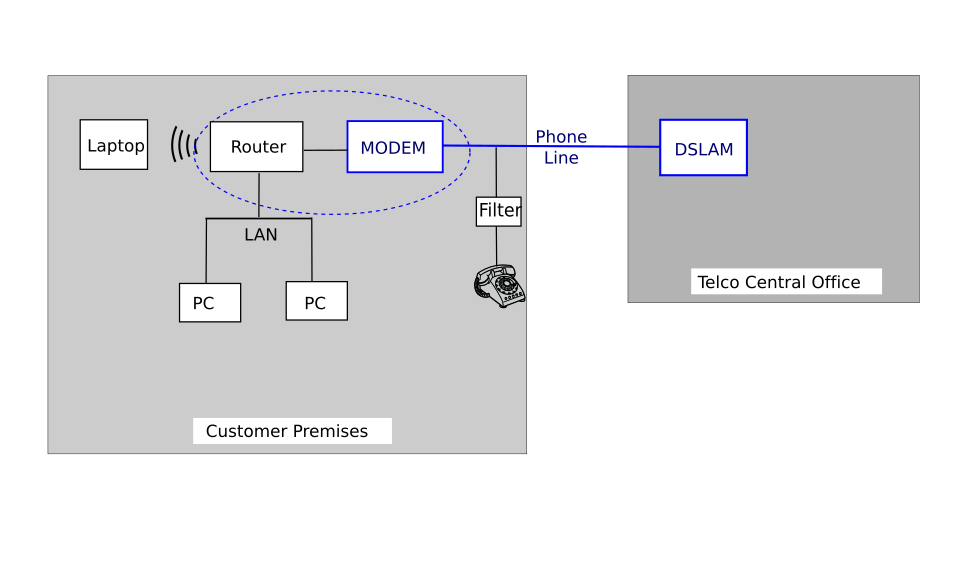
To ensure that high-frequency data signals do not manifest as audible hiss on a telephone, DSL filters (or microfilters) are installed on every phone in the house. These act as low-pass filters, allowing only voice frequencies to pass through to the handset. Conversely, the DSL modem uses high-pass filters to block voice frequencies from interfering with the data stream.
The Evolution of DSL Standards
The journey of DSL began with the realization in the 1950s that copper lines could carry signals far beyond modest modem speeds. By the 1980s, techniques for broadband communication emerged, leading to the development of ADSL by Bellcore employees who placed wide-band digital signals above the analog voice baseband.
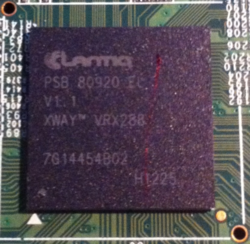
As Very-Large-Scale Integration (VLSI) technology advanced, the cost of the complex digital signal processors required for DSL dropped, making the technology commercially viable for the masses in the late 1990s.
From ADSL to Terabit DSL
DSL has evolved through several generations to meet the demand for higher bandwidth:
- ADSL/ADSL2+: The standard for home internet, offering downstream speeds from 256 kbit/s up to 24 Mbit/s.
- VDSL/VDSL2: Very-high-bit-rate DSL, capable of delivering up to 200 Mbit/s aggregate speeds.
- G.fast: A modern standard capable of approximately 1 Gbit/s aggregate speeds over short distances (100m).
- XG-FAST: An advanced iteration reaching up to 10 Gbit/s over distances up to 30 meters.
- Terabit DSL: An experimental technology using the space between dielectrics as waveguides to potentially reach 1 terabit per second over 100 meters.
Network Infrastructure and Equipment
A DSL connection requires specific hardware at both the service provider's end and the customer's premises.
Exchange Equipment
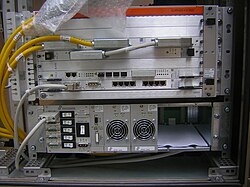
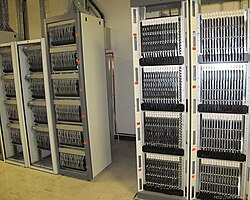
At the telephone exchange, a Digital Subscriber Line Access Multiplexer (DSLAM) terminates the DSL circuits and aggregates the data to be handed off to a backbone network, such as Ethernet or a PON network. The DSLAM also separates the voice component from the data. In rural areas, "load coils" (used to extend voice range) must be removed, as they block the high frequencies required for DSL.
Customer Equipment
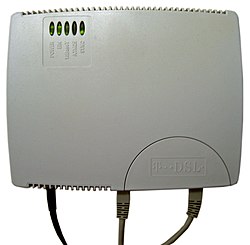
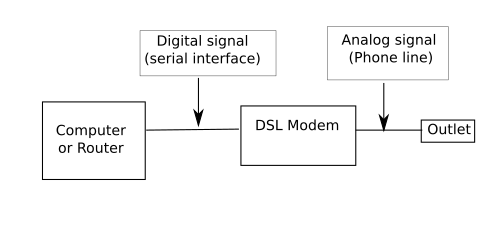
The customer uses a DSL modem to modulate and demodulate the digital signals. For those who do not require telephone service, Naked DSL is an option, providing the data connection without a linked voice line.
DSL Technology Comparison
| Technology | Abbreviation | Typical Downstream Speed | Key Characteristic |
|---|---|---|---|
| Asymmetric Digital Subscriber Line 2+ | ADSL2+ | Up to 24 Mbit/s | Most common consumer broadband |
| Very-high-bit-rate Digital Subscriber Line 2 | VDSL2 | Up to 200 Mbit/s (aggregate) | High speed, short range |
| G.fast | G.fast | Up to 1 Gbit/s (aggregate) | Ultra-short range copper |
| Symmetric Digital Subscriber Line | SDSL | Equal Up/Down | Ideal for business/hosting |
Frequently Asked Questions
What is the difference between ADSL and SDSL?
ADSL (Asymmetric) has different speeds for uploading and downloading, typically favoring downloads. SDSL (Symmetric) provides identical speeds for both directions.
Why do I need a DSL filter on my phone?
DSL filters block the high-frequency data signals from entering the telephone handset, which prevents you from hearing a hiss or static during voice calls.
How does distance affect my DSL speed?
DSL signals attenuate as they travel along copper wires. The further you are from the DSLAM at the telephone exchange, the fewer usable high-frequency channels are available, resulting in lower speeds.
Can I have DSL without a landline phone?
Yes, this service is known as "Naked DSL," where the provider delivers the data connection without the associated voice service.
What is a DSLAM?
A DSLAM (Digital Subscriber Line Access Multiplexer) is the equipment located at the telephone exchange that connects multiple customer DSL lines to a high-speed internet backbone.