Industrial Agriculture: Evolution, Impact, and the Shift Toward Sustainability
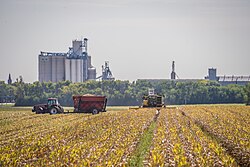
Industrial agriculture is a modern approach to farming characterized by the industrialized production of crops, livestock, and animal products such as milk and eggs. By leveraging technological innovation, genetic engineering, and economies of scale, this system has become the primary source of meat, dairy, fruits, and vegetables found in supermarkets across developed nations and throughout the world.
The transition to industrial methods was driven by a desire for greater productivity and lower costs, fundamentally changing how humanity feeds its growing population. From the introduction of synthetic chemicals to the rise of global trade networks, the scale of food production has reached unprecedented levels.
Key Facts
- Global Reach: Industrial methods produce 74% of the world's poultry, 68% of eggs, and 43% of beef.
- Productivity Gains: U.S. agricultural productivity rose by an average of 2% annually between 1930 and 2000.
- Labor Shift: In the U.S., the agricultural workforce dropped from 24% of the population in the 1930s to 1.5% in 2002.
- Concentration: Four companies produce 81% of cows, 73% of sheep, 57% of pigs, and 50% of chickens in the U.S.
- Vulnerability: A disruption in inputs like fertilizers could potentially drop global yields by 35-48%.
Historical Development
Industrial agriculture evolved alongside the broader Industrial Revolution. A pivotal moment occurred with the identification of NPK (nitrogen, potassium, and phosphorus) as essential for plant growth, which enabled the manufacture of synthetic fertilizers and more intensive farming.
Scientific Breakthroughs
The early 20th century brought discoveries in vitamins and animal nutrition, allowing livestock to be raised indoors by the 1920s. Later, the development of vaccines and antibiotics made it possible to raise animals in concentrated environments by mitigating the diseases typically caused by crowding. Additionally, chemicals developed during World War II paved the way for modern synthetic pesticides.
The British Agricultural Revolution
Preceding the global industrial shift, the British agricultural revolution (16th to mid-19th century) saw a massive increase in output. This was driven by four primary changes: enclosure (consolidating land), mechanization, selective breeding, and the four-field crop rotation system. This surge in productivity supported population growth and provided the workforce necessary to fuel the Industrial Revolution.
The Green Revolution and Crop Innovation
The Green Revolution expanded the use of irrigation, pesticides, and synthetic nitrogen fertilizers globally. Its most significant contribution was the creation of High-Yielding Varieties (HYVs), often called "miracle seeds," for wheat, rice, and maize.
These HYVs were engineered with semi-dwarfing genes to prevent the plants from falling over (lodging) under the weight of increased grain production. By reducing the energy invested in the stem, the plants redirected nutrients to the grain, significantly increasing commercial yields when paired with adequate chemical inputs. However, because many HYVs are F1 hybrids, farmers must purchase new seeds every season rather than saving them, increasing production costs.
Challenges and Societal Impact
While industrial agriculture has made food cheap and abundant, it has introduced significant environmental and social liabilities. The system relies heavily on non-renewable fossil fuels for machinery, transport, and chemical production, making food prices vulnerable to energy market fluctuations.
Environmental Consequences
- Pollution: Herbicides, insecticides, and animal waste contaminate surface and groundwater. For example, nitrogen runoff from the U.S. Midwest travels down the Mississippi River to damage fisheries in the Gulf of Mexico.
- Biodiversity Loss: Monoculture and chemical use are linked to Colony Collapse Disorder, threatening the bee populations essential for pollinating many fruits and vegetables.
- Climate Change: Heavy fossil fuel use and methane byproducts from livestock contribute to global warming and ozone pollution.
Animal Welfare and CAFOs
Concentrated Animal Feeding Operations (CAFOs) are designed to produce meat, eggs, or milk at the lowest possible cost. These facilities house massive numbers of animals in confined spaces. In the U.S., the EPA regulates CAFOs as point source polluters. Waste is often stored in large lagoons; if these leak or burst—as seen in a 1995 North Carolina spill that killed millions of fish—they can cause severe groundwater contamination.
Comparing Agricultural Models
| Feature | Industrial Agriculture | Sustainable Agriculture | Organic Farming |
|---|---|---|---|
| Primary Goal | Maximized yield & low cost | Environmental & social health | Natural biological processes |
| Key Inputs | Synthetic fertilizers & pesticides | Integrated resource management | Naturally occurring biologicals |
| Scale | Large-scale / Vertical integration | Community-focused / Profitable | Holistic / Traditional methods |
| Environmental Impact | High pollution / Resource intensive | Stewardship / Conservation | Low chemical footprint |
The Path to Sustainability
In response to the liabilities of the industrial model, sustainable agriculture has emerged. This approach seeks to balance three goals: environmental stewardship, farm profitability, and the prosperity of farming communities.
Similarly, organic farming rejects synthetic chemicals in favor of a holistic approach. While it may incorporate some scientific knowledge, it relies on biological processes that occur over longer periods, contrasting with the reductionist, immediate-effect strategies of industrial farming.
Frequently Asked Questions
What is the main difference between industrial and sustainable agriculture?
Industrial agriculture focuses on maximizing output and minimizing cost through synthetic inputs and economies of scale. Sustainable agriculture integrates environmental stewardship and community prosperity alongside farm profitability.
What are HYVs and why are they controversial?
High-Yielding Varieties (HYVs) are "miracle seeds" bred for higher nitrogen absorption and shorter stems to increase grain yield. They are controversial because they require expensive chemical inputs to outperform traditional varieties and must be repurchased every season.
What is a CAFO?
A Concentrated Animal Feeding Operation (CAFO) is an intensive livestock operation that houses large numbers of animals in a confined space to produce meat, milk, or eggs at the lowest possible cost.
How does industrial agriculture affect the environment?
It contributes to groundwater and surface water pollution via chemical runoff and animal waste, promotes bee population decline through monoculture and pesticides, and increases greenhouse gas emissions through fossil fuel reliance and methane production.
Why is industrial agriculture considered vulnerable to shocks?
The system is highly dependent on a steady supply of external inputs like synthetic fertilizers and pesticides. A major disruption in these supplies could lead to a global yield drop of 35-48%, and up to 75% in highly industrialized regions.