India's Political History: From Ancient Assemblies to Modern Democracy
India's journey toward governance is a complex tapestry that stretches from ancient tribal assemblies to its current status as the world's largest liberal democracy. While the modern Indian state was forged in the crucible of 20th-century anti-colonial struggle, the roots of collective decision-making in the subcontinent date back millennia.
Pre-Modern Governance
Long before the modern era, early societies such as the Shakyas, Koliyas, Mallakas, and Licchavis utilized assemblies. However, these were typically accessible only to affluent men of specific social classes. Other bodies, known as saṅghas and gaṇas, operated as councils of unelected nobles, functioning more as elite oligarchies than representative democracies. Despite this, the Greek historian Diodorus noted the existence of democratic states in India around the 3rd century BCE, though this likely referred to autonomous polities rather than electoral systems.
By the 10th century CE, evidence of more localized representation emerged. Inscriptions at the Vaikunda Perumal Temple indicate that the Chola Empire employed the election of local representatives to village councils.
The Struggle for Independence
After nearly two centuries of British colonial rule—first under the East India Company and later the British Crown—India launched a sustained nationalist movement. This effort was led primarily by the Indian National Congress (INC), with figures like Mahatma Gandhi and Jawaharlal Nehru at the forefront. The movement was a diverse coalition, incorporating communist ideologies and the efforts of Dalit leaders, most notably B. R. Ambedkar, who campaigned for the abolition of the caste system. Other influential figures included the militant nationalist Subhas Chandra Bose.
Independence in 1947 was achieved but marred by intense religious and communal divisions. This resulted in the Partition of the Indian subcontinent, creating a Muslim-majority Pakistan and a Hindu-majority India. The process triggered mass displacement and one of history's largest refugee crises.
In 1950, India became a sovereign, democratic republic with the adoption of the world's longest written constitution, drafted by a Constituent Assembly chaired by B. R. Ambedkar.
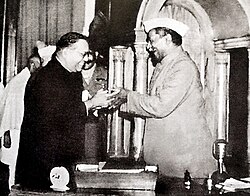
The first general elections (1951–1952) implemented universal adult suffrage and followed the Westminster parliamentary system. The Congress party won decisively, and Jawaharlal Nehru became the first prime minister.
The Nehruvian Era (1947–1964)
Jawaharlal Nehru, often called the architect of modern India, served as prime minister for sixteen years. His leadership was defined by republicanism, secularism, social democracy, and a policy of non-alignment during the Cold War. In 1956, he oversaw the reorganization of states along linguistic lines and the integration of over 500 princely states.
While the Congress dominated, 1957 saw a landmark event in Kerala, where the Communist Party of India (CPI) under E. M. S. Namboodiripad formed one of the world's first democratically elected communist governments. Economically, Nehru introduced the Licence Raj—a system of strict socialist regulations. While intended to manage growth, these regulations often benefited large corporations over small businesses.
Indira Gandhi and the State of Emergency
Following the brief premiership of Lal Bahadur Shastri, Indira Gandhi became India's first and only female prime minister in 1966.
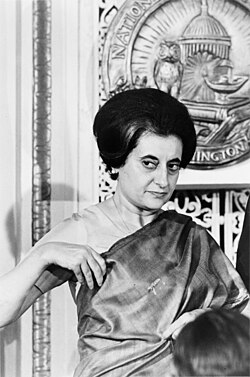
Gandhi shifted toward a populist platform, leading to a split in the Congress party in 1969. While she won a landslide victory in 1971, her tenure was marked by the centralization of power. During this period, the Naxalbari uprising began in West Bengal, launching a decades-long Maoist-inspired insurgency.
Economic turmoil and political dissent culminated in the Bihar Movement, led by Jayaprakash Narayan. After the Allahabad High Court found Gandhi guilty of electoral malpractice in 1975, she declared a state of emergency. From June 1975 to 1977, India experienced nationwide censorship, mass arrests, and the suspension of fundamental rights. This era ended in 1977 when the Janata Party, led by Morarji Desai, won a historic victory, marking the first time a non-Congress party held power.
Dynastic Politics and the Rise of Coalitions
Indira Gandhi returned to power in 1980 but was assassinated in 1984 by her Sikh bodyguards following Operation Blue Star, a military action at the Golden Temple. This event triggered nationwide anti-Sikh pogroms and intensified the Punjab insurgency. Her son, Rajiv Gandhi, succeeded her, establishing the Nehru-Gandhi political dynasty.
The 1990s saw a shift toward coalition politics and the rise of Hindutva (Hindu nationalism). Key events included the demolition of the Babri Masjid and the implementation of the Mandal Commission report, which expanded reservations for lower-caste Hindus. In 1991, under P. V. Narasimha Rao, India initiated sweeping economic liberalisation to resolve a severe balance of payments crisis.
Atal Bihari Vajpayee of the Bharatiya Janata Party (BJP) later became the first non-Congress prime minister to complete a full term (1999–2004). His tenure included successful nuclear tests in 1998 and improved ties with the U.S., though his term was also marked by the 2002 Gujarat riots.
The UPA and the Transition to the Modi Era
From 2004 to 2014, the United Progressive Alliance (UPA), led by the Congress, governed under Manmohan Singh. Singh, the first Sikh prime minister, is credited with sustained economic growth and navigating the Great Recession. However, his later years were plagued by corruption scandals and perceived policy paralysis.
In 2014, Narendra Modi led the BJP to a historic landslide victory, the first single-party majority since 1984. Modi's administration focused on reducing bureaucratic red tape and further economic liberalisation. However, his second term (beginning in 2019) saw a pronounced shift toward Hindutva and a reported decline in democratic norms, including the suppression of dissent in journalism and academia.
Critics have pointed to rising economic inequality, termed the "Billionaire Raj," and the mishandling of the COVID-19 pandemic. In the 2024 general election, the BJP lost its outright majority and now governs via the NDA coalition.
Key Facts
- First Prime Minister: Jawaharlal Nehru, who served for 16 years.
- Constitution: Adopted in 1950; it is the longest written constitution in the world.
- The Emergency: A period of dictatorial rule from 1975 to 1977 under Indira Gandhi.
- Economic Shift: Major liberalisation began in 1991 under P. V. Narasimha Rao.
- Political Shift: The 2014 election ended decades of Congress dominance, bringing the BJP to a single-party majority.
| Era/Leader | Key Focus/Characteristics | Major Event/Outcome |
|---|---|---|
| Nehru Era | Secularism, Non-alignment, Licence Raj | State reorganization (1956) |
| Indira Gandhi | Populism, Centralization | The Emergency (1975-1977) |
| Coalition Era (90s) | Economic Liberalisation, Hindutva | 1991 Economic Reforms |
| UPA (Manmohan Singh) | Economic Growth, Centrist Coalition | Navigation of Great Recession |
| Modi Era | Right-wing Populism, Hindutva | 2014 & 2019 Landslide Victories |
Frequently Asked Questions
What was the Licence Raj?
The Licence Raj refers to a system of elaborate licenses, regulations, and red tape required to set up and run businesses in India during the Nehruvian era, which often favored large corporations over small enterprises.
What happened during the Emergency of 1975?
Declared by Indira Gandhi, the Emergency involved the suspension of the constitution, the nullification of fundamental rights, mass arrests of political opponents, and strict nationwide censorship.
Who was B. R. Ambedkar?
B. R. Ambedkar was a leading advocate for the abolition of the caste system and the chairman of the Constituent Assembly that drafted the Constitution of India.
What is Hindutva?
Hindutva is a political ideology associated with Hindu nationalism, which has seen a significant rise in Indian politics, particularly under the leadership of the BJP.
How did the 1991 economic reforms change India?
Initiated by P. V. Narasimha Rao's government during a balance of payments crisis, these reforms introduced sweeping economic liberalisation, reducing state control and opening the economy to more global trade.