Hydrozoa: The Complex World of Hydroids and Medusae
Hydrozoa, commonly known as hydroids, are a diverse class of predatory animals within the phylum Cnidaria. These organisms, which range from solitary individuals to massive colonies, primarily inhabit saline waters, though a few genera have adapted to freshwater environments. Closely related to corals and jellyfish, hydrozoans are characterized by their small size and often complex life cycles that alternate between different physical forms.
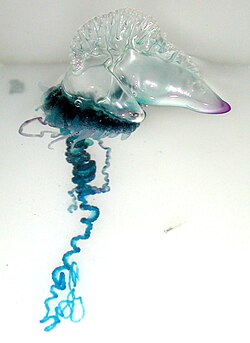
Common examples of this class include the freshwater jelly (Craspedacusta sowerbii), the freshwater polyp (Hydra), and the famous Portuguese man o' war (Physalia physalis). Other notable members include the pink-hearted hydroids (Tubularia) and chondrophores (Porpitidae).
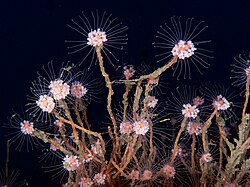
Key Facts
- Temporal Range: Present from the late Precambrian (approximately 575 million years ago) to the present day.
- Life Cycle: Often alternates between a stationary polyp stage and a swimming medusa stage.
- Structure: Colonial species are connected by a hollow tube called a hydrocaulus.
- Diversity: Includes highly specialized forms like the Siphonophorae, which can reach several meters in length.
- Unique Ability: Certain species, such as those in the genus Turritopsis, can revert from a mature medusa back to a juvenile polyp.
Anatomy and Biological Forms
Most hydrozoans utilize two distinct body plans during their lives: the polypoid (stationary) and the medusoid (swimming) stages. While many species transition between both, some have evolved to rely on only one. For instance, Hydra lacks a medusa stage entirely, whereas Liriope exists only as a medusa.
The Polyp Stage
In colonial species, polyps are linked by tubelike structures called hydrocauli. This shared hollow cavity allows the colony to distribute nutrients. To anchor themselves to the seabed, they use a horizontal, root-like structure known as a stolon. While most colonies are only a few centimeters wide, some Siphonophorae can grow to several meters.
The hydrocaulus is typically protected by the perisarc, a sheath made of proteins and chitin. In some species, the perisarc forms a protective lid over the polyp's tentacles.
Polyps are specialized based on their function:
- Feeding Polyps: Cylindrical bodies with a mouth located on a raised hypostome, surrounded by stinging tentacles.
- Reproductive Polyps: Lacking tentacles, these produce buds that develop into the medusoid stage.
- Defensive Polyps: Armed with high concentrations of stinging cells to protect the colony.
- Float Polyps: Specialized structures that allow the colony to drift in open water.
The Medusa Stage
Hydrozoan medusae are generally smaller than typical jellyfish, usually measuring between 0.5 and 6 cm in diameter. Their body consists of a dome-shaped umbrella with a central tube leading to the mouth. Most possess four tentacles, though exceptions occur.
Movement is achieved through striated muscle fibers that contract the bell, expelling water to create propulsion. Their nervous system is advanced for cnidarians, featuring two nerve rings, sensory organs like statocysts (balance organs), and ocelli (primitive light-sensitive eyes). In the genus Sarsia, organized ganglia have even been observed.
Life Cycle and Reproduction
Hydroid colonies are typically dioecious, meaning a single colony is either entirely male or entirely female. Reproductive polyps, known as gonozooids, produce medusae asexually. These medusae then mature and release gametes into the water.
The resulting zygotes develop into larvae—either planula (which settle on a substrate) or actinula (which may develop directly into a polyp or medusa). The lifespan of the medusa stage varies wildly; some fire coral medusae live only a few hours, while others survive for months in the plankton.
Systematics and Evolution
The classification of Hydrozoa is complex and has evolved as molecular data has become available. Historically, they were grouped into the "Hydroida," but this is now considered a paraphyletic group (one that does not include all descendants of a common ancestor).
Modern taxonomy generally divides the class into two subclasses:
- Hydroidolina: Includes the Siphonophorae and the bulk of former "hydroids" (Anthoathecata and Leptothecata).
- Trachylinae: Includes more primitive forms such as Limnomedusae, Narcomedusae, and Trachymedusae.
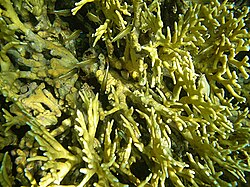
Some researchers further debate the placement of specific families, such as the Porpitidae, which some place in a separate order called "Chondrophora".
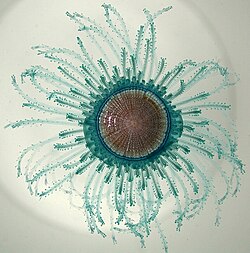
| Subclass | Order | Key Characteristics / Examples |
|---|---|---|
| Hydroidolina | Anthoathecata | Includes fire corals; often lack a chitinous perisarc. |
| Leptothecata | Typically possess a protective perisarc sheath. | |
| Siphonophorae | Highly specialized colonial forms (e.g., Portuguese man o' war). | |
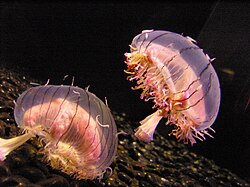
| Trachylinae | Limnomedusae | Primitive hydrozoans; includes flower hat jellies. |
| Narcomedusae | Specialized medusae. | |
| Trachymedusae | Specialized medusae. |
Frequently Asked Questions
What is the difference between a polyp and a medusa?
A polyp is a stationary, often colonial form that attaches to a substrate, while a medusa is a free-swimming, umbrella-shaped form. Many hydrozoans alternate between these two stages during their life cycle.
Can any hydrozoan live forever?
While not truly immortal, species in the genus Turritopsis can undergo a process of transdifferentiation, transforming their mature medusa stage back into a juvenile polyp stage, effectively restarting their life cycle.
Are all hydrozoans colonial?
No. While many are colonial and connected by a hydrocaulus, some species are solitary. For example, Hydra is a noncolonial hydrozoan.
What are nematocysts and where are they found in hydrozoans?
Nematocysts are stinging cells used for prey capture and defense. In hydrozoans, these are found on the tentacles and the outer surface of the animal, but notably absent from the lining of the central digestive cavity.
How do Siphonophores differ from other hydroids?
Siphonophores are highly specialized colonial hydrozoans that can reach massive sizes (several meters). They often feature specialized polyps, such as floats, that allow the entire colony to drift in open water rather than remaining anchored to the bottom.