Hydropower: Harnessing Water for Sustainable Energy
Hydropower, derived from the Ancient Greek word hydro meaning water, is the process of using falling or fast-running water to generate electricity or power mechanical machinery. By converting the kinetic energy of moving water or the gravitational potential energy of stored water, this method provides a sustainable alternative to fossil fuels.
Today, hydropower is primarily utilized for large-scale hydroelectric power generation and as a critical component of energy storage systems known as pumped-storage hydroelectricity. Because it does not directly emit carbon dioxide or other atmospheric pollutants, international organizations like the World Bank recognize it as a low-carbon pathway for economic development.
Key Facts
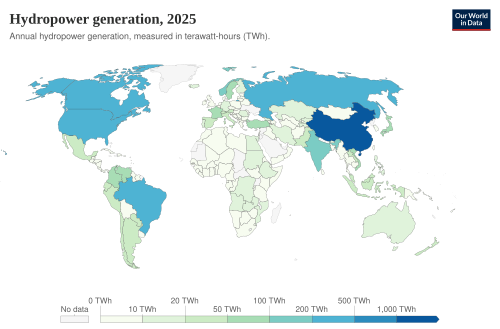
- Global Impact: Hydroelectricity generates approximately 15% of the world's electricity.
- Capacity: In 2021, global installed hydropower capacity reached nearly 1400 GW, the highest of any renewable technology.
- Sustainability: It provides a consistent power source without direct carbon emissions.
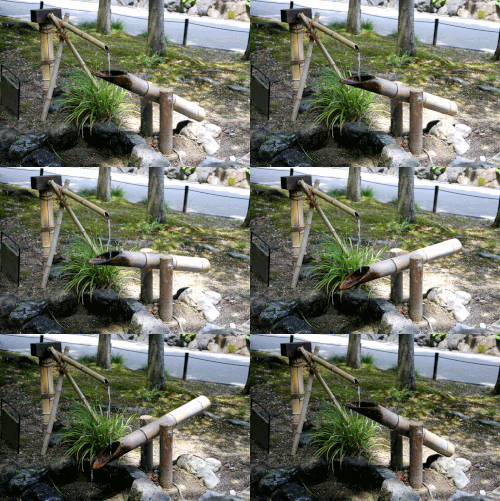
- Versatility: Applications range from massive dams to micro-turbines powered by rooftop rain runoff.
Calculating Available Power
The amount of power generated by a hydropower system depends on several physical variables, including the head (the vertical distance the water falls) and the flow rate (the volume of water passing a point per second). Efficiency losses in the turbine also affect the final output.
| Parameter | Value |
|---|---|
| Efficiency | 85% |
| Flow Rate | 1 m/s |
| Head | 10 m |
| Water Density | 999.4 kg/m³ |
| Acceleration (Gravity) | 9.80665 m/s² |
| Total Power | 83.307 kW |
| Capacity Factor | 65% |
| Annual Power Output | 474.665 MWh |
For example, a turbine with 85% efficiency, a flow rate of 80 cubic metres per second, and a head of 145 metres produces approximately 97 megawatts of power.
Applications of Hydropower
Mechanical Power
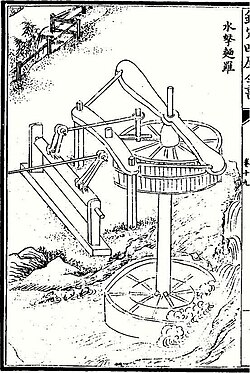
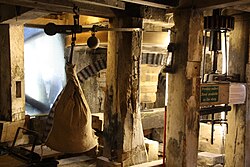
Before the advent of electricity, water power was used directly to drive machinery. Watermills were essential for grinding grain and other industrial processes.
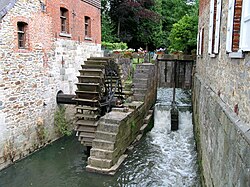
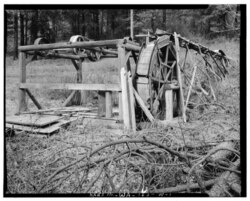
Other mechanical applications included rail transport, the compression of air, and specialized ore mills used in the late nineteenth century.
Electricity Generation
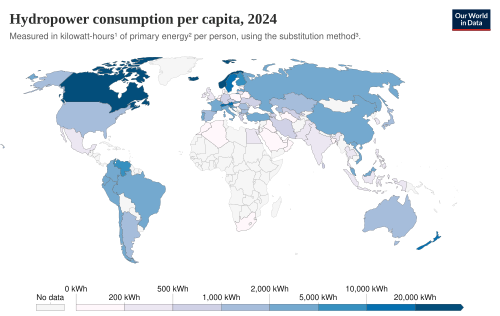
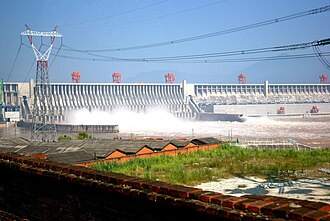
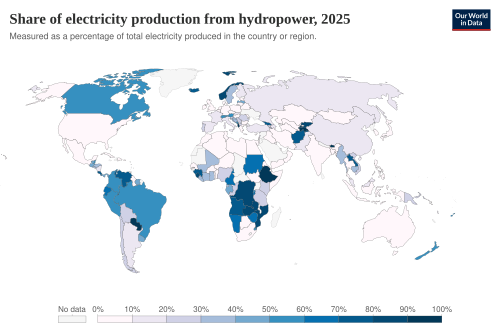
Hydroelectricity is the most dominant application of water power. It provides at least 50% of the total electricity supply for more than 35 countries.
Rain Power and Micro Hydro
Innovative small-scale systems can extract energy from precipitation. Research suggests that piezoelectric devices (materials that generate power when they move) could extract 12 milliwatts from a single raindrop. However, a more efficient method is using rooftop gutters to drive microturbines. The "Pluvia" system, for instance, uses rainwater runoff to spin a microturbine to charge 12-volt batteries.
History and Evolution
Ancient and Early Modern Era
Hydropower has been used for centuries, from ancient water-lifting devices to the 12th-century mills of Europe. In 1753, Bernard Forest de Bélidor detailed vertical and horizontal hydraulic machines in his work Architecture Hydraulique.
The 19th and 20th Centuries
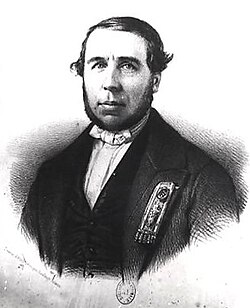
The 19th century saw a major leap with French engineer Benoît Fourneyron, who developed the first hydropower turbine. This technology was utilized at Niagara Falls in 1895 and remains operational today.
By the early 20th century, hydropower drove national industrialization. In Italy, the transition from mechanical watermills to electrical plants shifted power from rural mountains to urban centers. Germany utilized dams not only for power but also for irrigation and flood control.
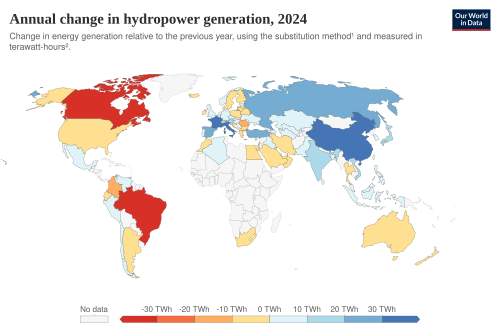
However, the late 20th century brought a shift in perspective. Between 1965 and 1990, the cost of building new dams increased by 4% annually. This, combined with the rise of anti-dam movements and NGOs, made large-scale projects more difficult to fund, leading to a resurgence of interest in small-scale hydropower in the 1970s.
Regional Developments
Africa
In Africa, hydropower has often been intertwined with geopolitics. The Aswan High Dam in Egypt, funded by the Soviet Union after the US and UK withdrew support, generated one-third of Egypt's electricity between 1977 and 1990, though it caused disputes with Sudan over water volume. More recently, Ethiopia began construction of the Grand Ethiopian Renaissance Dam in 2011.
Europe
Switzerland, Italy, and Scandinavia led an early "hydropower race" by damming Alpine and northern rivers. Italy's early adoption of near-nationwide electrification was almost entirely powered by hydro, fueling its rise as a European power.
Frequently Asked Questions
What is the difference between hydropower and hydroelectricity?
Hydropower is the general concept of using water to produce power (either mechanical or electrical), while hydroelectricity refers specifically to the generation of electricity from water.
How does pumped-storage hydroelectricity work?
It acts as an energy storage system by moving water between two reservoirs at different elevations, storing energy by pumping water up and releasing it to generate power when demand is high.
Is hydropower truly sustainable?
While it is a low-carbon energy source that does not produce direct atmospheric pollutants, it can have economic, sociological, and environmental downsides, and requires specific geographic features like rivers or elevated lakes.
Can rain actually be used to generate electricity?
Yes, through microturbines placed in rain gutters or piezoelectric devices, though the energy yield is significantly lower than that of large-scale river or dam systems.
Who invented the first hydropower turbine?
The first hydropower turbine was developed by the French engineer Benoît Fourneyron in the 19th century.