Hunminjeongeum Haerye: The Definitive Guide to the Origins of Hangul
The Hunminjeongeum Haerye (Korean: 훈민정음 해례), often referred to simply as the Haerye, is a seminal text that serves as the official commentary and manual for the native Korean alphabet, Hangul. Published around October 1446 during the Joseon dynasty, the work provides the scientific and philosophical rationale behind the creation of the letters, explaining how their shapes were derived to represent sounds.
The document is divided into two primary components: the base Hunminjeongeum (the core introduction to the letters) and the Haerye (the detailed explanations and examples). While the base text remained well-known throughout history, the Haerye section vanished from the historical record, possibly as early as the 16th century, leaving a gap in the understanding of Hangul's design until its dramatic rediscovery in the 20th century.
Key Facts
- Authorship: King Sejong the Great wrote the preface and basic introduction; the Haerye section was coauthored by scholars of the Hall of Worthies.
- Publication: Published circa October 1446 in Joseon.
- Significance: It explains the derivation of Hangul's letter shapes, revolutionizing linguistic scholarship.
- Kansong Copy: Rediscovered in 1940, designated a South Korean National Treasure (1962) and UNESCO Memory of the World (1997).
- Sangju Copy: A second copy discovered in 2008, currently the subject of legal ownership disputes.
The Authors and Structure
The creation of the Hunminjeongeum Haerye was a collaborative effort led by King Sejong the Great (r. 1418–1450). While the King authored the preface and the fundamental introduction to the alphabet, the technical commentary was produced by a group of elite scholars from the Hall of Worthies, a royal research institute. These coauthors included Chŏng Inji, Ch'oe Hang, Pak P'aengnyŏn, Sin Sukchu, Sŏng Sammun, Kang Hŭian, Yi Kae, and Yi Sŏllo. The work concludes with a postface written by Chŏng Inji.
Contents of the Haerye
The Haerye section is organized into six distinct parts, some of which utilize seven-syllable lines in irregular rhyme:
- Explanation of the Design of the Letters: The theoretical basis for the shapes.
- An Explanation of the Initials: Details on the starting consonants.
- An Explanation of the Medials: Details on the vowels.
- An Explanation of the Finals: Details on the closing consonants.
- An Explanation of the Combination of the Letters: How characters are assembled.
- Examples of the Uses of the Letters: Practical applications of the script.
The Kansong Copy: A Scholarly Revolution
For centuries, the specific logic behind the shapes of Hangul was lost. This changed in 1940 with the rediscovery of a copy held by the family of Yi Han'gŏl in Andong. This version, now housed in the Kansong Art Museum, is known as the "Kansong copy." Its emergence provided the missing link in Korean linguistics, proving that the letters were designed based on specific phonetic and philosophical principles.
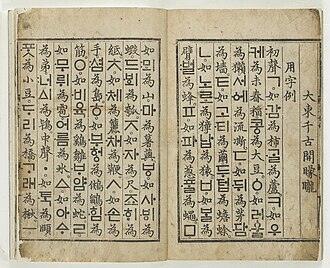
Forgery and Restoration
The Kansong copy has a complex history of preservation. It is believed that during the reign of King Yeonsangun (r. 1495–1506), when Hangul texts were targeted for destruction, the cover and first two leaves were intentionally destroyed to hide the book's identity. Before the copy was acquired by collector Jeon Hyeong-pil, the owner's son, Yi Yongjun, attempted to restore these missing parts. These restorations were later identified as forgeries.
Scholars identified several flaws in the forged sections, including the use of boiled paper to simulate age, missing tone markings, and a mistake in the final character of Sejong's preface (using 矣 instead of 耳). Despite these additions, the bulk of the text is considered an authentic original from 1446, though some scholars suggest it may have been produced shortly before the Imjin War (1592–1598).
The Sangju Copy: Controversy and Conflict
In 2008, a second copy—the "Sangju copy"—was announced by book dealer Bae Ik-gi. Unlike the Kansong copy, this version has been shrouded in secrecy and legal battles. It was originally stolen from the Gwangheungsa temple in Andong in 1999 before passing through several hands.
![Some pages of the Sangju copy (photo taken in 2009)[38]](/images/cb/44/cb44080c346bf87f575ca75a94f1403ddea7c46863b03a8d3e2670e156adb43f.jpg)
The copy became the center of a decade-long dispute involving theft allegations and failed police raids. In 2015, Bae's home was destroyed by fire, leading to fears that the document was lost. However, he later released a photo showing the book had survived, albeit with some charring at the bottom.
![Part of a photo Bae released in 2015 to prove that the Sangju copy was not destroyed in his house fire. Fire damage is visible on the bottom.[42]](/images/72/2a/722a7d3c1fee5973280cb35658011c6159f4709c158f26bca85cbcff3aeae0bb.jpg)
Despite a 2019 Supreme Court ruling that the state is the rightful owner, the copy remains hidden. Bae has previously attempted to sell the work for ₩100 billion (approximately US$ 90 million), citing a much higher valuation by the Korea Heritage Service.
Comparison of the Two Copies
| Feature | Kansong Copy | Sangju Copy |
|---|---|---|
| Discovery Year | 1940 | 2008 |
| Current Status | Publicly held (Kansong Art Museum) | Privately hidden (Bae Ik-gi) |
| Legal Status | National Treasure / UNESCO Register | Ruled state property (2019) |
| Physical Condition | Rebound; contains some forgeries | Partially charred; missing pages |
| Paper Type | Traditional Korean paper | Mulberry paper |
Frequently Asked Questions
What is the difference between the Hunminjeongeum and the Haerye?
The Hunminjeongeum is the base text that introduces the alphabet and its purpose, while the Haerye is the detailed commentary that explains the scientific design and provides examples of how to use the letters.
Why is the Kansong copy so important to linguistics?
Before its discovery in 1940, the original logic and derivation of Hangul's shapes had been forgotten. The Kansong copy restored the historical and scientific understanding of how the alphabet was constructed.
When is Hangul Day celebrated and why?
Hangul Day is celebrated on October 9. This date is derived from the postface of the Haerye, which was completed in the first ten days of the 9th month of 1446 (Korean calendar); October 9 is the Gregorian equivalent of the 10th day of that month.
Is the Sangju copy an original?
Scholar Nam Kwonhui believes it to be an original 15th-century first edition. Evidence suggests it was printed using the same woodblocks as the Kansong copy, although it may be missing several pages.
Who is believed to have performed the calligraphy for the Kansong copy?
It is generally believed that Grand Prince Anp'yŏng, a son of King Sejong and a renowned calligrapher, wrote both the base text and the Haerye, using two different styles to distinguish the King's words from those of his subjects.