Hundred Days Offensive: The Final Allied Push of World War I
The Hundred Days Offensive, spanning from August 8 to November 11, 1918, was the decisive series of Allied victories that brought the First World War to a close. Rather than a single planned campaign, it was a rapid succession of massive offensives that pushed the Imperial German Army back across the Western Front, effectively undoing the gains the Germans had made during their spring offensive earlier that year.
Beginning in Amiens, France, and concluding in Mons, Belgium, this period of intense warfare saw the Allies break through the most formidable German defenses, leading directly to the Armistice of November 11, 1918.
Key Facts
- Duration: 95 days (August 8 – November 11, 1918).
- Outcome: Decisive Allied victory and the end of World War I.
- Key Breakthrough: The breach of the Hindenburg Line, a vast system of German fortifications.
- Major Forces: Combined armies of France, the British Empire (including Canada, Australia, New Zealand, Newfoundland, and South Africa), and the United States.
- Turning Point: The Battle of Amiens, described by German leadership as "the Black Day of the German Army."
Strategic Background
By July 1918, the German spring offensive—which had reached as far as the River Marne—had stalled. The Allied supreme commander, Ferdinand Foch, recognized that the German Army had lost its momentum. Following the Second Battle of the Marne, Foch ordered a counter-offensive to reclaim lost territory and force a German collapse.
The Allies were well-positioned for this push. The British Expeditionary Force (BEF) had been reinforced with troops from the Italian front and the Sinai and Palestine campaign. Simultaneously, General Pershing's American Expeditionary Force (AEF) provided a massive influx of fresh manpower. Foch and Field Marshal Sir Douglas Haig decided to strike along the River Somme to protect the vital Amiens–Paris railway and exploit the relatively weak defenses of the German 2nd Army.
The terrain in Picardy was particularly suited for tanks, which would play a critical role in breaking the stalemate of trench warfare.
The Advance in Picardy and the Somme
The Battle of Amiens
On August 8, the Allies launched the Battle of Amiens. Masterminded by Australian Lieutenant General John Monash, the attack utilized over 500 tanks and more than 10 divisions of British, French, Australian, and Canadian forces. The element of surprise was total; the Allies created a 15-mile gap in the German lines in a single day, capturing 17,000 prisoners and 339 guns.
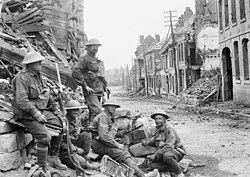
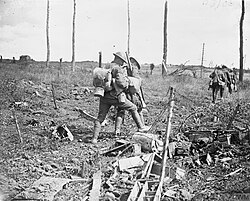
While the initial breakthrough was spectacular, the advance slowed over the following days as troops outran their artillery support and supplies. Nevertheless, the blow to German morale was permanent.
Pushing Toward the Hindenburg Line
Following Amiens, the Allies launched a series of coordinated attacks. The Battle of Albert (August 21) pushed the German 2nd Army back over a 34-mile front, while the French Tenth Army captured Noyon on August 29. To the north, the Second Battle of Arras further widened the Allied breach.
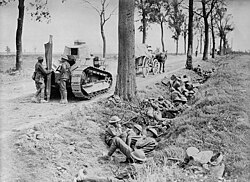
By early September, the Allies had forced the Germans back toward the Hindenburg Line—a sophisticated network of defensive fortifications stretching from the Aisne river to Arras. The Australian Corps played a pivotal role during this phase, crossing the Somme River and breaking lines during the Battle of Mont Saint-Quentin.
Breaking the Hindenburg Line
Foch implemented a "Grand Offensive," a series of concentric attacks designed to sever German lateral communications (the roads and rails used to move troops and supplies). This began with the Meuse-Argonne Offensive on September 26, involving French and American forces, and the Fifth Battle of Ypres in Flanders.
The central blow fell on September 29 during the Battle of St Quentin Canal. By October 5, the Allies had broken through the depth of the Hindenburg defenses over a 19-mile front. The subsequent Second Battle of Cambrai saw the fall of the city to Canadian troops, signaling the total collapse of the German defensive strategy.
![Comparison of Allied and German frontline rifle strength before and after the Hundred Days Offensive and the arrival of additional American troops.[23]](/images/f5/23/f5235a5493338acf2d45997dd2814e59583d92028ff790ca663f86007b0835e9.jpg)
The Final Pursuit and Armistice
Throughout October, the German armies retreated toward the Metz-to-Bruges railway line. Forced to abandon heavy equipment and supplies, German morale plummeted. The Allies maintained relentless pressure through a series of engagements, including the battles of the Selle, the Lys, and the Sambre.
The fighting continued until 11:00 on November 11, 1918, when the Armistice took effect. The final casualty of the war, Henry Gunther, died just one minute before the ceasefire.
| Category | Allied Forces | German Empire |
|---|---|---|
| Strength (Nov 11, 1918) | c. 6,559,000 (Combined) | c. 3,562,000 |
| Total Casualties | c. 1,070,000 (July 18 - Nov 11) | c. 1,172,075+ |
| Prisoners Captured | N/A | c. 386,342 |
| Artillery Lost | N/A | 6,700 pieces |
Frequently Asked Questions
What was the Hundred Days Offensive?
It was a series of massive Allied offensives from August 8 to November 11, 1918, that broke the German Army's defenses on the Western Front and led to the end of World War I.
Why was the Battle of Amiens significant?
The Battle of Amiens is considered the turning point of the offensive. Its success, driven by tanks and surprise, caused a collapse in German morale that Erich Ludendorff called "the Black Day of the German Army."
What was the Hindenburg Line?
The Hindenburg Line was a vast system of deep defensive fortifications built by the Germans to protect their positions on the Western Front. Its breach in October 1918 convinced the German High Command that the war was lost.
Which nations participated in the offensive?
The offensive was a joint effort by France, the United States, and the British Empire, which included significant contributions from Canada, Australia, New Zealand, Newfoundland, and South Africa.
How did the offensive end?
The offensive ended with the signing of the Armistice on November 11, 1918, which ceased all hostilities at 11:00 AM.