German Spring Offensive of 1918: The Final Gamble of the Kaiser's Army
The German Spring Offensive, historically known as the Kaiserschlacht ("Kaiser's Battle") or the Ludendorff Offensive, represented the German Empire's final attempt to secure a victory in World War I. Launched on March 21, 1918, this series of massive attacks along the Western Front was a race against time. Following the entry of the United States into the war in April 1917, German leadership recognized a narrow window of opportunity to defeat the Allied powers before American manpower and resources could be fully deployed in Europe.
The German Army entered 1918 with a temporary numerical advantage, having freed nearly 50 divisions following the Russian withdrawal from the war via the Treaty of Brest-Litovsk. While the offensive achieved the deepest territorial gains on the Western Front since 1914, it ultimately failed to deliver a decisive blow, leading many historians to categorize it as a Pyrrhic victory—a win achieved at such a devastating cost that it amounted to a defeat.
![Comparative numbers of German and Allied front-line infantry from April to November 1918.[6]](/images/2d/ab/2daba719263cb120636d54c8f5ba36adccd1b5322d383c02bc6efbbf26e6a345.jpg)
Key Facts
- Duration: March 21 to July 18, 1918.
- Primary Goal: Defeat the Allies before the full arrival of United States forces.
- Major Operations: Operation Michael, Georgette, Blücher–Yorck, and Gneisenau.
- Total Casualties: Approximately 1.7 million combined (863,374 Allied and 688,341 German).
- Outcome: Initial German territorial gains were completely reversed during the subsequent Hundred Days Offensive.
Strategic Planning and Tactical Shifts
The German Strategy
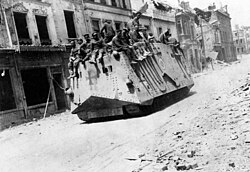
The offensive was primarily driven by General Erich Ludendorff. On November 11, 1917, Ludendorff decided to launch a strike near Saint-Quentin, the hinge between the British and French armies. This location was chosen for tactical expediency: the ground was expected to dry faster after winter rains, and the sector was perceived as a line of least resistance where Allied forces were relatively weak.
Allied Defensive Adaptations
In response to German tactics, the Allies implemented defence in depth. This strategy involved reducing the number of troops in the front-line trenches and pulling reserves and supply depots further back, beyond the reach of German artillery, to minimize casualties from initial bombardments.
The Major Phases of the Offensive
Operation Michael
Launched on March 21, Operation Michael began with the largest artillery barrage of the war, firing over 1.1 million shells in five hours across 150 square miles. The attack shattered the British Fifth Army, forcing a full retreat within two days.
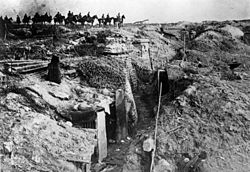
Despite the breakthrough, the German advance slowed as stormtroopers (specialized shock troops) outran their supply lines. The terrain, devastated by the 1916 Battle of the Somme, further hindered logistics. While the Germans gained ground, they suffered 239,000 casualties, many of whom were irreplaceable elite specialists.
Operation Georgette
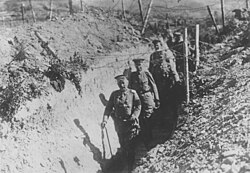
Beginning on April 9, this attack targeted the flat sectors defended by the Portuguese Expeditionary Corps. Due to poor organization during a relief-in-place operation, the Portuguese 2nd Division was left to defend an 11 km front alone and was virtually annihilated, losing over 7,000 men.
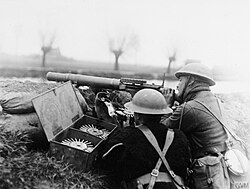
The crisis led Field Marshal Sir Douglas Haig to issue his famous "Order of the Day" on April 11, declaring that the British army fought with "their backs to the wall." Ultimately, the Germans occupied a vulnerable salient, and the strategic results remained disappointing.
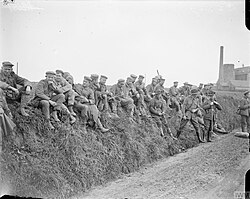
Blücher–Yorck and Gneisenau
Subsequent attacks aimed to split the British and French forces. During Blücher–Yorck, the U.S. 1st Division began reinforcing the line, launching their first attack at Cantigny on May 28. Operation Gneisenau, launched on June 9, was halted by a sudden French counter-attack at Compiègne involving 150 tanks, which caught the Germans by surprise.
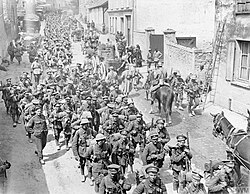
Aftermath and Analysis
By July 1918, the German Army was exhausted. The strength of the force had plummeted from 5.1 million to 4.2 million fighting men. The territorial gains were shaped as salients—bulges in the line—which increased the length of the front the Germans had to defend while their manpower dwindled.
The arrival of fresh American troops restored the Allied numerical advantage. In August, the Allies launched the Hundred Days Offensive, which collapsed the Hindenburg Line and forced the German capitulation in November 1918.
| Category | German Empire | Allied Powers |
|---|---|---|
| Key Commanders | Hindenburg, Ludendorff | Foch, Haig, Pétain |
| Total Casualties | 688,341 | 863,374 |
| Tactical Approach | Stormtrooper infiltration | Defence in depth |
| Final Result | Territorial gains reversed | Strategic victory/Capitulation |
Frequently Asked Questions
Why did Germany launch the Spring Offensive in 1918?
Germany sought to win the war before the United States could fully deploy its military resources in Europe, utilizing a temporary numerical advantage gained from Russia's exit from the war.
What were stormtroopers?
Stormtroopers (Stoßtruppen) were elite, specialized shock troops trained in infiltration tactics to lead attacks and break through enemy lines.
Why is the offensive considered a Pyrrhic victory?
Although Germany captured significant territory, they suffered irreplaceable losses among their best-trained soldiers and failed to achieve a decisive strategic victory, leaving them vulnerable to counter-attacks.
How did the United States contribute to the failure of the offensive?
The arrival of American troops provided the Allies with a critical numerical advantage and fresh manpower, which allowed them to launch the Hundred Days Offensive that ended the war.
What was the significance of Operation Michael?
It was the opening and largest phase of the offensive, featuring the biggest artillery barrage of the war and achieving the deepest German advances since 1914.