Hu Jintao: Leadership, Economic Shifts, and Foreign Policy in China
Hu Jintao served as the paramount leader of the People's Republic of China from 2002 to 2012, a decade defined by rapid economic expansion, significant social reforms, and a pragmatic approach to global diplomacy. His tenure marked a transition from the era of Jiang Zemin to the current leadership under Xi Jinping, balancing the need for internal stability with the ambitions of a rising global superpower.
Key Facts
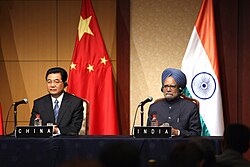
- Tenure: Served as CCP General Secretary (2002–2012) and President of China (2003–2013).
- Economic Growth: Averaged approximately 10% growth, surpassing the economies of Japan, Germany, France, and the UK.
- Healthcare: Expanded coverage to 95% of the population by 2012 through new rural and urban insurance schemes.
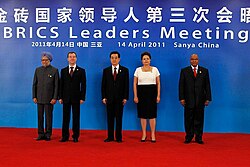
- Foreign Policy: Promoted a "harmonious world" view and strengthened ties with the Global South and BRICS nations.
- Taiwan Relations: Shifted from a "no-contact" policy under Chen Shui-bian to a thaw in relations under Ma Ying-jeou based on the 1992 Consensus.
Political Ascent and Governance
Hu Jintao's rise to power began on November 15, 2002, when he became the General Secretary of the Chinese Communist Party (CCP). By March 2003, he was elected President of China, and by 2005, he had consolidated power across the three pillars of the state: the party, the government, and the military (the Central Military Commission).
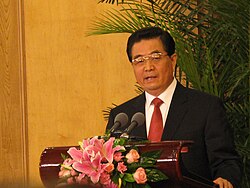
Politically, Hu was characterized as conservative regarding structural reforms but sought to improve the ruling capacity of the CCP. He introduced greater transparency by mandating spokespersons for central party bodies and initiating collective study sessions for the Politburo. He also launched the "Socialist Concept of Honor and Disgrace" in 2006 to encourage morality and selflessness among citizens.
Internal Power Dynamics and Challenges
Despite his official status, Hu initially navigated the influence of the "Shanghai clique," a powerful faction linked to his predecessor, Jiang Zemin. Over time, Hu asserted more control, evidenced by the 2006 removal of Shanghai Party Secretary Chen Liangyu following a pension scandal.
Toward the end of his tenure, the party faced a significant shock in 2012 with the Wang Lijun incident. This event led to the downfall of Bo Xilai, the Party Secretary of Chongqing, who was eventually sentenced to life imprisonment for corruption in 2013.
Economic Strategy and Social Welfare
Under Hu and Premier Wen Jiabao, China adopted a more egalitarian and populist economic approach. While maintaining high growth, the administration increased funding for education and healthcare and halted privatization efforts. This period saw the rise of "national champions"—large state-owned enterprises (SOEs) that received massive subsidies to compete globally.
| Metric | Detail/Value |
|---|---|
| Average GDP Growth | ~10% |
| SOE Share of Total Output | 26% |
| Healthcare Coverage (2012) | 95% of population |
| Health Spending per Person | $19 (2002) to $155 (2011) |
| Yuan Value vs USD | Rose 31% (2005–2012) |
Healthcare Revolution
The 2003 SARS outbreak served as a catalyst for healthcare reform. Hu's administration established the New Cooperative Medical Scheme for rural populations and the Urban Resident Basic Medical Insurance for those outside the formal employment sector. Between 2009 and 2011, the government invested $230 billion to expand infrastructure and insurance coverage.
National Security and Media Control
Hu's leadership placed a heavy emphasis on stability maintenance. This resulted in increased spending for law enforcement and a rise in reported "public order disturbances," which peaked at 180,000 cases in 2010 before the Ministry of Public Security ceased releasing the data.
In terms of media, Hu introduced the concept of "channeling" public opinion. He advocated for the party to leverage new technologies and "grasp the online discourse power" to ensure that mainstream narratives remained positive and aligned with party goals.
Foreign Policy and Global Relations
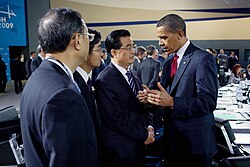
Hu Jintao pursued a pragmatic foreign policy centered on the concept of a "harmonious world." He rejected unilateralism and hegemonic ambitions, focusing on four developmental objectives: prioritizing big powers, focusing on periphery countries, building a foundation with developing nations, and using multilateralism as the stage.
Regional Dynamics: Asia and Europe
Relations with Japan fluctuated, deteriorating significantly after the 2010 Senkaku boat collision and the 2012 Japanese government purchase of the Senkaku Islands. In Europe, Hu maintained a close strategic partnership with Russia, meeting frequently with Vladimir Putin and Dmitry Medvedev, though relations were briefly downgraded during the 2008 Russo-Georgian war over sovereignty concerns.
The Taiwan Question
Hu's approach to Taiwan evolved from "hard" to "soft." During the presidency of Chen Shui-bian, Hu maintained a no-contact policy and passed the 2005 Anti-Secession Law. However, the election of Ma Ying-jeou in 2008 led to a thaw. Both leaders embraced the 1992 Consensus—the agreement that there is only one China, while differing on its definition—leading to the resumption of direct mail, trade, and air links (the "Three Links") and the 2010 Economic Cooperation Framework Agreement (ECFA).
Ethnic Policies and Internal Unrest
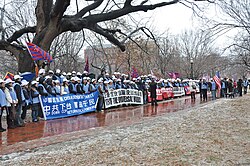
The administration faced several internal crises, including the 2008 Tibetan protests commemorating the 1959 Uprising and the 2009 Ürümqi riots in Xinjiang. The latter, sparked by ethnic tensions and a brawl in Shaoguan, resulted in 197 deaths and led to a surge in stability-preservation efforts in the region.
Transition to the Xi Era
The transition of power occurred in November 2012 during the 18th CCP National Congress. Xi Jinping, who had been positioned as the successor and served as Vice President, was elected General Secretary and Chairman of the Central Military Commission. Hu officially stepped down as President in March 2013, completing a smooth transfer of leadership.
Frequently Asked Questions
What was the 1992 Consensus in the context of Hu Jintao's leadership?
The 1992 Consensus is an agreement where both the PRC and the ROC (Taiwan) recognize there is only one China, but agree to differ on the specific definition of "China." Under Hu Jintao and Ma Ying-jeou, this served as the basis for resuming official dialogue and trade.
How did Hu Jintao change China's healthcare system?
Hu significantly expanded healthcare access by creating the New Cooperative Medical Scheme for rural residents and the Urban Resident Basic Medical Insurance. By 2012, these programs provided some form of coverage to 95% of the population.
What did Hu Jintao mean by "channeling" public opinion?
"Channeling" referred to the CCP's strategy of managing online discourse. It involved using new technologies and positive coverage to guide public discussion and ensure that the party maintained control over the mainstream narrative.
What was the impact of the "national champions" strategy on the economy?
The government provided massive subsidies and regulatory favors to large state-owned enterprises (SOEs) to create "national champions" capable of competing with foreign corporations. While this crowded out some private competitors, SOEs continued to account for 26% of total output.
How did Hu Jintao's foreign policy differ from previous leaders?
While continuing the pragmatic developmental diplomacy of Deng Xiaoping and Jiang Zemin, Hu emphasized a "harmonious world" and a structured four-phase objective focusing on big powers, periphery countries, developing nations, and multilateralism.