Horn: History, Types, and Evolution of the Orchestral Brass Instrument
The horn, often colloquially referred to as the French horn, is a versatile brass aerophone known for its rich, blending tone and wide dynamic range. Classified as a valved lip-reed aerophone with a moderately conical bore, it occupies a unique space in the orchestra, bridging the gap between the higher trumpets and the lower trombones and tubas.
While the term "French horn" remains common, the International Horn Society has recommended since 1971 that the instrument be called simply the horn. This shift reflects the historical transition in British and international orchestras from French-style instruments to German-style horns around 1930.
Key Facts
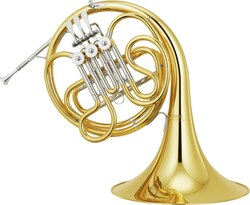
- Classification: Aerophone (Brass wind instrument).
- Primary Types: Single horn (F or B♭) and Double horn (F/B♭).
- Valve Systems: Rotary valves (common in German horns) and Périnet piston valves (common in French horns).
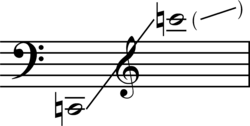
- Range: Spans from C two octaves below middle C to E above middle C.
- Standard Orchestral Use: Typically features at least two players, often expanding to four or more in larger works.
The Evolution of the Horn
From Natural Horn to Valves
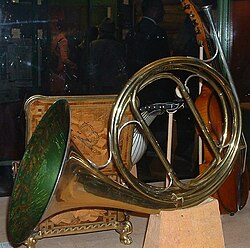
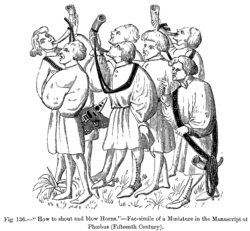
In the mid-18th century, musicians played the natural horn, which lacked valves. To adjust tuning and reach notes between harmonics, players developed the technique of inserting the right hand into the bell to alter the instrument's length.
The quest for a fully chromatic instrument led to the patenting of the first rotary valve horn in 1818 by Heinrich Stölzel and Friedrich Blümel. Shortly after, in 1839, François Périnet introduced piston valves in France. Despite these innovations, adoption was slow; many conservatories and traditionalists believed the natural horn offered a superior sound.
The Rise of the Double Horn
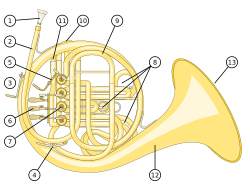
The single F horn presented challenges in its highest register, where notes (partials) became too close together for reliable accuracy. While some players switched to a B♭ horn for higher passages, the definitive solution arrived in 1897 when Fritz Kruspe introduced the double horn. This instrument combines the F and B♭ horns into one, allowing the player to switch between them via a thumb valve.
Types of Horns
The Double Horn
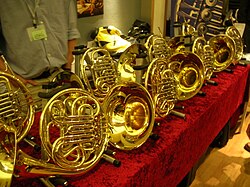
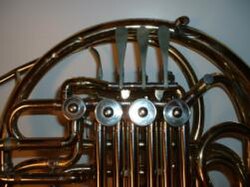
The double horn is the modern orchestral standard. In the United States, the Conn 8D was historically popular, though many orchestras have shifted toward Geyer model horns. In Europe, Alexander and Paxman are among the most prominent makers.
The French Horn (Specific Type)
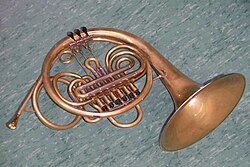
When used as a technical term, "French horn" refers to a narrow-bore instrument (10.8–11.0 mm) featuring three Périnet piston valves. It often utilizes an "ascending" third valve, which raises the pitch by a whole tone when pressed.

Other Variants
- Vienna Horn: A distinct regional variant used primarily in Austria.
- Mellophone: A marching band alternative to the orchestral horn.
- Wagner Tuba: A hybrid instrument developed for specific operatic works.
Horn in Musical Performance
Orchestral and Solo Repertoire
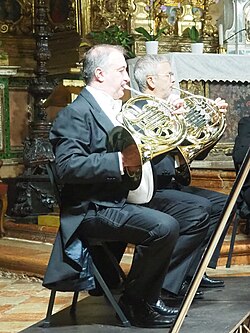
The horn has a vast repertoire, from the classical concerti of Wolfgang Amadeus Mozart to the complex works of Richard Strauss. Early compositions for the natural horn, such as those by Carl Maria von Weber, sometimes employed multiphonics—the technique of humming into the instrument while playing.
Jazz and Contemporary Use
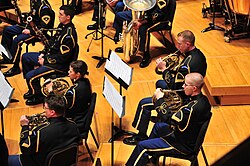
Though rare in early jazz, the horn was integrated into the genre by arrangers like Gil Evans and performers like Don Ellis. Improvising players such as Julius Watkins and John Graas further expanded the instrument's role in jazz ensembles.
Notation and the Bass Clef
Horn notation has evolved significantly. Prior to 1920, "old notation" in the bass clef wrote notes an octave below concert pitch. Modern "new notation" writes notes in the octave above concert pitch, mirroring the rules of the treble clef.
Summary of Horn Specifications
| Type | Valve Type | Bore Size | Primary Use |
|---|---|---|---|
| Natural Horn | None | Variable | Period Performance |
| French Horn (Type) | Périnet Piston | Narrow (10.8-11.0mm) | Traditional French Style |
| German/Double Horn | Rotary | Medium/Wide | Modern Orchestral |
| Vienna Horn | Rotary | Specific Regional | Viennese Orchestras |
Frequently Asked Questions
What is the difference between a single horn and a double horn?
A single horn is pitched in one key (usually F), which can make the high register difficult to play accurately. A double horn combines an F horn and a B♭ horn, allowing the player to switch between the two to improve accuracy and ease of playing in higher ranges.
Why is it called a "French horn" if it is often German?
The term is used colloquially to describe the instrument. However, German-style horns began replacing French-style instruments in British orchestras around 1930, leading the International Horn Society to recommend the simpler term "horn."
What are Périnet valves?
Périnet valves are piston valves that move up and down. They are characteristic of the specific "French horn" type, whereas most modern orchestral horns use rotary valves that turn a rotor to redirect airflow.
How did players tune the horn before valves existed?
Players of the natural horn used "crooks" (interchangeable pieces of tubing) to change the instrument's key and inserted their right hand into the bell to adjust the pitch between harmonics.
What is the role of an assistant principal horn in an orchestra?
The assistant principal doubles the first horn part during loud passages, takes over when the principal needs to rest, or plays specific sections to allow the principal to prepare for a solo.