Hieronymus Bosch: The Master of Nightmarish Visions and Religious Fantasy
Few artists in history have captured the human psyche with as much unsettling precision as Hieronymus Bosch. A prominent figure of the Early Netherlandish painting school, Bosch is celebrated for his extraordinary ability to translate complex religious narratives into fantastical, often macabre, visual landscapes. His work, characterized by hybrid creatures and dreamlike settings, continues to provoke intense debate and fascination among art historians and the public alike.
Born Jheronimus van Aken in 's-Hertogenbosch, the artist spent most of his life in the Duchy of Brabant. While much of his personal life remains shrouded in mystery due to a lack of surviving diaries or letters, his artistic legacy is unmistakable. He was a highly individualistic painter whose influence stretched across Northern Europe, most notably inspiring followers such as Pieter Bruegel the Elder.
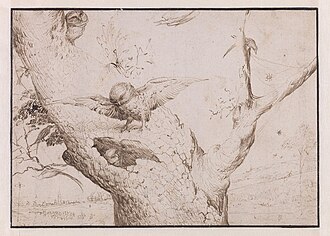
Key Facts
- Original Name: Jheronimus van Aken
- Lifespan: c. 1450 – August 9, 1516
- Artistic Movement: Early Netherlandish / Renaissance
- Primary Medium: Oil on oak wood
- Most Famous Work: The Garden of Earthly Delights
- Notable Style: Use of impasto (thickly applied paint) and fantastical imagery
The Life and Legacy of Jheronimus van Aken
The name "Bosch" is a direct reference to his birthplace, 's-Hertogenbosch (meaning "Duke's forest"). Bosch's family had deep roots in the arts; his grandfather was a painter, and his father served as an artistic adviser to the Illustrious Brotherhood of Our Blessed Lady, a prestigious local religious confraternity.
Bosch was a respected member of his community, joining the Brotherhood of Our Lady in the late 15th century. He married Aleid Goyaerts van den Meervenne, and the couple resided in the nearby town of Oirschot. Despite his fame during his lifetime—receiving commissions from as far as Spain and Austria—the specific details of his training and personal philosophy remain unknown.
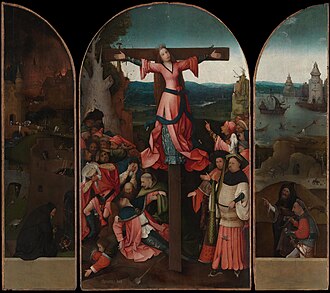
Artistic Style and Technique
Unlike many of his contemporaries in the Early Netherlandish tradition who sought to create perfectly smooth surfaces through multiple transparent glazes, Bosch often employed a more impasto technique. This resulted in rougher, more textured surfaces that allowed for a more immediate, expressive application of paint.
His subject matter frequently revolved around triptychs—large-scale paintings divided into three panels. These works often functioned as altarpieces, guiding the viewer through a narrative sequence, often moving from creation to sin and ultimately to judgment.
Masterpieces and Interpretations
Bosch's oeuvre is generally categorized into three periods: early (c. 1470–1485), middle (c. 1485–1500), and late (c. 1500–1516). His most acclaimed works are his triptychs, which present a window into a world of dreams and nightmares.
The Garden of Earthly Delights
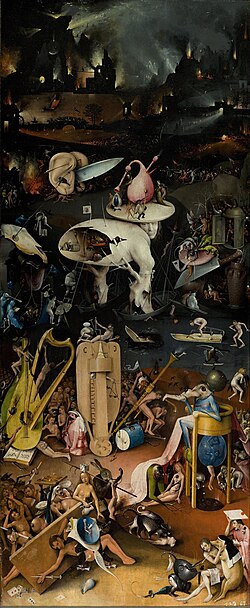
Perhaps his most iconic creation, The Garden of Earthly Delights (c. 1495–1505) is a complex triptych. The left panel depicts the Garden of Eden, where a youthful God presents Eve to Adam. The central panel is a sprawling panorama of nude figures engaged in various activities amidst oversized fruit and hybrid creatures. The right panel presents a terrifying vision of hell.
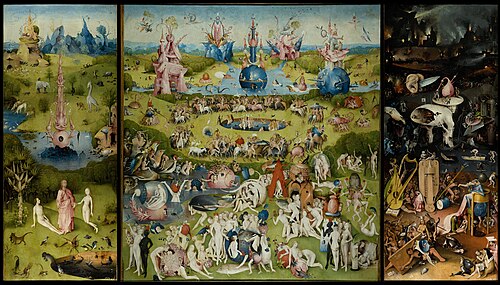
The sheer detail in the hell panel is legendary. Some scholars even suggest that Bosch included a self-portrait within the upper center of this panel, tucked beneath a table-like structure.
The Temptation of St. Anthony
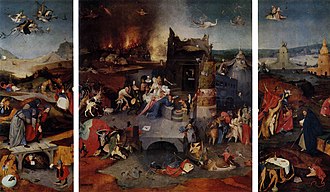
Another significant work is the Triptych of the Temptation of St. Anthony (c. 1501), which showcases his ability to depict the struggle between spiritual devotion and demonic temptation through bizarre, hybrid forms.
The Challenge of Attribution
One of the most complex aspects of studying Bosch is determining which paintings are truly his. Because his style was so influential, many artists in his workshop and subsequent followers produced works that mimicked his unique aesthetic. Today, only about 25 paintings and eight drawings are confidently identified as authentic works by Bosch.
Modern technology has played a crucial role in refining these attributions. The Bosch Research and Conservation Project (BRCP) uses advanced methods like infrared reflectography to examine underdrawings, helping to distinguish the master's hand from that of his workshop. For instance, a small panel once thought to be a workshop piece was recently re-credited to Bosch himself after intensive forensic study.
| Category | Details |
|---|---|
| Primary Movement | Early Netherlandish / Renaissance |
| Common Subjects | Religious narratives, hellscapes, hybrid creatures |
| Key Medium | Oil on oak wood |
| Major Collections | Museo del Prado (Madrid), National Museum of Ancient Art (Lisbon) |
| Confirmed Works | Approximately 25 paintings and 8 drawings |
Frequently Asked Questions
What does the name "Bosch" mean?
The name is derived from his birthplace, 's-Hertogenbosch, which is commonly referred to as "Den Bosch" (meaning "the forest") in the Netherlands.
Why is it difficult to identify Bosch's original paintings?
Attribution is difficult because Bosch's style was widely imitated by his followers and workshop members. Additionally, many copies and variations of his works circulated shortly after his death.
What is a triptych?
A triptych is a work of art, typically a painting, that is divided into three sections or panels, often joined by hinges so that the side panels can fold over the central one.
How did Bosch's style differ from other Netherlandish painters?
While many Netherlandish painters used multiple transparent glazes to create a smooth, "divine" surface, Bosch often used an impasto technique, leaving a rougher, more textured surface on his canvases.
Where can I see his most famous works today?
Many of his most significant works are held in major museums, including the Museo del Prado in Madrid, which houses The Garden of Earthly Delights.