Articles/The Garden of Earthly Delights: Decoding Hieronymus Bosch's Masterpiece
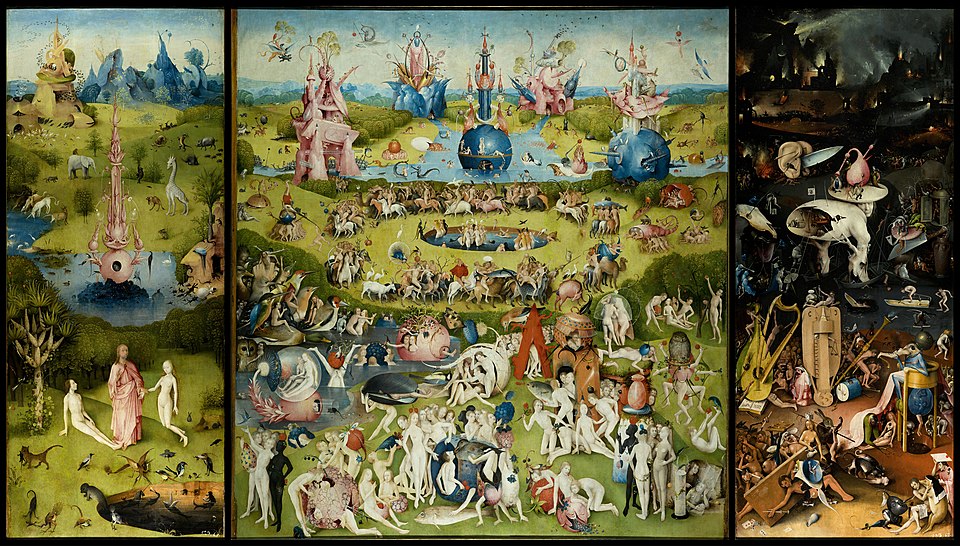
Hieronymus BoschThe Garden of Earthly DelightsEarly Netherlandish arttriptychMuseo del Prado
The Garden of Earthly Delights: Decoding Hieronymus Bosch's Masterpiece
The Garden of Earthly Delights: Decoding Hieronymus Bosch's Masterpiece Created between 1490 and 1510, The Garden of Earthly Delights stands as one of the most enigmatic and visually arre...
The Garden of Earthly Delights: Decoding Hieronymus Bosch's Masterpiece
Created between 1490 and 1510, The Garden of Earthly Delights stands as one of the most enigmatic and visually arresting works in the history of Western art. Painted by the Early Netherlandish master Hieronymus Bosch, this complex triptych—a work of art divided into three hinged panels—serves as a profound meditation on human nature, temptation, and divine judgment.
While the exact purpose of the work remains a subject of intense scholarly debate, many historians believe it functions as a moral warning against the perils of earthly temptation. Whether intended as a private collection piece or a complex religious allegory, its intricate symbolism continues to captivate viewers at the Museo del Prado in Madrid.
Hieronymus Bosch, The Garden of Earthly Delights, oil on oak panels, 205.5 cm × 384.9 cm (81 in × 152 in), Museo del Prado, Madrid: Hieronymus Bosch, The Garden of Earthly Delights, oil on oak panels, 205.5 cm × 384.9 cm (81 in × 152 in), Museo del Prado, Madrid
Key Facts
Artist: Hieronymus Bosch
Period: Early Netherlandish (c. 1490–1510)
Format: Triptych (three interior oil panels, two exterior oak panels)
Current Location: Museo del Prado, Madrid
Primary Themes: Creation, human temptation, and eternal damnation
The Structure of the Triptych
A triptych is traditionally designed to be read sequentially. In Bosch's work, the narrative flows from the left panel through the central scene to the harrowing conclusion on the right. When the outer panels are closed, they reveal a different perspective entirely.
The Exterior: The Third Day of Creation
The closed exterior panels depict the world during the Third Day of Creation. This scene shows the Earth in a state of transition, featuring the emergence of plant life after the separation of waters, but before the arrival of animals and humans.
The exterior panels show the world during creation, probably on the Third Day, after the addition of plant life but before the appearance of animals and humans.[4]: The exterior panels show the world during creation, probably on the Third Day, after the addition of plant life but before the appearance of animals and humans.[4]
The Interior Narrative
Once the triptych is opened, the viewer is met with a vibrant, sprawling landscape that shifts dramatically in tone as the eye moves from left to right.
The Left Panel: The Garden of Eden
The left panel presents the Garden of Eden, a place of primordial innocence. It depicts the introduction of humanity into a lush, paradisiacal environment. Within this scene, Bosch includes delicate details, such as the pre-incarnate Christ blessing Eve before her presentation to Adam.
Detail from the left hand panel, showing the pre-incarnate Christ blessing Eve before she is presented to Adam[16]: Detail from the left hand panel, showing the pre-incarnate Christ blessing Eve before she is presented to Adam[16]
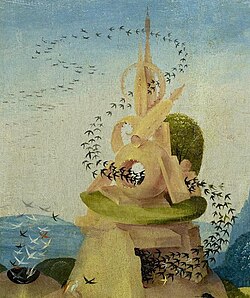
Birds swarming through cavities of a hut-shaped form in the left background of the left panel: Birds swarming through cavities of a hut-shaped form in the left background of the left panel
The giraffe on the right side of the left panel may be drawn from copies of those in Cyriac of Ancona's Egyptian Voyage (left), which was published c. 1440.[22]: The giraffe on the right side of the left panel may be drawn from copies of those in Cyriac of Ancona's Egyptian Voyage (left), which was published c. 1440.[22]
The Center Panel: The Garden of Earthly Delights
The central panel is the heart of the work, characterized by a teeming landscape of male and female nudes engaging in various pleasure-seeking activities. Unlike Bosch's other triptychs, God is notably absent from this central scene, suggesting a world where humanity acts with free will.
The landscape is filled with oversized fruits, strange hybrid creatures, and complex social interactions. Some scholars interpret this as a panorama of a lost paradise, while others see it as a depiction of humanity lost in sin. The skyline of this panel matches the left wing, creating a sense of spatial continuity.
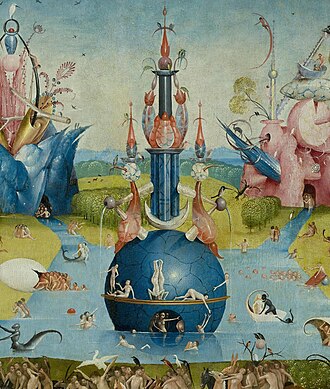
The central water-bound globe in the middle panel's upper background is a hybrid of stone and organic matter.: The central water-bound globe in the middle panel's upper background is a hybrid of stone and organic matter.
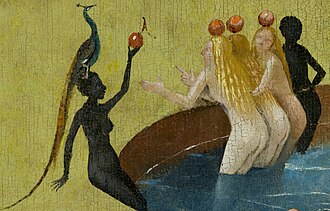
A group of females from the center panel. The head of one female is adorned with two cherries—a symbol of pride. To her right, a male drinks lustfully from an organic vessel. Behind the group, a male carries a couple encased in a mussel shell.[31]: A group of females from the center panel. The head of one female is adorned with two cherries—a symbol of pride. To her right, a male drinks lustfully from an organic vessel. Behind the group, a male carries a couple encased in a mussel shell.[31]
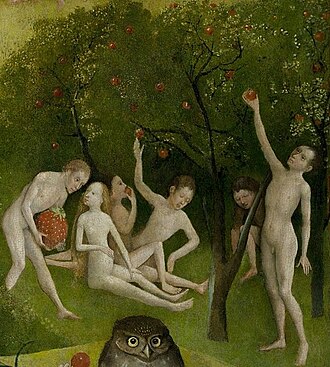
Male figures pluck fruit from a tree. One carries a large strawberry while an owl is in the foreground.: Male figures pluck fruit from a tree. One carries a large strawberry while an owl is in the foreground.
Naked figures seek pleasure in various ways.: Naked figures seek pleasure in various ways.
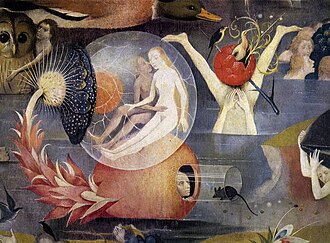
Detail showing nudes within a transparent sphere, which is the fruit of a plant: Detail showing nudes within a transparent sphere, which is the fruit of a plant
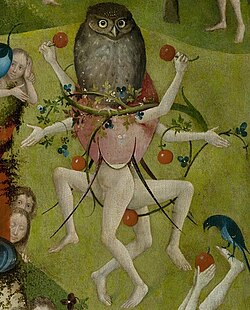
Detail from the center panel showing two cherry-adorned dancing figures who carry a surface on which an owl is perched. In the front right corner, a bird standing on a reclining human's foot is about to eat from a cherry offered to it.: Detail from the center panel showing two cherry-adorned dancing figures who carry a surface on which an owl is perched. In the front right corner, a bird standing on a reclining human's foot is about to eat from a cherry offered to it.
The Right Panel: The Hellscape
The transition to the right panel is jarring. The warmth and natural beauty of the previous scenes are replaced by a chilling, nocturnal hellscape. This panel illustrates the consequences of succumbing to temptation, depicting a world of cruel torture and retribution.
The colors are cold, and the waterways appear frozen, contributing to a sense of dread. This section is populated by monstrous figures and grotesque punishments, serving as a stark visual representation of eternal damnation.
A scene from the hellscape panel showing the long beams of light emitted from the burning city in the panel's background[18]: A scene from the hellscape panel showing the long beams of light emitted from the burning city in the panel's background[18]
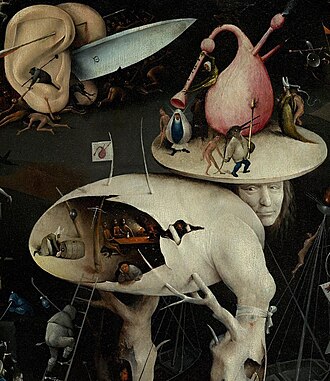
The "Tree-Man" of the right panel, and a pair of human ears brandishing a blade. A cavity in the torso is populated by three naked persons at a table, seated on an animal, and a fully clothed woman pouring drink from a barrel.: The "Tree-Man" of the right panel, and a pair of human ears brandishing a blade. A cavity in the torso is populated by three naked persons at a table, seated on an animal, and a fully clothed woman pouring drink from a barrel.
Gibson compares this "Prince of Hell" to a figure in the 12th-century Irish religious text Vision of Tundale, who feeds on the souls of corrupt and lecherous clergy.[47]: Gibson compares this "Prince of Hell" to a figure in the 12th-century Irish religious text Vision of Tundale, who feeds on the souls of corrupt and lecherous clergy.[47]
Hieronymus Bosch, Man Tree, c. 1470s. The "Tree-Man" of the right-hand panel, depicted in an earlier drawing by Bosch. This pen and bistre version contain no suggestion of Hell, yet its outline was adapted into one of The Garden's most memorable grotesques.[42]: Hieronymus Bosch, Man Tree, c. 1470s. The "Tree-Man" of the right-hand panel, depicted in an earlier drawing by Bosch. This pen and bistre version contain no suggestion of Hell, yet its outline was adapted into one of The Garden's most memorable grotesques.[42]
Summary of Triptych Panels
Overview of The Garden of Earthly Delights Panels
Panel Section
Theme
Visual Atmosphere
Exterior (Closed)
Creation (Third Day)
Naturalistic, emerging life
Left Panel
Garden of Eden
Lush, innocent, paradisiacal
Center Panel
Earthly Delights
Vibrant, crowded, hedonistic
Right Panel
Hell
Dark, chilling, chaotic
Historical Context and Provenance
The exact dating of the painting is debated. While some early historians viewed it as an early work, modern consensus places it between 1503 and 1504 or later. Dendrochronology (the study of tree rings) shows the oak panels date between 1460 and 1466, providing a baseline for the work's creation.
The painting's history is as complex as its imagery. It passed from the hands of Henry III of Nassau-Breda to his nephew, William the Silent. It was later confiscated by the Duke of Alba and eventually acquired by Philip II of Spain in 1591, who gifted it to El Escorial.
Henry III of Nassau-Breda (1483–1538) by Bernard van Orley. Henry may have been the patron of Bosch's triptych: he was well known as an avid collector of art.[49]: Henry III of Nassau-Breda (1483–1538) by Bernard van Orley. Henry may have been the patron of Bosch's triptych: he was well known as an avid collector of art.[49]
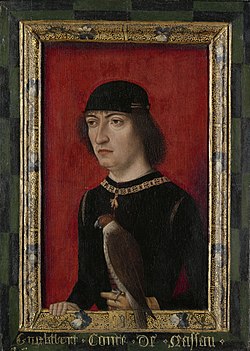
Portrait of Engelbrecht II of Nassau (1451–1504) in the Rijksmuseum Amsterdam: Portrait of Engelbrecht II of Nassau (1451–1504) in the Rijksmuseum Amsterdam
Hieronymus Bosch, in a c. 1550 drawing once thought to be a copy of a self-portrait. His age in this representation (believed to be around 60 years) has been used to estimate his date of birth, although its attribution remains uncertain.[90]: Hieronymus Bosch, in a c. 1550 drawing once thought to be a copy of a self-portrait. His age in this representation (believed to be around 60 years) has been used to estimate his date of birth, although its attribution remains uncertain.[90]
Artistic Legacy
Bosch's visionary style has left a lasting imprint on art history. While his influence was unique, several major artists drew inspiration from his work:
Pieter Bruegel the Elder: Directly acknowledged Bosch as an inspiration, incorporating elements of his hellscapes into works like The Triumph of Death.
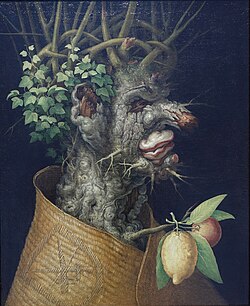
Giuseppe Arcimboldo: Echoed Bosch's use of organic matter and hybrid forms in his famous vegetable portraits.
Joan Miró: The Surrealist artist's work, such as The Tilled Field, structurally quotes the complex arrangements found in Bosch's center panel.
Giuseppe Arcimboldo, Winter, 1573. The concept of the "Tree-man", the hybrid organism, as well as the engorged fruit, all bear hallmarks of Bosch's Garden.: Giuseppe Arcimboldo, Winter, 1573. The concept of the "Tree-man", the hybrid organism, as well as the engorged fruit, all bear hallmarks of Bosch's Garden.
Frequently Asked Questions
What is the main meaning of the painting?
Interpretations vary widely. Most scholars view it as a moral warning against the temptations of the flesh and the consequences of sin, though some see it as a depiction of a lost paradise.
Where can I see the painting today?
The painting has been housed in the Museo del Prado in Madrid, Spain, since 1939.
Was this painting intended for a church?
It is unlikely it was designed as a traditional church altarpiece due to the extreme and controversial subject matter found in the center and right panels.
Who was the patron of the work?
The exact patron is unknown, though some historians suggest Henry III of Nassau-Breda may have been the patron due to his reputation as an art collector.
What is a triptych?
A triptych is a work of art, usually a painting, that is divided into three sections or panels, often hinged together so they can be closed.
References
At the time, paintings often had no fixed titles. It is listed in Philip IV of Spain's inventory as La Pintura del Madroño. It is known today in Spanish, at the Prado Museum, as El Jardín de las Delicias.
Bosch's exact date of birth is unknown but is estimated to be 1450. Gibson, 15–16
![The exterior panels show the world during creation, probably on the Third Day, after the addition of plant life but before the appearance of animals and humans.[4]](/images/8b/d2/8bd2b9487d313b57e930669f88252ec76508886a4e952ec67034e16d3e63c176.jpg)
![Detail from the left hand panel, showing the pre-incarnate Christ blessing Eve before she is presented to Adam[16]](/images/37/7a/377a78e718fd924ca3561d8c9a1b1d9f21ff89ef455d3465f0ee3b21d6e8af09.jpg)
![The giraffe on the right side of the left panel may be drawn from copies of those in Cyriac of Ancona's Egyptian Voyage (left), which was published c. 1440.[22]](/images/5c/26/5c26f9b8bf468a816efb59f305ac1e59831161dc6d14ff33eb54cd914e24a8ef.jpg)
![A group of females from the center panel. The head of one female is adorned with two cherries—a symbol of pride. To her right, a male drinks lustfully from an organic vessel. Behind the group, a male carries a couple encased in a mussel shell.[31]](/images/5a/3b/5a3b76f8ed5cdd6e1e822caf1e0c3b2578e90e424182d61442f193bc7c94beed.jpg)
![A scene from the hellscape panel showing the long beams of light emitted from the burning city in the panel's background[18]](/images/2b/dd/2bdd50e19f248507d1e65acf69bacf0983121742a88690084ebd09fee63b8017.jpg)
![Gibson compares this "Prince of Hell" to a figure in the 12th-century Irish religious text Vision of Tundale, who feeds on the souls of corrupt and lecherous clergy.[47]](/images/09/93/0993b6f957e9a9878303d4fd15226d95ee420c342bcdf6ea73355932a0a746e6.jpg)
![Hieronymus Bosch, Man Tree, c. 1470s. The "Tree-Man" of the right-hand panel, depicted in an earlier drawing by Bosch. This pen and bistre version contain no suggestion of Hell, yet its outline was adapted into one of The Garden's most memorable grotesques.[42]](/images/0a/31/0a31033857e0977875b66b32da3a34ea2e73c352d0d9ebe43d594307974492ab.jpg)
![Henry III of Nassau-Breda (1483–1538) by Bernard van Orley. Henry may have been the patron of Bosch's triptych: he was well known as an avid collector of art.[49]](/images/f4/fb/f4fbe9d439a825fa63aaaa86070ff4c3355d536c72eb0e156825533a585da6a1.jpg)
![Hieronymus Bosch, in a c. 1550 drawing once thought to be a copy of a self-portrait. His age in this representation (believed to be around 60 years) has been used to estimate his date of birth, although its attribution remains uncertain.[90]](/images/d6/94/d694c14471e7d1580b87520f37e779d28f3981a37a24cce79ec541a35e0f9f88.jpg)