Herero People: History, Culture, and the Legacy of Resilience
The Herero (known in their own language as the Ovaherero) are a Bantu ethnic group with a deep-rooted history in Southern Africa. Primarily residing in Namibia, they are a people defined by their pastoral traditions, a complex social structure, and a profound history of resilience in the face of colonial violence. Today, they maintain a vibrant cultural identity that blends ancestral customs with historical memories.
According to the 2023 census, 178,987 people in Namibia identify as Ovaherero. Beyond Namibia, significant populations live in Angola (approximately 25,000) and Botswana (approximately 19,000), with a small number in South Africa. These migrations, particularly to Botswana and South Africa, were largely the result of displacement during the early 20th century.
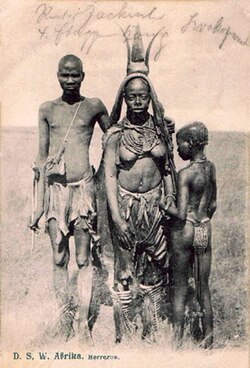
Key Facts
- Total Population: Approximately 329,000 across Southern Africa.
- Primary Language: Otjiherero, a Bantu language.
- Core Regions: Namibia, Angola, and Botswana.
- Traditional Economy: Historically centered on cattle herding and pastoralism.
- Governance: A system of Royal Traditional Authorities led by Paramount Chiefs.
- Religion: A blend of Christianity and traditional faith.
Governance and the Paramount Chieftaincy
The Ovaherero maintain a sophisticated central governance system established in 1863. This system was born out of necessity during conflicts with the Nama people in the 1860s, which required the various Herero clans to unite under a single leader.
Traditional Authorities
Governance is divided among several Royal Traditional Authorities, including:
- Ovaherero Traditional Authority (formerly led by Chief Hoze Riruako)
- Maharero Royal Traditional Authority (Chief Tjinaani Maharero)
- Zeraeua Royal Traditional Authority at Omaruru
- Ovambanderu Royal Traditional Authority (Chief Eben Nguvauva)
- Onguatjindu Royal Traditional Authority at Okakarara (Chief Sam Kambazembi)
Lineage of Paramount Chiefs
The role of the Paramount Chief has been pivotal in guiding the people through colonization and independence. Notable leaders include Maharero ka Tjamuaha, the first Paramount Chief elected in 1863, and Samuel Maharero, who led the people during the early 20th-century uprisings. Later leaders such as Hosea Kutako, Clemens Kapuuo, Kuaima Riruako, and Vekuii Rukoro continued to navigate the political landscape of Namibia.
Historical Journey: From Migration to Genocide
The Herero migrated from the east into present-day Namibia during the 15th century, establishing themselves as skilled herdsmen. By the 19th century, they encountered the Nama people and later European merchants and German missionaries.
The Era of German South West Africa
In 1884, Germany claimed the territory as German South West Africa. Initially, German settlers acquired land for farming, but by the turn of the century, the colonial administration began aggressively expropriating land and cattle from the Herero and Nama peoples.
The Herero and Nama Genocide (1904–1908)
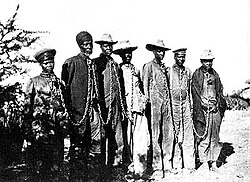
In January 1904, Samuel Maharero led a large-scale uprising against German rule. While initially successful, the tide turned when General Lothar von Trotha took command. Von Trotha issued an "annihilation order," treating the conflict as a "race war." The German military systematically drove the Herero into the desert, blocking access to watering holes to induce starvation.
The results were catastrophic. Of the roughly 80,000 Herero living in the colony at the start of German rule, only about 15,000 survived the revolt and subsequent concentration camps. Approximately 65,000 people were killed in what is recognized as one of the first genocides of the 20th century.
Cultural Identity and Traditions
Despite the trauma of the past, the Ovaherero have preserved a distinct and rich culture. Their social structure is based on a double descent system: heritage is traced through the mother's lineage (eanda), while clan leadership is inherited through the father's lineage (oruzo).
The Holy Fire
The okuruuo (Holy Fire) is a central spiritual symbol of the Herero, traditionally located at Okahandja. It serves as a connection to ancestors and a focal point for community identity.
Traditional Dress and Symbolism
The attire of the Herero is one of the most recognizable cultural markers in Africa. During the wars of 1904–1907, Herero warriors sometimes wore the uniforms of fallen German soldiers to symbolically transfer the soldiers' power to themselves.
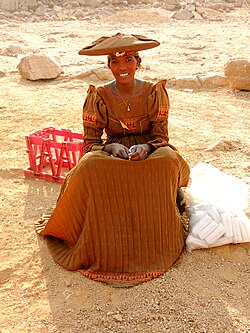
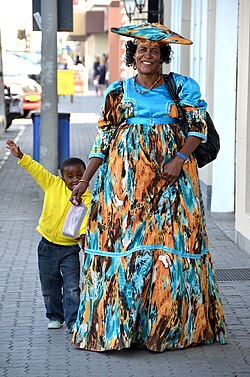
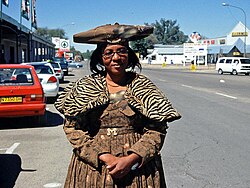
Today, this history is reflected in ceremonial dress. Men often wear military-style garb, including peaked caps and epaulettes, to honor their ancestors. Women wear voluminous, Victorian-style dresses and the otjikaiva (headgear), which often matches the dress.
Pastoralism and Livestock
Cattle remain central to Herero life, representing wealth, status, and spiritual connection. While Nguni cattle are highly prized, the Herero also keep goats, sheep, horses, and donkeys.

Summary of Herero Demographics and Culture
| Category | Details |
|---|---|
| Total Population | ~329,000 |
| Primary Locations | Namibia, Angola, Botswana |
| Language | Otjiherero |
| Social System | Double descent (Eanda and Oruzo) |
| Key Livestock | Cattle (Nguni), goats, sheep |
| Spiritual Center | The Holy Fire (Okuruuo) |
Frequently Asked Questions
What is the significance of the Herero women's dresses?
The dresses are a blend of Victorian influence and historical memory. They evolved from the colonial era and are worn today during ceremonial occasions to maintain cultural identity and honor the history of their ancestors.
What was the "annihilation order"?
The annihilation order was a decree issued by German General Lothar von Trotha in 1904, stating that every Herero found within German borders, regardless of whether they were armed, would be shot, effectively initiating a genocide.
How does the Herero double descent system work?
In this system, a person inherits their clan identity and heritage from their mother's line (eanda), but they inherit their leadership positions and certain rights from their father's line (oruzo).
Where do the Herero people live today?
The majority live in Namibia, but there are also significant populations in Angola and Botswana, as well as a small number of people in South Africa.
What is the role of the Paramount Chief?
The Paramount Chief serves as the overarching leader of the various Herero clans, a role established in 1863 to ensure unity and collective security against external threats.