German South West Africa: A History of Colonialism and Conflict
From 1884 to 1915, German South West Africa (known in German as Deutsch-Südwestafrika) served as a key colony of the German Empire. Located in the region that is now modern-day Namibia, this territory was the only German colony where European settlers arrived in significant numbers, driven by the promise of mining and farming. Its history is marked by a transition from missionary activity and merchant trade to a brutal era of colonial warfare and genocide.
Key Facts
- Duration: 1884–1915 (officially ceded in 1919).
- Capital: Windhuk.
- Key Events: The Herero and Nama genocide (1904–1908) and the 1915 occupation by the Union of South Africa.
- Demographics: In 1912, the population was approximately 250,000, with 99% being Black African.
- Infrastructure: Over 2,100 kilometers of railway were constructed using forced labor.
Early Settlements and Colonial Foundation
Before formal colonization, the region saw the arrival of the German Rhenish Missionary Society in 1840, which took over activities from the London Missionary Society. Missionaries like Franz Heinrich Kleinschmidt and Carl Hugo Hahn established churches and exerted significant influence over the local culture, dress, and politics.
The formal shift toward imperial control began on November 16, 1882, when merchant Adolf Lüderitz sought protection from Chancellor Otto von Bismarck for a planned station. His employee, Heinrich Vogelsang, purchased land from a native chief to establish a settlement at Angra Pequena, later renamed Lüderitz. Following British acquiescence and the arrival of German naval vessels, the German flag was officially raised on August 7, 1884, with claims later confirmed during the Conference of Berlin.
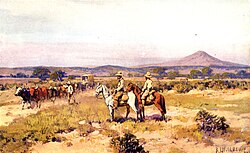
Resistance and the Herero and Nama Genocide
German rule was met with frequent resistance. Early uprisings occurred between 1893 and 1894, led by the Nama under Hendrik Witbooi. Tensions escalated due to German attempts to seize property from the Khaua-Mbandjeru people, ignoring traditional collective tribal ownership in favor of European legal views.
This friction culminated in the Herero Wars of 1904. After Herero forces attacked remote farms and killed approximately 150 settlers, Germany deployed 14,000 additional troops under Lieutenant General Lothar von Trotha. The rebellion was crushed at the Battle of Waterberg.
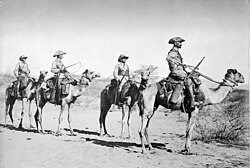
Following the Herero conflict, the Nama entered the struggle under leaders Hendrik Witbooi and Jakobus Morenga (often called "the black Napoleon"). This uprising was suppressed between 1907 and 1908. The human cost was devastating: between 25,000 and 100,000 Herero, over 10,000 Nama, and 1,749 Germans died.
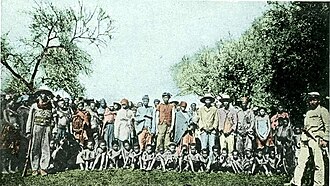
Colonial Administration and Society
The colony was governed by a series of Governors, including Theodor von Leutwein and Theodor Seitz. While the population remained overwhelmingly Black African, the German settler population grew steadily from roughly 3,000 in 1884 to over 12,000 by 1913.
Education and Media
Education was strictly segregated. The first government school in Windhuk (1894) was for white children only. By 1906, compulsory education was introduced for white children living near towns. Media was similarly restricted; newspapers like the Windhuker Anzeiger promoted settler self-governance, but the colonial government frequently suspended publications that were critical of authority.
Economic Infrastructure
The German administration focused on expanding its reach through a vast railroad network, totaling over 2,100 kilometers. These railways, such as the line from Windhoek to Swakopmund opened in 1902, were built using forced labor from the Herero and Nama peoples. This infrastructure allowed for faster transport and provided military protection to settlers within 100 kilometers of the tracks.
World War I and the End of German Rule
The outbreak of World War I brought an end to German control. On September 13, 1914, South African troops launched an assault on the Ramansdrift police station. The German Schutztruppe (colonial protection force) and Afrikaner volunteers fought primarily as a delaying tactic against the numerically superior South African forces.
On July 9, 1915, the last commander, Victor Franke, capitulated near Khorab. Although the territory was occupied in 1915, Germany did not officially cede the colony until the signing of the Treaty of Versailles on June 28, 1919.
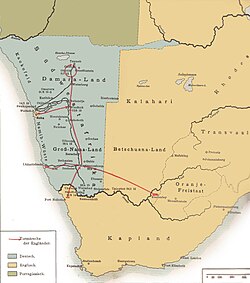
Summary of German South West Africa
| Category | Details |
|---|---|
| Official Name | Deutsch-Südwestafrika |
| Capital | Windhuk |
| Area (1912) | 835,100 km² |
| Population (1912) | 250,000 |
| Official Language | German |
| Currency | German South West African Mark |
Frequently Asked Questions
When did Germany officially lose control of South West Africa?
While the territory was captured by the Western Allies (specifically South African troops) on July 9, 1915, Germany did not officially cede the territory until the Treaty of Versailles was signed on June 28, 1919.
Who were the primary leaders of the resistance against German rule?
Key leaders included Hendrik Witbooi and Jakobus Morenga of the Nama people, as well as the leaders of the Herero people during the 1904 uprisings.
What was the Schutztruppe?
The Schutztruppe was the colonial military force used by the German Empire to maintain order and suppress rebellions within its overseas territories.
How was the colonial railroad network constructed?
The German administration built over 2,100 kilometers of railway using forced labor from the indigenous Herero and Nama populations.
What was the demographic makeup of the colony in 1912?
The population was approximately 250,000 people, consisting of 99% Black African, 0.8% White, and 0.2% other ethnic groups.