Henri Bergson: The Philosopher of Time, Intuition, and Creative Evolution
Henri Bergson (1859–1941) was a towering figure in early 20th-century thought, whose work bridged the gap between analytic philosophy (a tradition emphasizing logic and language) and continental philosophy (a tradition often focused on existence and experience). A Nobel Prize laureate in Literature, Bergson challenged the rigid scientific views of his time by proposing that life and time cannot be fully captured by mathematical formulas or static snapshots.
His influence spanned across the globe, impacting not only academic circles but also the general public, who attended his lectures at the Collège de France in vast numbers. From his early struggles with faith to his intellectual debates with Albert Einstein, Bergson's journey was one of constant movement and creativity.
Key Facts
- Nobel Prize: Awarded the Nobel Prize in Literature in 1927.
- Core Concept: Developed the theory of duration (the lived experience of time).
- Biological Theory: Introduced the élan vital (vital impetus) to explain evolution.
- Academic Career: Held prestigious chairs at the Collège de France in Greek, Roman, and Modern Philosophy.
- Major Works: Author of Time and Free Will, Matter and Memory, and Creative Evolution.
Early Life and Academic Foundation
Born in Paris during the Second French Empire, Henri-Louis Bergson received a Jewish religious education in his youth. However, between the ages of 14 and 16, he experienced a moral crisis and lost his faith. This shift was largely driven by his discovery of the theory of evolution, which suggested a common ancestry between humans and primates, removing the perceived need for a creative deity.
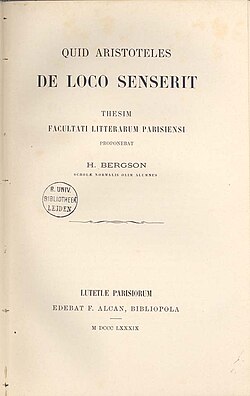
Bergson displayed an early aptitude for mathematics and science, winning prizes at the Lycée Fontanes and publishing a mathematical solution in the Nouvelles Annales de Mathématiques at age 18. Despite his teachers' preferences, he chose to pursue the humanities, entering the École Normale Supérieure at 19. He eventually earned his Ph.D. from the University of Paris in 1889 under the guidance of Paul Janet.
The Evolution of a Philosophical Giant
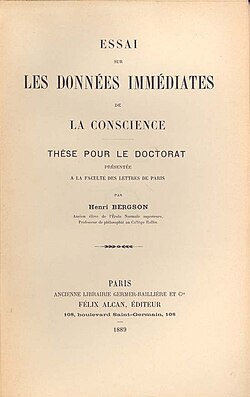
Bergson's career was defined by four principal works that evolved from the study of consciousness to the nature of the universe. His doctoral dissertation, Time and Free Will (1889), laid the groundwork for his exploration of the immediate data of consciousness.
By 1907, he published Creative Evolution, which became a global phenomenon. The book argued against a purely mechanistic view of life, suggesting that evolution is driven by a creative force. Its popularity was immense; by 1918, it had gone through 21 editions. This work established Bergson as a leader in process philosophy, which views the universe as a series of changing processes rather than static objects.
Relationship with William James
Bergson found a kindred spirit in the American philosopher William James. Meeting in London in 1908, the two formed a deep friendship based on their mutual interest in psychology and the limits of intellectualism. James was instrumental in introducing Bergson's work to the English-speaking world, encouraging the first English translation of Creative Evolution.
The Debate with Albert Einstein
In 1922, Bergson entered a high-profile intellectual clash with Albert Einstein regarding the nature of time. In his book Duration and Simultaneity, Bergson argued that the mathematical time used in Einstein's theory of relativity differed from the lived experience of time. While some critics argued Bergson lacked sufficient physics knowledge, others, like Maurice Merleau-Ponty, suggested that Einstein failed to grasp the philosophical nuances of Bergson's argument.
Core Philosophical Concepts
Bergson's philosophy centers on the tension between the intellect and intuition. He believed that the intellect is a tool for action and manipulation, which tends to "freeze" reality into discrete parts. In contrast, intuition allows us to enter into the flow of an object or experience to understand its true essence.
- Duration: The idea that time is a continuous flow that cannot be divided into separate units (like seconds or minutes) without losing its essence.
- Élan Vital: The "vital impetus" or creative force that drives biological evolution and the development of complexity in nature.
- Immediate Data of Consciousness: The raw, unfiltered experience of the mind before it is processed by the intellect.
Summary of Major Works
| Year | Title (English) | Key Focus |
|---|---|---|
| 1889 | Time and Free Will | Immediate data of consciousness and duration |
| 1896 | Matter and Memory | The relationship between perception and recollection |
| 1907 | Creative Evolution | The élan vital and the nature of biological change |
| 1932 | The Two Sources of Morality and Religion | The distinction between closed and open societies |
Frequently Asked Questions
What is the "élan vital"?
The élan vital, or "vital impetus," is Bergson's theory that a creative force drives the evolution of living organisms, pushing them toward greater complexity and unpredictability, rather than following a predetermined mechanical path.
How did Bergson define "duration"?
Duration is the lived experience of time as a continuous, indivisible flow. Bergson argued that while science treats time as a series of points on a line (spatialized time), true duration is a qualitative experience where the past flows into the present.
Why did Bergson and Einstein disagree?
Their disagreement centered on whether time is a physical dimension that can be measured mathematically (Einstein's view) or a psychological and metaphysical flow that transcends such measurements (Bergson's view).
What was Bergson's view on intuition?
Bergson believed intuition was a method of knowing that allows a person to grasp the essence of a thing by coinciding with it, as opposed to the intellect, which analyzes things from the outside by breaking them into parts.
What is the significance of the "open society" in his work?
In his later work, Bergson discussed the "open society" as a dynamic form of social organization that is capable of growth, creativity, and the integration of new moral impulses, contrasting it with the static nature of "closed societies."