Critique of Pure Reason: Immanuel Kant's Investigation into Metaphysics
Published in 1781 by Johann Friedrich Hartknoch in Riga, the Critique of Pure Reason (German: Kritik der reinen Vernunft) stands as one of the most influential works in the history of philosophy. Written by the German philosopher Immanuel Kant, this seminal text—often called the "First Critique"—was designed to determine the limits and scope of metaphysics.
Kant's primary objective was to examine the faculty of reason in general, specifically regarding knowledge that the mind strives for independently of all experience. By doing so, he sought to decide whether metaphysics, as a science, was even possible.
Key Facts
- Author: Immanuel Kant.
- First Published: 1781 (Second edition in 1787).
- Core Goal: To establish the boundaries of human reason and the possibility of metaphysics.
- Key Distinction: The difference between phenomena (things as they appear) and noumena (things-in-themselves).
- Philosophical Position: Transcendental Idealism.
- Successor Works: Followed by the Critique of Practical Reason (1788) and the Critique of Judgment (1790).
Foundational Concepts
To understand the Critique of Pure Reason, one must first grasp the technical distinctions Kant employs to describe how we acquire knowledge.
A Priori vs. A Posteriori
Kant distinguishes between a priori knowledge, which is independent of all experience (such as mathematical truths), and a posteriori knowledge, which is derived from sensory experience.
Analytic vs. Synthetic Judgments
An analytic judgment is one where the predicate is already contained within the concept of the subject. A synthetic judgment, however, adds new information to the subject. Kant's revolutionary contribution was the proposal of synthetic a priori judgments—claims that are necessarily true but also provide new information about the world.
Transcendental Idealism
Kant proposed transcendental idealism to bridge the gap between rationalism and empiricism. He argued that while we can know phenomena (objects as they are perceived through our senses and processed by our minds), we can never know the noumena (the thing-in-itself, or the object as it exists independently of our perception).

Structure of the Critique
The work is divided into two primary doctrines: the Transcendental Doctrine of Elements and the Transcendental Doctrine of Method.
Transcendental Doctrine of Elements
This section is further split into the Transcendental Aesthetic and the Transcendental Logic.
- Transcendental Aesthetic: Focuses on the conditions of sensibility, specifically space and time, which Kant argues are not external realities but the inherent forms of human intuition.
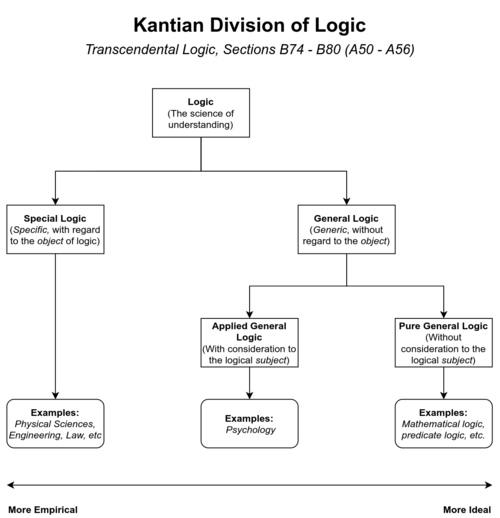
- Transcendental Logic: Examines the understanding. It is divided into the Transcendental Analytic (how we use concepts to organize experience) and the Transcendental Dialectic (the illusions that occur when reason attempts to go beyond experience).
The Categories of Understanding
Kant identifies specific categories that the mind uses to process sensory data. These are organized by the function of thought in judgment:
| Function of Thought | Logical Forms | Categories | Principles of Understanding |
|---|---|---|---|
| Quantity | Universal, Particular, Singular | Unity, Plurality, Totality | Axioms of Intuition |
| Quality | Affirmative, Negative, Infinite | Reality, Negation, Limitation | Anticipations of Perception |
| Relation | Categorical, Hypothetical, Disjunctive | Inherence/Subsistence, Causality/Dependence, Community | Analogies of Experience |
| Modality | Problematic, Assertoric, Apodeictic | Possibility, Existence, Necessity | Postulates of Empirical Thought |
The Transcendental Dialectic and Illusions
In the Transcendental Dialectic, Kant addresses the "Transcendental Illusion," where reason attempts to apply categories to things that cannot be experienced. This leads to several logical fallacies:
- Paralogisms: Errors in reasoning regarding the soul (e.g., the mistaken belief that the soul is a simple, immortal substance).
- Antinomies: Contradictions that arise when reason tries to determine the nature of the universe (e.g., whether the world has a beginning in time).
- The Ideal: The attempt to prove the existence of God through ontological or cosmological proofs, which Kant refutes.
Transcendental Doctrine of Method
The final portion of the work focuses on the application of these findings. It includes the Discipline, Canon, Architectonic, and History of Pure Reason, guiding the reader on how to properly employ reason without falling into metaphysical error.
Frequently Asked Questions
What is the difference between phenomena and noumena?
Phenomena are the objects of our experience—things as they appear to us through the filters of space, time, and the categories of understanding. Noumena are the "things-in-themselves," the reality that exists independently of our perception, which Kant argues is fundamentally unknowable.
What are synthetic a priori judgments?
These are statements that are necessarily true (a priori) but also expand our knowledge by adding a predicate to a subject that was not already contained within it (synthetic). Kant believed these were the foundation of mathematics and natural science.
How does Kant refute the ontological proof of God's existence?
Kant argues that "existence" is not a real predicate. Adding "exists" to the concept of a being does not change the essence or the definition of that being; therefore, one cannot prove existence simply by analyzing a concept.
What is the purpose of the Refutation of Idealism?
Kant intended this section to distance his transcendental idealism from subjective idealism. He argues that the existence of external objects is a necessary precondition for our own internal experience of time and self-consciousness.