Hemichordates: The Evolutionary Bridge Between Invertebrates and Chordates
Hemichordates are a phylum of marine worms that provide critical insights into the evolution of complex animal life. As members of the Ambulacraria clade—alongside echinoderms—they are the closest living relatives to the chordates (the group including vertebrates). By studying these organisms, scientists can better understand how the fundamental body plans of higher animals first emerged.
The phylum is primarily divided into two distinct classes: the Enteropneusta, commonly known as acorn worms, and the Pterobranchia, which include the graptolites. While these two groups appear morphologically different, the discovery of the stem group hemichordate Gyaltsenglossus suggests that early members of the phylum combined characteristics of both classes.
Key Facts
- Phylogenetic Position: Closest extant relatives of chordates within the superphylum Deuterostomia.
- Diversity: Approximately 120 to 130 described species, with many more being discovered in the deep sea.
- Temporal Range: Present from the Miaolingian period to the present day.
- Core Classes: Enteropneusta (acorn worms) and Pterobranchia (including graptolites).
- Development: Can occur via direct development or indirect development involving a plankton-feeding tornaria larva.
Anatomy and Physiological Systems
Nervous System
In adult enteropneusts, the nervous system is organized into several key components: a basiepidermal nerve net, a dorsal nerve cord, a ventral nerve cord, a prebranchial nerve ring, and an apical ganglion.
Circulatory and Respiratory Systems
Hemichordates possess an open circulatory system, meaning they lack capillaries. In the Enteropneusta class, blood flows into the glomerulus—a vascular complex located on either side of the anterior stomochord—where excretion takes place.
Respiration is handled by several pairs of gill slits located dorsally on the trunk. These slits are housed within the branchial portion of the pharynx. In species such as Balanoglossus, each slit opens into an atrial chamber or gill-pouch where gaseous exchange occurs before exiting through gill pores on the dorsal region.
![Anatomy of Saccoglossus kowalevskii[9]](/images/59/ba/59ba1f1ecb9277732cd8e71d942af9fbbfabb2837ba744b1a45a847792e3a4cb.webp)
Embryonic Development
Hemichordates are of immense interest to biologists because their development mirrors early chordate evolution. They employ two primary strategies: direct development and indirect development. Indirect development is characterized by a pelagic plankotrophic tornaria larval stage, where the organism feeds on plankton before maturing into an adult worm.
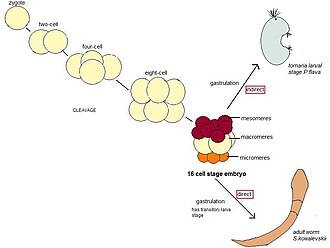
Indirect Development: Ptychodera flava
Ptychodera flava serves as a primary model for indirect development. Its early cleavage begins with equal, orthogonal divisions of the zygote. By the 16-cell stage, the embryo consists of four vegetal micromeres, eight animal mesomeres, and four larger macromeres. The mesomeres eventually form the larva's ectoderm, while the micromeres develop into internal endomesodermal tissues.
Direct Development: Saccoglossus kowalevskii
In contrast, Saccoglossus kowalevskii develops directly. Its eggs are oval and become spherical after fertilization. The cleavage process progresses through a series of divisions—from the 8-cell stage to a 128-cell blastula. This structure then undergoes gastrulation to form a gill slit larva, which eventually matures into a marine acorn worm.
Genetic Control and Patterning
Research into S. kowalevskii has revealed genetic markers homologous to those found in chordates. For example, it utilizes bmp 2/4 (a dorsalizing factor) and its antagonist, chordin, to establish the dorsal-ventral axis during gastrulation. While it also possesses netrin (essential for neural patterning in chordates), its Shh (sonic hedgehog) gene is expressed in regions that differ from the ventral midline expression seen in developing chordates.
Classification and Phylogeny
The phylum Hemichordata is categorized into three proposed classes: Enteropneusta, Pterobranchia, and Planctosphaeroidea (the latter based on a single larval species). Current evidence suggests that Pterobranchia may have evolved from within Enteropneusta, which would make Enteropneusta paraphyletic.
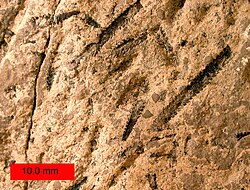
Historically, the group includes extinct organisms like the graptolites, which were prominent during the Ordovician period.
| Feature | Enteropneusta | Pterobranchia |
|---|---|---|
| Common Name | Acorn Worms | Includes Graptolites |
| Development | Direct or Indirect (Tornaria) | Indirect |
| Habitat | Marine (often burrowing) | Marine (often colonial) |
| Circulation | Open (with glomerulus) | Open |
Frequently Asked Questions
What is the relationship between hemichordates and chordates?
Hemichordates are part of the Ambulacraria clade and are the closest living phylogenetic relatives to chordates, sharing a common ancestor within the superphylum Deuterostomia.
What is a tornaria larva?
A tornaria larva is a plankton-feeding (plankotrophic) larval stage found in hemichordates that undergo indirect development.
How do hemichordates breathe?
They breathe through several pairs of gill slits located on the dorsal side of the trunk, where gaseous exchange occurs within gill-pouches.
What are the two main classes of hemichordates?
The two main classes are Enteropneusta (acorn worms) and Pterobranchia (which includes the extinct graptolites).
Do hemichordates have a closed circulatory system?
No, hemichordates have an open circulatory system, which means their blood flows through open spaces rather than being entirely contained within capillaries.