Chordates: The Evolutionary Journey of Animals with Notochords
From the smallest translucent sea creatures to the massive blue whale, the phylum Chordata encompasses some of the most diverse and complex life forms on Earth. Defined by a unique set of anatomical features, chordates represent a significant branch of the animal kingdom, evolving over 525 million years to dominate nearly every habitat on the planet.
At its core, the name "chordate" is derived from the notochord, a flexible, rod-like structure that provides primary support for the body. This feature is one of several synapomorphies—shared derived characteristics—that define the group. Chordates are characterized by bilateral symmetry, a coelom (a fluid-filled body cavity), a closed circulatory system, and metameric segmentation.

Key Facts
- Temporal Range: Present from the Cambrian period to the present (approximately 525–0 Ma).
- Defining Feature: The notochord, which plays a critical role in body structuring and movement.
- Broad Diversity: Includes over 66,100 species of vertebrates, 3,000 species of tunicates, and 32 species of lancelets.
- Lineage: Chordates are members of the Deuterostomia superphylum, a group where the first opening in the embryo becomes the anus rather than the mouth.
Anatomy and Body Plan
The chordate body plan is built around several key structural elements. While these may be modified or lost in adult stages of some species, they are fundamental to the phylum's identity. These include an encephallic bulge (the beginning of a brain), a mouth opening, light sensors, and a post-anal tail.
In most vertebrates, the notochord is replaced during development by a bony or cartilaginous vertebral column. However, some species maintain a visible backbone that houses the spinal cord.
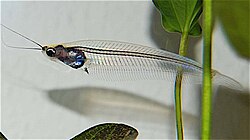
Classification of Chordates
The phylum Chordata is divided into three primary subphyla, ranging from simple filter-feeders to complex land-dwelling mammals.
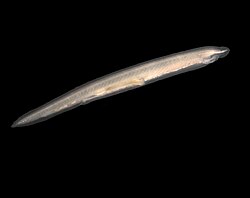
Cephalochordata (Lancelets)
Consisting of only 32 species, lancelets are small, fish-like creatures that retain the notochord throughout their entire lives. They serve as a foundational example of the chordate body plan.
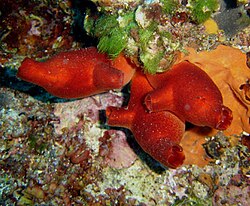
Tunicata (Urochordata)
Tunicates, including sea squirts, comprise about 3,000 species. Many of these animals lose their notochord and tail as they transition from a mobile larval stage to a sessile (stationary) adult stage.
Vertebrata (Craniata)
The largest group with over 66,100 species, vertebrates are defined by having a cranium (skull) and usually a vertebral column. This group is further divided into:
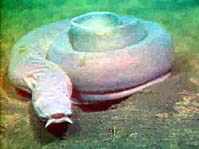
- Agnatha: Jawless vertebrates, such as hagfish and lampreys.
- Gnathostomata: Jawed vertebrates, which include cartilaginous fish (sharks), bony fish, and tetrapods.
- Tetrapoda: Four-limbed vertebrates, encompassing amphibians, reptiles, birds, and mammals.
Evolutionary History and Phylogeny
The evolutionary split between protostomes and deuterostomes likely occurred at least 558 million years ago, well before the start of the Cambrian period. Some of the oldest evidence of the chordate lineage comes from Ediacaran fossils such as Ausia fenestrata and Burykhia hunti, which may be early tunicates dating back 555 to 548 million years.
Early Cambrian fossils like Haikouichthys ercaicunensis provide a glimpse into the earliest known fish, appearing around 518 million years ago in China.
![Haikouichthys ercaicunensis, from around 518 million years ago in China, may be the earliest known fish[42]](/images/ae/5d/ae5d06aff8ca7754e900fc695967a732054f7ac5bc430f0e9ddda14711c984ce.png)
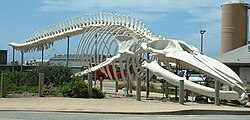
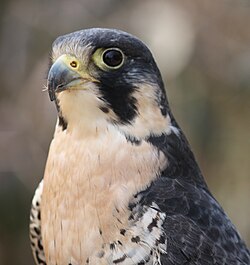
Over millions of years, chordates evolved extreme specializations. This is evident in the blue whale, the largest animal ever discovered, and the peregrine falcon, the world's fastest animal.
Chordate Diversity Summary
| Subphylum | Common Examples | Approx. Species Count | Key Characteristic |
|---|---|---|---|
| Cephalochordata | Lancelets | 32 | Notochord persists throughout life |
| Tunicata | Sea Squirts, Salps | 3,000 | Notochord often lost in adulthood |
| Vertebrata | Fish, Mammals, Birds | 66,100+ | Possess a cranium and usually a backbone |
Closest Non-Chordate Relatives
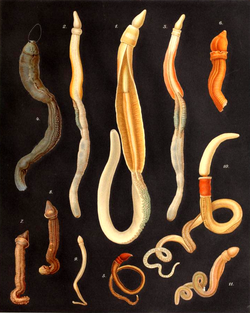
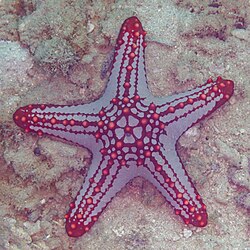
Chordates are closely related to other deuterostomes. Hemichordates, such as acorn worms, and Echinoderms, such as sea stars, share a common evolutionary ancestry with chordates.
Frequently Asked Questions
What is a notochord?
A notochord is a flexible, rod-like structure that provides skeletal support. It is the defining characteristic of all chordates and, in vertebrates, is typically replaced by the spinal column during development.
Are all chordates vertebrates?
No. While all vertebrates are chordates, not all chordates are vertebrates. Lancelets (Cephalochordata) and tunicates (Tunicata) are chordates that do not possess a bony vertebral column.
When did chordates first appear?
The chordate lineage is believed to have emerged during the Ediacaran period, with some potential evidence dating back to 555–548 million years ago, though they became more prominent during the Cambrian period.
What is the difference between a protostome and a deuterostome?
The difference lies in embryonic development. In protostomes, the first opening (blastopore) becomes the mouth; in deuterostomes, which include chordates, the first opening becomes the anus.
Which is the largest animal in the phylum Chordata?
The blue whale is the largest animal ever discovered in this phylum, with recorded lengths reaching up to 98 feet (30 meters).