Hebrew Union College: A History of Reform Jewish Education
Founded in 1875 in Cincinnati, Hebrew Union College (HUC) stands as a cornerstone of Reform Jewish education. Established under the leadership of Rabbi Isaac Mayer Wise, the institution was designed to provide a rigorous academic and spiritual foundation for those entering the rabbinate. From its early days in Ohio to its expansion into a global network of campuses, HUC has played a pivotal role in shaping the landscape of modern Judaism.
Founding and the Controversial Trefa Banquet
The early years of the college were marked by the administrative guidance of Jacob Ezekiel, who served as the Secretary of the Board, registrar, and treasurer from the college's inception until 1899. The institution reached a major milestone in 1883 with the graduation of its first rabbinical class.
However, the celebration of this first graduating class became a defining moment in Jewish history. The graduation banquet, later known as the Trefa Banquet, served food that was not kosher (non-compliant with Jewish dietary laws), including shrimp, clams, soft-shell crabs, frogs' legs, and dairy products served immediately after meat. This event highlighted a deep divide among Reform rabbis regarding the applicability of traditional dietary restrictions. The controversy led some traditionalist Reform rabbis to seek a middle ground between Reform and Orthodox Judaism, ultimately resulting in the founding of American Conservative Judaism.
Global Expansion and Campus Evolution
Over the following decades, Hebrew Union College expanded its reach to accommodate a growing international student body. In 1950, the college merged with the Reform Jewish Institute of Religion in New York, which had previously been affiliated with the Stephen Wise Free Synagogue. This merger provided HUC with its second campus.
The institution continued to grow with the addition of a campus in Los Angeles in 1954 and a campus in Jerusalem in 1963. In New York, the college moved its operations to 1 West Fourth Street in Greenwich Village in 1979.
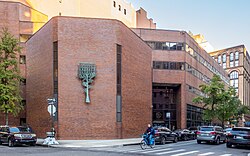
Recent years have seen significant changes to the New York real estate. In January 2025, HUC sold the West 4th Street building to New York University for $75 million. The college plans to vacate the property by 2027. To replace this facility, HUC acquired the First Battery Armory in February 2025, which will undergo renovations to serve as the new Manhattan location by 2027.
Academic Programs and Partnerships
Today, Hebrew Union College operates as an international seminary and graduate school. While it is most famous for its Rabbinical School, it offers a diverse array of professional and academic programs, including:
- Schools of Graduate Studies and Education
- Jewish Non-Profit Management
- Sacred Music
- Biblical archaeology
- An Israeli rabbinical program
In Los Angeles, the college maintains a strong 50-year collaboration with the University of Southern California (USC). This partnership led to the creation of the Center for Muslim-Jewish Engagement (CMJE), an interfaith think tank supported by HUC, USC, and the Omar Foundation, which conducts religious text-study programs throughout the city.
Leadership and Social Milestones
The college has been led by a series of influential presidents who steered the institution through eras of social change. Rabbi Alfred Gottschalk, the sixth president, oversaw several historic "firsts," including the ordination of Sally Priesand as the first female rabbi in the United States, the investiture of the first female hazzan (cantor) in Reform Judaism, and the ordination of Naamah Kelman as the first female rabbi in Israel.
Subsequent leadership included Rabbi Sheldon Zimmerman (7th President, appointed 1996) and Rabbi David Ellenson (8th President, appointed 2000). Rabbi Aaron D. Panken, a scholar of rabbinic and Second Temple literature, served as the 9th president starting in 2014 until his untimely death in a plane crash on May 5, 2018. Andrew Rehfeld was elected as the 10th president on December 18, 2018, and was inaugurated at Plum Street Temple in October 2019.
Continuing its tradition of evolution, HUC granted its first certificate of ordination to a nonbinary candidate in 2022. However, the college also faced challenges; in April 2022, the Board of Governors voted to close the residential rabbinical program in Cincinnati by 2026 due to falling enrollment and financial difficulties.
Key Facts
- Founded: 1875 in Cincinnati by Rabbi Isaac Mayer Wise.
- Campuses: Cincinnati, New York, Los Angeles, and Jerusalem.
- Historic Firsts: Ordained the first female rabbi in the US (Sally Priesand) and the first female rabbi in Israel (Naamah Kelman).
- Recent Real Estate: Sold the West 4th Street campus to NYU for $75 million in 2025; acquired the First Battery Armory.
- Interfaith Work: Partners with USC and the Omar Foundation for the Center for Muslim-Jewish Engagement.
| President | Order | Key Notes/Dates |
|---|---|---|
| Alfred Gottschalk | 6th | Ordination of first female US rabbi |
| Sheldon Zimmerman | 7th | Appointed 1996 |
| David Ellenson | 8th | Appointed 2000 |
| Aaron D. Panken | 9th | Elected 2014; died in office 2018 |
| Andrew Rehfeld | 10th | Elected 2018; inaugurated 2019 |
Frequently Asked Questions
What was the Trefa Banquet?
The Trefa Banquet was a 1883 graduation dinner for HUC's first rabbinical class. It served non-kosher foods, sparking a theological debate over dietary laws that contributed to the birth of American Conservative Judaism.
Who was the first woman ordained as a rabbi in the US?
Sally Priesand was the first woman ordained as a rabbi in the United States, a milestone that occurred during the presidency of Rabbi Alfred Gottschalk.
Where is the New York campus moving?
HUC sold its West 4th Street property to NYU in 2025 and acquired the First Battery Armory, which will serve as the new Manhattan location following renovations completed by 2027.
What is the relationship between HUC and USC?
HUC and the University of Southern California have a 50-year collaboration, which includes joint degrees and the creation of the Center for Muslim-Jewish Engagement (CMJE).
Is the Cincinnati residential program continuing?
No, the Board of Governors voted in 2022 to shutter the residential rabbinical program in Cincinnati by 2026 due to financial issues and declining enrollment.