Judaism and Same-Sex Marriage Across Different Branches
The Jewish faith is not a monolith, but a collection of diverse movements with varying interpretations of halacha (Jewish law) and tradition. One of the most significant areas of divergence among these branches is the approach to same-sex relationships and marriage. While some movements adhere strictly to traditional prohibitions, others have evolved to fully embrace and sanctify same-sex unions.
Key Facts
- Orthodox Judaism generally maintains traditional bans on same-sex marriage, though some individual rabbis dissent.
- Conservative Judaism formally approves of same-sex marriage ceremonies as of 2012.
- Reform Judaism supports same-sex civil marriage and allows rabbis to perform rituals of union.
- Reconstructionist Judaism has supported same-sex marriage and full LGBTQ inclusion since 1992.
- The term kiddushin (holy union) is often a point of theological debate due to its gender-specific traditional language.
Orthodox Judaism: Traditional Adherence
Orthodox Judaism maintains traditional bans on both marriage and sexual acts between members of the same sex. This stance is reflected in the actions of major organizations; for example, the Orthodox Union in the United States supported a federal Constitutional amendment to ban same-sex marriage, and the Organisation of Rabbis Australasia (ORA) has publicly opposed the legalization of such marriages in Australia.
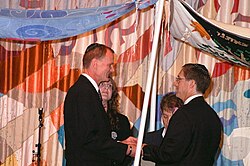
However, the movement is not entirely without internal debate. Rabbi Steven Greenberg has argued that a new interpretation of halacha is necessary to be more accepting of homosexual individuals. In November 2011, Rabbi Greenberg became the first rabbi to officiate a same-sex wedding that received legal recognition from the local government.
Conservative Judaism: A Shift in Policy
The American branch of Conservative Judaism has undergone a significant evolution regarding same-sex unions. In December 2006, the Law Committee of Conservative Judaism prohibited same-sex marriage but permitted rabbis to perform commitment ceremonies.
This position changed in June 2012, when the Committee of Jewish Law and Standards voted 13 to 0 (with one abstention) to formally approve same-sex marriage ceremonies. The committee developed two separate service guides for rabbis. Notably, these services avoid the language and symbols of kiddushin (the legal Hebrew term for "holy union") because the term is gender-specific. Despite this official ruling, some Conservative synagogues still only permit commitment ceremonies, citing a belief that scripture requires monogamy for all sexually active couples.
Reform Judaism: Progressive Affirmation
Reform Judaism has moved steadily toward full inclusion over several decades. In 1996, the Central Conference of American Rabbis (CCAR) passed a resolution approving same-sex civil marriage, though it initially distinguished civil marriage from religious marriage, stating that the elements of qiddushin (sanctification) could not be applied to same-sex relationships.
By 1998, a CCAR ad hoc committee on Human Sexuality reported that holiness could indeed be present in committed same-gender relationships, which can serve as the foundation for stable Jewish families. This led to a 2000 resolution stating that same-gender relationships are worthy of affirmation through Jewish ritual, while respecting the individual choice of rabbis to either officiate or decline.
The movement's commitment to inclusion expanded in 2003 to explicitly include bisexual and transgender communities. This progress is evident in liturgical changes; the 2015 prayer book Mishkan HaNefesh replaced references to a "bride and groom" with "couples under the chuppah" (wedding canopy) and introduced the gender-neutral term mibeit ("from the house of") for calling worshipers to the Torah.
Institutional Support and Advocacy
Reform Judaism has also integrated these values into education and law. The Hebrew Union College-Jewish Institute of Religion established the Institute for Judaism, Sexual Orientation & Gender Identity to combat homophobia. Furthermore, in 2014, the CCAR joined a lawsuit against North Carolina's ban on same-sex marriage, marking the first faith-based challenge to such bans in the United States.
Reconstructionist Judaism: Early Adoption
Reconstructionist Judaism has been among the most proactive branches in its support for LGBTQ rights. Since the 1992 Report of the Reconstructionist Commission on Homosexuality, the movement has supported same-sex marriage and the full inclusion of gay and lesbian people in all aspects of Jewish life.
While the Jewish Reconstructionist Federation leaves the final decision to officiate to individual rabbis, the procedure is officially included in the Reconstructionist Rabbi's Manual. Unlike some other branches, many Reconstructionist rabbis choose to use the traditional language and symbols of kiddushin for same-sex weddings.
Comparison of Jewish Branches on Same-Sex Marriage
| Branch | Official Stance | Use of Kiddushin | Key Milestone |
|---|---|---|---|
| Orthodox | Generally Prohibited | No | Individual dissenters (e.g., Rabbi Greenberg) |
| Conservative | Approved (since 2012) | Avoided (gender-specific) | 2012 Committee vote (13-0-1) |
| Reform | Affirmed/Supported | Adapted/Inclusive | 2000 resolution on ritual affirmation |
| Reconstructionist | Fully Supported | Often Used | 1992 Commission Report |
Frequently Asked Questions
What is kiddushin and why is it controversial in same-sex marriage?
Kiddushin is the Hebrew term for "holy union" and the legal term for marriage in traditional Jewish law. It is controversial in the context of same-sex marriage because the traditional language and legal frameworks associated with it are gender-specific, leading some branches to create new rituals instead.
Does every Reform rabbi perform same-sex weddings?
No. While the CCAR recognizes that same-gender relationships are worthy of affirmation, it explicitly supports the diversity of opinion within its ranks, leaving the decision to officiate up to the individual rabbi.
When did Conservative Judaism change its stance on same-sex marriage?
The shift occurred in June 2012, when the Committee of Jewish Law and Standards voted to reverse a 2006 ruling that had previously prohibited same-sex marriage while allowing commitment ceremonies.
How has Reform Judaism updated its liturgy for LGBTQ inclusion?
The 2015 prayer book Mishkan HaNefesh updated language to refer to "couples under the chuppah" rather than specifically a "bride and groom," and introduced the gender-neutral term mibeit for Torah readings.
Which branch of Judaism was among the first to support same-sex marriage?
Reconstructionist Judaism expressed its support for same-sex marriages and the full inclusion of gay and lesbian people as early as 1992.