Hans Holbein the Younger and the Court of Henry VIII
Between 1532 and 1543, the artistic landscape of the English court was profoundly shaped by the presence of Hans Holbein the Younger. Arriving from Basel during a period of intense religious turmoil, Holbein sought a sanctuary for artistic expression amidst iconoclasm—the deliberate destruction of religious images—which was then sweeping through his home city.
Holbein's ascent to the royal court was not accidental. His reputation had already been established through high-profile works, including the 1527 portrait of Sir Thomas More and various depictions of Lutheran merchants. A pivotal commission in 1533, created during the procession of Anne Boleyn, ultimately secured his position within the inner circle of the monarchy.
The King's Painter and Royal Propaganda
Recognized as "the King's Painter" by the court poet Nicholas Bourbon, Holbein's work served a purpose far beyond mere aesthetics. His portraits were strategically utilized as propaganda, designed to rehabilitate Henry VIII's public image and elevate his status during the scandals surrounding the establishment of the Church of England.
Throughout his tenure, Holbein documented the most significant milestones of the Tudor dynasty. This included the now-lost Whitehall Mural of 1537, which commemorated the birth of Edward VI. Many of these royal commissions, which often captured the King's various marriages, were coordinated through the influence of Thomas Cromwell.
Analyzing the Portrait of Henry VIII (1540)
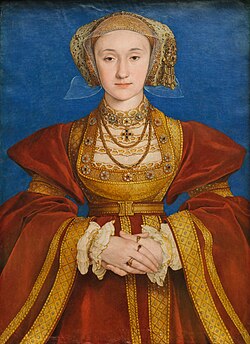
Following Henry's marriage to his fourth wife, Anne of Cleves, in January 1540, Holbein was commissioned to create an official portrait that projected the King's absolute authority. Rather than relying on traditional symbols of royalty like a crown or sceptre, Holbein used subtle but powerful cues to convey power.
In this work, Henry is depicted holding a glove in one hand and gripping the hilt of his sword with the other. By utilizing a smaller canvas to increase the visual coverage of the King's body and emphasizing his lavish clothing and jewelry, Holbein highlighted Henry's imposing physical size and commanding presence.
The painting includes the Latin inscription ANNO ÆTATIS SVÆ XLIX, which dates the work to 1540, the year Henry turned 49.
Key Facts
- Tenure: Holbein served in the court of Henry VIII from 1532 until his death in 1543.
- Purpose: His portraits functioned as political propaganda to support the King during the English Reformation.
- Key Works: Notable commissions include the Portrait of Sir Thomas More (1527) and the lost Whitehall Mural (1537).
- Symbolism: In his 1540 portrait of Henry VIII, authority is signaled via a sword-hilt and glove rather than a crown.
- Coordination: Many of Holbein's royal projects were organized by Thomas Cromwell.
| Period/Year | Key Event or Work | Significance |
|---|---|---|
| 1527 | Portrait of Sir Thomas More | Established Holbein's early reputation. |
| 1532–1543 | Court Painter to Henry VIII | Created propaganda for the Church of England. |
| 1537 | Whitehall Mural | Commemorated the birth of Edward VI (now lost). |
| 1540 | Portrait of Henry VIII | Projected authority following marriage to Anne of Cleves. |
Frequently Asked Questions
Why did Holbein leave Basel for the English court?
Holbein sought a way to continue his artistic expression during a time of iconoclasm in Basel, where religious imagery was being systematically destroyed.
How did Holbein's art help Henry VIII politically?
His portraits were used as propaganda to elevate the King's image and rehabilitate his reputation amidst the scandals of the Reformation and the creation of the Church of England.
What is the significance of the inscription "ANNO ÆTATIS SVÆ XLIX"?
This Latin phrase indicates the age of the subject, dating the portrait of Henry VIII to 1540, when the King was 49 years old.
Who helped coordinate Holbein's royal commissions?
Many of the commissions documenting the King's life events and marriages were coordinated by Thomas Cromwell.
What symbols of power did Holbein use in the 1540 portrait?
Instead of a crown or sceptre, Holbein emphasized Henry's authority through his imposing physical size, rich jewelry, clothing, a glove, and the hilt of a sword.