Hans Holbein the Younger: Analysis of the 1541 Portrait of a Man
Among the masterpieces of the Northern Renaissance, the portraits of Hans Holbein the Younger are celebrated for their psychological depth and meticulous detail. One of the finest examples from his later years is the 1541 portrait of an unidentified man, currently housed in the Galleria Regionale della Sicilia in Palermo. This work exemplifies Holbein's ability to capture both the physical presence and the inner spirit of his subjects through a refined, half-length composition.
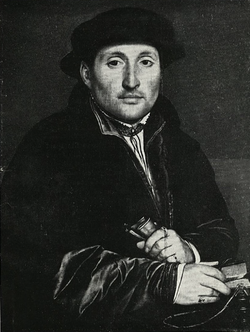
The subject is depicted seated at a table, his body turned slightly to the right while his gaze meets the spectator directly. This direct engagement creates a sense of immediacy and presence, reminiscent of Holbein's 1533 portrait of Derek Born. The man's grey-blue eyes are particularly striking, possessing a visionary, far-seeing expression rendered with extraordinary subtlety and vividness.
Key Facts
- Artist: Hans Holbein the Younger.
- Date: 1541.
- Sitter's Age: 28 years old.
- Location: Galleria Regionale della Sicilia, Palermo.
- Composition: Half-length figure, less than life-size.
Detailed Visual Analysis
Attire and Accessories
The sitter's clothing reflects the high fashion and status of the 16th century. He wears a brown silk doublet topped with a black cloak featuring a deep collar and a brown fur lining. His head is covered by a black brimmed cap that almost entirely conceals his hair. A notable detail is the collar of his white shirt, which features blackwork—a style of linear embroidery using black silk thread on white linen—tied with black laces.
The man's accessories further suggest a person of education and means. In his left hand, he holds grey gloves, and on his left index finger, he wears a ring featuring an intaglio (an engraved gemstone). His right hand rests upon a green cloth covering the table, with the forefinger marking a place within a gilt-edged book. Beside the book sits an inkstand with a red cord.
Setting and Composition
The background is divided into two distinct sections: a blue-grey wall on the upper portion and wooden panelling below. At head height, a gold inscription provides critical biographical data: ANNO·DÑI·1541· // · ETATIS · SVÆ · 28, confirming the painting was completed in 1541 when the sitter was 28 years old.
Artistic Influence and Identity
Recurring Holbein Motifs
This portrait demonstrates Holbein's tendency to reuse successful visual elements from his previous works. The wooden panelling, the presence of a book, and the green table cloth are all motifs previously seen in his portrait of Thomas Cromwell (1532–33). Additionally, the positioning of the sitter's right hand mirrors that of Hermann von Wedigh (1532), while the gloves, the ring, and the specific shape of the ear echo an Unknown Gentleman painted around 1540.
The Mystery of the Sitter
Despite the precision of the portrait, the identity of the man remains a subject of scholarly debate. Art historian Paul Ganz suggested the man might have been a German merchant, possibly associated with the Steelyard (the headquarters of the Hanseatic League) in London. However, other scholars, including John Rowlands, argue that he could just as easily have been English. The absence of a merchant's mark or a coat of arms leaves his exact identity an open question.
| Feature | Description |
|---|---|
| Clothing | Brown silk doublet, black fur-lined cloak, blackwork shirt collar |
| Objects | Gilt-edged book, inkstand, grey gloves, intaglio ring |
| Background | Blue-grey wall with wooden panelling |
| Inscription | Year 1541; Age 28 |
Frequently Asked Questions
Who is the man in the 1541 portrait?
His identity is unknown. While Paul Ganz proposed he was a German merchant from the Steelyard in London, John Rowlands and other experts suggest he may have been English.
What does the inscription in the painting mean?
The gold inscription "ANNO·DÑI·1541· // · ETATIS · SVÆ · 28" indicates that the painting was created in the year of our Lord 1541 and that the sitter was 28 years old at the time.
What is "blackwork" in the context of this painting?
Blackwork refers to the specific style of embroidery on the sitter's white shirt collar, characterized by black silk thread patterns on a white background.
Which other Holbein works influenced this painting?
Holbein reused motifs from the portrait of Thomas Cromwell (wood panelling, book, and green cloth), the portrait of Hermann von Wedigh (the right hand), and an Unknown Gentleman from c. 1540 (the ring, gloves, and ear shape).