Hans-Dietrich Kinkel: A Legacy of German Diplomacy and Justice
Hans-Dietrich Kinkel stands as a pivotal figure in Germany's post-Cold War political landscape. Serving in high-ranking roles including Federal Minister of Justice, Foreign Minister, and Vice Chancellor, Kinkel navigated the complexities of a reunified Germany while steering the nation toward deeper European integration and a more active role in global peacekeeping.
Key Facts
- Ministerial Roles: Served as Federal Minister of Justice (1991–1992) and Foreign Minister (1992–1998).
- Vice Chancellorship: Held the position of Vice Chancellor of Germany from January 21, 1993.
- Diplomatic Milestones: Signatory of the 1995 Dayton Agreement and a key architect of the International Criminal Tribunal for the former Yugoslavia.
- European Integration: Successfully advocated for the ratification of the Maastricht Treaty in 1992.
- Military Shift: Oversaw the constitutional amendments allowing German troops to participate in UN-sanctioned peacekeeping operations.
Early Ministerial Career in Justice
Kinkel's tenure as Federal Minister of Justice began on January 18, 1991. During his time in this office, he focused on accountability and the rule of law. He notably led the efforts to ensure that Erich Honecker, the former leader of East Germany, returned to face trial. Additionally, Kinkel engaged in high-stakes public negotiations with the Red Army Faction, a militant group, successfully urging them to renounce their use of violence.
Leading German Foreign Policy
In a surprising political turn on April 29, 1992, the FDP parliamentary group rejected the nomination of Irmgard Schwaetzer and instead voted for Kinkel to lead the Federal Foreign Office. His leadership coincided with a period of intense global instability and transition.
International Justice and Conflict Resolution
Kinkel was instrumental in the creation of the International Criminal Tribunal for the former Yugoslavia, contributing significantly to the drafting of its statutes. He also signed the 1995 Dayton Agreement, which brought an end to the Bosnian War. In a move to maintain international stability, Germany became the first government to suspend contacts with Bosnian envoys abroad following a recommendation from Carlos Westendorp, the High Representative of the International Community in Bosnia-Herzegovina.
Global Security and Military Evolution
Under the guidance of Chancellor Helmut Kohl and Kinkel, the German Bundestag passed a three-point amendment to the 1949 Constitution in 1993. This landmark change allowed German troops to engage in international peacekeeping operations sanctioned by the United Nations and other bodies, provided parliament gave advance approval. This paved the way for the United Nations Operation in Somalia II, which represented Germany's largest deployment of ground forces abroad since World War II.
Simultaneously, Kinkel led Germany in implementing the Treaty on Conventional Armed Forces in Europe by destroying stockpiles of tanks and heavy weaponry in the early 1990s.
European Integration and Global Relations
A fervent supporter of European unity, Kinkel pushed for the ratification of the Maastricht Treaty—the foundation for European political and economic union—which Germany signed in December 1992. He also advocated for Germany to hold a permanent seat on the United Nations Security Council, arguing against the merger of British and French seats into a single EU representative seat.
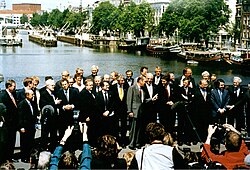
However, his tenure also faced diplomatic challenges. Relations with China strained after Beijing dismissed Kinkel's appeal to release dissident Wei Jingsheng and expelled journalist Henrik Bork. In 1996, China canceled Kinkel's planned visit to Beijing in response to a German parliamentary resolution condemning human rights abuses in Tibet. Regarding EU expansion, Kinkel argued in 1997 that Turkey did not qualify for membership due to economic issues and its record on human rights, the Kurdish question, and relations with Greece.
Party Leadership and Parliamentary Service
Kinkel served as the chairman of the FDP from 1993 to 1995. Following a series of electoral setbacks for the party in state and European Parliament elections, as well as a narrow victory in the 1994 federal elections, he chose not to seek re-election as chairman. He remained a member of the Bundestag from 1994 until 2002, eventually resigning his ministerial and vice-chancellorship posts after the government's defeat in the 1998 federal election.
| Role | Period | Key Achievement/Event |
|---|---|---|
| Federal Minister of Justice | 1991–1992 | Negotiated Red Army Faction's renunciation of violence |
| Federal Foreign Minister | 1992–1998 | Signatory of the Dayton Agreement; Maastricht Treaty ratification |
| Vice Chancellor of Germany | 1993–1998 | Coordinated government policy under Helmut Kohl |
| FDP Chairman | 1993–1995 | Led the Free Democratic Party during mid-90s transitions |
| Member of the Bundestag | 1994–2002 | Legislative service in the German Parliament |
Frequently Asked Questions
What role did Kinkel play in the Bosnian War?
Kinkel was a signatory of the 1995 Dayton Agreement, which ended the Bosnian War, and he helped establish the International Criminal Tribunal for the former Yugoslavia.
How did Kinkel change the German military's role?
He helped secure constitutional amendments in 1993 that allowed German troops to participate in UN-sanctioned peacekeeping operations, leading to the deployment in Somalia.
What was Kinkel's stance on European integration?
He was a strong supporter, successfully advocating for the ratification of the Maastricht Treaty in 1992 to foster European political and economic union.
Why did relations with China deteriorate during his term?
Tensions rose due to China's refusal to release dissident Wei Jingsheng, the expulsion of journalist Henrik Bork, and a German parliamentary resolution condemning human rights in Tibet.
What was Kinkel's view on Turkey's EU membership in 1997?
He argued that Turkey did not qualify for membership based on its economic status, its record on human rights, the Kurdish question, and its relationship with Greece.