Hangul Orthography: The Evolution and Divergence of the Korean Script
The Korean alphabet, known internationally as Hangul, is a sophisticated writing system that has undergone significant transformations throughout its history. While it is the foundation of Korean literacy, its application varies by region: it is referred to as Hangeul in South Korea and Choson'gŭl in North Korea. Beyond the Korean peninsula, the script is also utilized to transcribe other languages, such as Jeju and Cia-Cia, often incorporating additional letters to meet specific phonetic needs.
Understanding the complexities of Hangul requires looking at its structural mechanics, its historical shifts in writing direction, and the political divisions that led to the development of distinct orthographies in the North and South.
Key Facts
- Regional Names: Hangeul (South Korea) and Choson'gŭl (North Korea).
- Syllable Capacity: Current standard letters can form 11,172 possible syllables, though scholars estimate only about 2,000 are used in natural language.
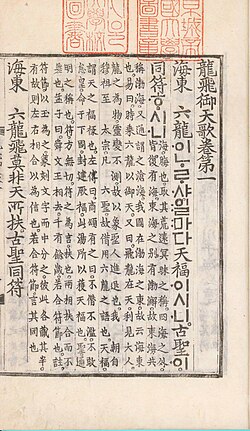
- Writing Direction: Historically written vertically (top to bottom, right to left), it transitioned to horizontal writing in the 19th century.
- Standardization: The Unified Hangul Orthography (UHO) of 1933 served as the basis for both North and South Korean standards following the 1945 liberation.
The Mechanics of Hangul Syllables
Hangul is unique because it is organized into syllable blocks. Rather than writing letters in a simple linear string, consonants and vowels are combined into a single square block. To construct these blocks, specific rules are applied based on whether a character is an initial consonant, a medial vowel, or a final consonant (known as jongseong).
The current standard Hangul system consists of 19 initial consonants, 21 vowels, and 28 final consonants. While the mathematical combinations allow for over 11,000 syllables, the practical vocabulary of the language relies on a much smaller subset.
Historical Evolution and Reform Movements
The 16th to 19th Century Shifts
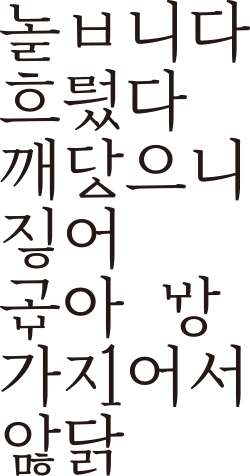
Between the 16th and early 19th centuries, the script underwent several phonetic and orthographic changes. Several archaic letters, such as ㆆ and ㅿ, gradually fell out of use. Additionally, tone markings—dots used to indicate pitch—ceased to be used by approximately the 1580s. Historically, these markings distinguished between level tone (no dots), departing tone (one dot), and rising tone (two dots).
![An essay from Chu Sigyŏng's 1914 book Marŭi sori that illustrates his proposed p'urŏssŭgi orthography. In present South Korean orthography, the title reads "우리 글의 가로쓰는 익힘".[80][81]](/images/64/11/641134c01dd489649625b9526e28341afde2a8d5e2cfd453f9cd4031457a0b5c.jpg)
The Hangul Movement and Modernization
During the Enlightenment and Korean Empire periods (roughly 1896–1910), the Hangul Movement emerged. A pivotal figure in this era was Chu Sigyŏng, often called the "father of modern Korean linguistics." He founded the Society for the Standardization of Korean Writing and proposed various orthographies, including p'urŏssŭgi, which explored different ways of arranging characters.
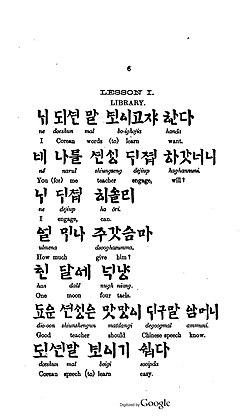
The 19th century also marked a major shift in writing direction. While serosseugi (vertical writing) was the traditional method, garosseugi (horizontal writing) began to emerge. One of the earliest known examples of horizontal Hangul was found in the 1877 Corean Primer by Scottish missionary John Ross.
The Colonial Period and the Unified Hangul Orthography
During the Japanese colonial period, various official orthographies were promulgated by the Government-General. However, the Korean Language Society (KLS) worked to develop a more robust system, leading to the Unified Hangul Orthography (UHO) in 1933. The UHO introduced morphophonemic spelling reforms, such as simplifying complex consonant digraphs into double consonants (e.g., changing ㅺ to ㄲ).
![Cover of a revision of the Unified Hangul Orthography [ko]](/images/1a/f5/1af556335f9717709ec29bc638c7a249a51e622288a359502b5c466a1091c1b3.jpg)
North-South Divergence in Orthography
Following the liberation in 1945, the division of the peninsula led to the development of two distinct linguistic paths. While both sides initially drew from the UHO, their standards eventually diverged significantly.
South Korean Orthography
In South Korea, the current standard is known as Hangeul Orthography. The development of this system involved decades of debate, with a major government-led commission conducting surveys in the 1970s. The current system was officially adopted in 1989, following years of linguistic scrutiny and public discussion.
North Korean Orthography
North Korea's language policy has been heavily influenced by the state. After following the 1940 version of the UHO, the North adopted the Korean Orthography in 1954, which notably replaced the sai-siot (a connecting consonant) with an apostrophe. This was later superseded by the Compendium of Korean Language Norms in 1966, which remains the current official standard.
Summary of Orthographic Standards
| Region/Context | Official Name | Key Characteristics |
|---|---|---|
| South Korea | Hangeul Orthography | Developed through extensive commission surveys; adopted 1989. |
| North Korea | Compendium of Korean Language Norms | Current standard since 1966; influenced by state policy. |
| Historical (1933) | Unified Hangul Orthography (UHO) | Simplified digraphs; basis for post-liberation scripts. |
| Other Languages | Jeju/Cia-Cia Orthographies | Uses Hangul with additional specific letters. |
Frequently Asked Questions
What is the difference between Hangul and Hangeul?
The difference is primarily regional: Hangeul is the term used in South Korea, while Hangul is the international standard, and Choson'gŭl is the term used in North Korea.
How many syllables can be written in Hangul?
Using the 19 initial consonants, 21 vowels, and 28 final consonants, it is mathematically possible to create 11,172 syllables, though only about 2,000 are commonly used.
Did Hangul always use horizontal writing?
No. Historically, Hangul was written vertically from top to bottom and right to left. Horizontal writing began to appear in the 19th century.
Who was Chu Sigyŏng?
Chu Sigyŏng was a linguist known as the "father of modern Korean linguistics." He was a key figure in the Hangul Movement and worked on standardizing Korean writing in the early 20th century.
Why do North and South Korea have different spelling rules?
The divergence began after the 1945 liberation. While both started with the Unified Hangul Orthography, different political and linguistic reforms were implemented in each region, leading to the distinct systems used today.