GW150914: The First Direct Detection of Gravitational Waves
For a century, the scientific community viewed gravitational waves—ripples in the fabric of spacetime—as a theoretical prediction of Albert Einstein's general relativity. While these waves had been inferred indirectly through the timing of pulsars in binary star systems, they remained elusive to direct measurement until a historic breakthrough in 2015.
On September 14, 2015, the Laser Interferometer Gravitational-Wave Observatory (LIGO) recorded a signal that changed our understanding of the universe. Named GW150914, this event provided the first direct evidence of gravitational waves and the first observation of two stellar-mass black holes merging.

Key Facts
- Detection Date: September 14, 2015, at 9:50:45 UTC.
- Event Origin: The merger of two black holes approximately 1.4 billion light-years away.
- Energy Release: Roughly 3.0 solar masses were converted into pure energy in the form of gravitational waves.
- Peak Power: The radiated power peaked at 3.6 × 1052 watts, exceeding the combined light of all stars in the observable universe by 50 times.
- Result: The merger created a single remnant black hole of approximately 62 solar masses.
The Mechanics of GW150914
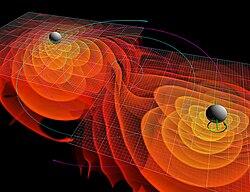
The signal detected by LIGO was the result of a binary black hole merger. This process occurs when two black holes orbit one another in an inward spiral, gradually losing energy through the emission of gravitational waves. As they draw closer, their orbital speed increases, leading to a violent collision and merger.
The specific event GW150914 involved two black holes with masses of approximately 36 and 29 solar masses (M☉). The resulting collision produced a final black hole of 62 M☉. The "missing" mass—about 3.0 M☉—was radiated away as gravitational energy during a brief window of approximately 200 milliseconds.
The Ringdown Phase
Following the merger, the newly formed single black hole underwent a process called ringdown, where it settled into a stable state, emitting final, decaying gravitational waves. The waveform of this entire process matched the precise mathematical predictions of general relativity.
Observation and Measurement
The detection was made possible by the LIGO observatories in Hanford and Livingston. By measuring the infinitesimal stretching and squeezing of spacetime, LIGO was able to capture the signal from a distance of roughly 1.4 billion light-years (a luminosity distance of 440 megaparsecs). This distance corresponds to a cosmological redshift—the stretching of light and waves as the universe expands—of 0.093.
Energy Impact on Earth
Despite the staggering power of the event at its source, the waves were incredibly faint by the time they reached Earth. The total energy received by the entire planet was approximately 36 billion joules, only a tiny fraction of which was actually absorbed by the detectors.
Summary of Event GW150914
| Parameter | Value |
|---|---|
| Progenitors | Two black holes (36 M☉ and 29 M☉) |
| Remnant Mass | 62 M☉ |
| Energy Radiated | 3.0 ± 0.5 M☉ × c2 |
| Distance | c. 1.4 billion light-years |
| Signal Duration | c. 200 milliseconds |
| Redshift | 0.093 +0.030 −0.036 |
The Dawn of Gravitational-Wave Astronomy
The success of GW150914 proved that binary stellar-mass black hole systems exist and can merge within the current age of the universe. This discovery opened a new window into the cosmos, allowing scientists to "hear" events that are invisible to traditional telescopes.
Following this discovery, LIGO announced another signal, GW151226, on June 15, 2016. The Advanced LIGO project predicted a significant increase in detections, anticipating dozens of binary star mergers annually, alongside more exotic sources that may challenge current theoretical physics.
Frequently Asked Questions
What exactly is a gravitational wave?
A gravitational wave is a ripple in the curvature of spacetime caused by the acceleration of massive objects, such as merging black holes, which travels outward from the source at the speed of light.
How did LIGO detect the signal?
LIGO uses laser interferometry to measure incredibly small changes in the distance between mirrors in its long arms, detecting the slight stretching and squeezing of space caused by a passing gravitational wave.
Why was GW150914 so significant?
It was the first direct observation of gravitational waves, confirming a major prediction of Einstein's general relativity and proving that binary black hole mergers occur in our universe.
How much energy was released during the merger?
Approximately 3.0 solar masses were converted into energy. At its peak, the power output was 50 times greater than the combined light of all stars in the observable universe.
What happened to the two black holes after they merged?
The two black holes combined to form a single, larger black hole with a mass of approximately 62 solar masses.