Gustave Schlumberger: Scholar of the Byzantine Empire and the Crusader States
Gustave Schlumberger was a multifaceted French intellectual whose life spanned the worlds of medicine, historical research, and high society. While he began his professional journey in the medical field, he eventually became a distinguished authority on the Byzantine Empire (the eastern continuation of the Roman Empire) and the history of the Crusader states.
Born in Guebwiller, Alsace—a region that shifted between French and German control—Schlumberger's early life was marked by the political turbulence of his era. He moved to Paris in 1863 to study medicine and served as a medic for the French side during the Franco-Prussian War. By 1872, he had earned his doctorate with a thesis focused on the respiratory tract.
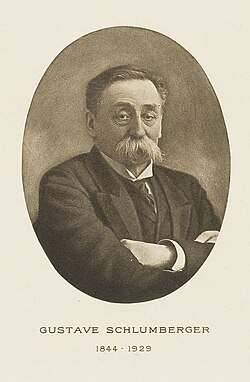
Transition to Historical Research
Following his medical studies, Schlumberger embarked on extensive travels across North Africa, Syria, Asia Minor, Spain, Portugal, Switzerland, Italy, and Germany. These journeys sparked a deep interest in antiquity, leading him to pivot from medicine to the rigorous study of history and numismatics (the study or collection of currency).
His scholarly contributions were recognized by the highest academic institutions in France. He served as the president of the Societé des Antiquaires de France and was elected a member of the Académie des Inscriptions et Belles-Lettres in 1884. His expertise in coinage and ancient history also earned him the Medal of the Royal Numismatic Society in 1903.
Social Circles and Literary Connections
Schlumberger was a prominent figure in the Parisian social scene, maintaining friendships with several notable literary figures. He was a close friend of the American author Edith Wharton, who once compared his appearance to a Gaul depicted on the Arch of Titus. He also maintained a prolific correspondence with the Greek writer Penelope Delta, providing historical insights that influenced her novels set in the Byzantine era.
However, his relationship with the literary world was not always harmonious. He had a strained relationship with the novelist Marcel Proust. After Schlumberger failed to be elected to the Académie française in 1908, Proust referred to him as a "disabused pachyderm." In return, Schlumberger described Proust as "bizarre" and found his writing to be "incomprehensible." Despite this friction, Schlumberger appears in Proust's masterpiece, À la recherche du temps perdu.
Political Views and Controversies
Schlumberger was an ultra-conservative and a vocal supporter of the anti-Dreyfusard movement (those who opposed the exoneration of Alfred Dreyfus). His convictions were so strong that he once stormed out of a salon hosted by Genevieve Straus after Joseph Reinach asserted Dreyfus' innocence.
His memoirs reveal the prejudices of the time. While praising his friend Charles Haas—who served as a model for the character Swann in Proust's work—Schlumberger noted that Haas was an exception to the "faults of his race" due to his Jewish origins.
Key Facts
- Academic Honors: Member of the Académie des Inscriptions et Belles-Lettres and recipient of the Royal Numismatic Society Medal.
- Educational Background: Doctorate in medicine (1872) specializing in the respiratory tract.
- Research Focus: Specialized in the Byzantine Empire and the Crusader states.
- Political Stance: Ultra-conservative and active anti-Dreyfusard.
- Legacy: The Gustave Schlumberger Prize was established in his honor.
Summary of Achievements
| Year/Period | Achievement/Event | Field |
|---|---|---|
| 1872 | Doctorate awarded for respiratory tract thesis | Medicine |
| 1884 | Elected to Académie des Inscriptions et Belles-Lettres | History/Archaeology |
| 1903 | Awarded Medal of the Royal Numismatic Society | Numismatics |
| Posthumous | Establishment of the Gustave Schlumberger Prize | Academic Legacy |
Frequently Asked Questions
What was Gustave Schlumberger's original profession?
He originally studied medicine in Paris and earned a doctorate in 1872, focusing his thesis on the respiratory tract.
Which historical periods did Schlumberger specialize in?
He focused his research on the Byzantine Empire and the history of the Crusader states.
How did Schlumberger influence Penelope Delta?
Through extensive correspondence, Schlumberger provided historical information that influenced several of Delta's historical novels set in Byzantine times.
What was the nature of his relationship with Marcel Proust?
The two disliked each other; Proust called him a "disabused pachyderm," while Schlumberger found Proust's books incomprehensible and described the author as "bizarre."
What is the Gustave Schlumberger Prize?
It is an award created in his name by the Académie des Inscriptions et Belles-Lettres, which has been awarded to scholars such as Denys Pringle and Joshua Prawer.