Grovers Mill, New Jersey: From Colonial Gristmill to Martian Landing Site
Nestled in the heart of Mercer County, Grovers Mill is an unincorporated community within West Windsor, New Jersey. Centered around the intersection of Clarksville Road and Cranbury Road, this quiet hamlet is defined by its historic mill pond and a legacy that stretches from the colonial era to the heights of 20th-century pop culture.
Strategically located, Grovers Mill sits just 4 miles southeast of Princeton, 6 miles northwest of Hightstown, and 12 miles northeast of Trenton, the state capital. While it has evolved into a suburban area, it retains a distinct identity rooted in its industrial beginnings.
Key Facts
- Location: West Windsor, Mercer County, New Jersey.
- Origin: Developed around a saw and gristmill likely built in the mid-1700s.
- Coordinates: 40°19′00″N 74°36′34″W.
- Claim to Fame: The fictional landing site of a Martian invasion in the 1938 War of the Worlds radio broadcast.
- Elevation: 69 feet (21 meters) above sea level.
The Industrial Roots of Grovers Mill
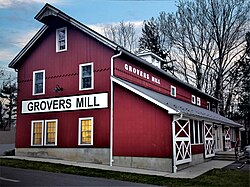
The community first grew around a saw and gristmill—a facility used for sawing lumber and grinding grain—located at 164 Cranbury Road. Records indicate that Daniel Wolsey was the mill's first owner in 1759, though the structure was likely constructed earlier in the mid-1700s.
To power the mill, a pond was created by damming the Bear Brook. This water flowed through a concrete-walled raceway, driving a large wooden water wheel that served the community for generations.
A Legacy of Changing Names
Throughout the 18th and 19th centuries, the community was known by various names based on who owned the mill. This naming pattern reflects the shifting ownership of the local industry:
- Woolsey's Mill (1750s)
- Wright's Mill (1760s)
- Bergen's Mill (1770s–1805; 1811–1816)
- Walker's Mill (1805–1811)
- Thomas' Mill / Bear Mill (1816–1837)
- Schwenger's Mill (1837–1868)
- Grover's Mill (1868–Present), following the purchase by Joseph H. Grover.
Preserving Colonial Architecture
Beyond the mill, the area features several houses from the 1700s and 1800s, which are believed to have originally housed tenant workers. Notable structures include the millwright's house (the residence of the person who maintains the mill) at 175 Cranbury Road and a potentially older home at 429 Clarksville Road known as "Ladyfair." Despite suburban growth in the mid-1900s that claimed much of the surrounding farmland, these historic buildings remain as testaments to the area's past.
Grovers Mill in Popular Culture
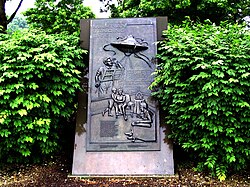
While its history is rooted in agriculture, Grovers Mill gained global notoriety on October 30, 1938. Orson Welles, performing with The Mercury Theatre on the Air for CBS Radio, adapted H.G. Wells' The War of the Worlds. In the broadcast, Grovers Mill was depicted as the initial landing site for a Martian invasion of Earth.
The choice of location was entirely random; scriptwriter Howard Koch reportedly dropped a pencil onto a map of New Jersey and selected Grovers Mill because he "liked the sound" of the name. This broadcast became one of the most famous moments in radio history, leading to the installation of a historical marker in the community today.
Influence on Modern Fiction
The "Martian landing" legacy has inspired numerous references across various media:
- Literature and Film: References appear in The Adventures of Buckaroo Banzai Across the 8th Dimension and the Wild Cards book series. A 2006 film titled Grovers Mill was also produced.
- Television: The X-Files featured a town called "Miller's Grove" in the episode "War of the Coprophages," and the War of the Worlds TV series featured an episode set in Grovers Mill on the 50th anniversary of the radio play.
- Comics: In DC Comics' The Shadow Strikes (1989), a character named Grover Mills—based on a young Orson Welles—appears in the story.
- Audio Drama: A 2018 black comedy audio series titled Grovers Mill uses the setting for a satire about the Moon landing conspiracy.
Community Summary
| Category | Details |
|---|---|
| Administrative Status | Unincorporated community in West Windsor, NJ |
| Primary Landmark | Historic saw/gristmill at 164 Cranbury Road |
| Key Historical Figure | Joseph H. Grover (purchased mill in 1868) |
| Cultural Milestone | 1938 War of the Worlds radio broadcast |
| ZIP Code | 08550 |
Frequently Asked Questions
Why is Grovers Mill famous?
Grovers Mill is most famous for being the fictional site of a Martian landing during Orson Welles' 1938 radio broadcast of The War of the Worlds, which caused widespread panic among some listeners.
Who gave the community its current name?
The community took its current name after Joseph H. Grover purchased the local mill in 1868.
What was the original purpose of the mill?
The mill served as both a saw mill for processing lumber and a gristmill for grinding grain, powered by a water wheel fed by the dammed Bear Brook.
How was Grovers Mill chosen for the radio play?
Scriptwriter Howard Koch chose the location by randomly dropping a pencil onto a map of New Jersey and deciding he liked the sound of the name.
Are there still historic buildings in Grovers Mill?
Yes, despite suburban expansion in the mid-20th century, several buildings from the 1700s and 1800s remain, including the mill site and former worker housing.