Green Belts: Balancing Urban Growth and Environmental Preservation
A green belt is a strategic land-use zone designation used in urban planning to maintain areas of undeveloped, wild, or agricultural land surrounding urban centers. By establishing an invisible border around a city, these zones prevent urban sprawl and create a sanctuary where wildlife can establish themselves and nature can thrive.
While often confused with greenways or green wedges—which are linear strips of nature that typically run through a city—green belts are designed to encircle it. In the United States, the broader term green space is frequently used, though this can refer to any natural area, including small city parks.
Key Facts
- Primary Goal: To prevent urban sprawl and stop neighboring cities from merging.
- Environmental Impact: Improves urban air quality and protects natural ecosystems.
- Social Benefit: Provides city dwellers with essential access to the countryside for recreation and education.
- Global Reach: Implemented in various forms across the UK, Canada, Australia, South Korea, Iran, and Brazil.
- Evolution: Modern planning now views these as part of a "Greenstructure," integrating all urban and peri-urban green spaces for sustainable development.
The Purpose and Benefits of Green Belts
Governments implement green belt policies to achieve several critical environmental and social objectives. By restricting development, these zones protect semi-natural environments and act as "lungs" for the city, filtering pollutants to improve air quality.
Beyond ecology, green belts offer significant human benefits. They ensure that urban populations have nearby access to nature, which supports mental well-being and provides educational opportunities. Furthermore, they encourage more efficient land use within the city core, preventing haphazard expansion.
However, the effectiveness of these zones varies. In some cases, development "jumps" over the green belt, leading to the creation of satellite towns. While these towns are physically separated from the city, they often function as suburbs rather than independent communities.
A Brief History of Urban Containment
The concept of restricting urban growth is not new. In the 7th century, Muhammad established a green belt around Medina by prohibiting the removal of trees in a 12-mile strip. Later, in 1580, Elizabeth I of England banned new buildings in a 3-mile belt around London to curb the spread of the plague, though this was poorly enforced.
Modern green belt planning emerged from continental Europe, exemplified by the Ringstraße in Vienna. The United Kingdom pioneered the modern policy to combat rural flight. The term was first used by Octavia Hill in 1875, and the London Society's 1919 "Development Plan of Greater London" proposed a continuous belt to halt urban sprawl.
Global Implementations and Examples
United Kingdom
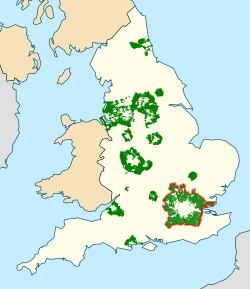
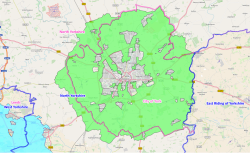
Established in 1955, the UK's green belts prevent large built-up areas from merging. There are 14 green belt areas covering 16,716 km (12.4%) of England and 164 km of Scotland.
North America
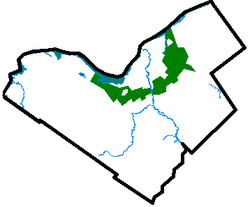
Canada features the National Capital Greenbelt in Ottawa, managed by the National Capital Commission, and a massive 7,300 km² provincially-designated belt around the Greater Toronto Area and Niagara Peninsula to protect the Oak Ridges Moraine aquifer.
In the United States, states like Oregon, Washington, and Tennessee use Urban Growth Boundaries (UGBs). Notable examples include Portland, Oregon, and Lexington, Kentucky, which established the first U.S. greenbelt in 1958.
Australia and New Zealand
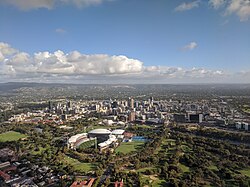
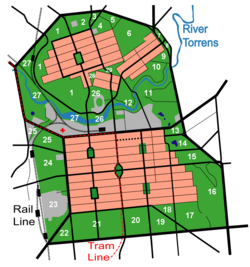
Adelaide, Australia, is famous for its Park Lands that completely encircle the city center, while the Nillumbik Shire near Melbourne is known as "The Green Wedge Shire." In New Zealand, these areas are commonly called "Town Belts," such as the Dunedin Town Belt, which dates back to the 1860s.
![Four green belts in Western Sydney, Australia; three of them are riparian strips along creeks, serving as natural corridors for recreation and ecological conservation in the region.[1]](/images/96/fb/96fb611611fc04cc0fdc245d9a697758220b29ae7e00da5fa456d42f4f0ddf4f.jpg)
Other International Examples
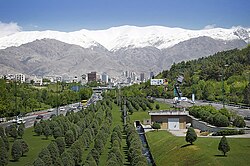
In Iran, Tehran's green belt expanded from 29 km² in 1979 to 530 km² by 2017, which has helped lower summer temperatures by up to 4 °C. Brazil's São Paulo City Green Belt Biosphere Reserve protects over 6,000 km² of the threatened Atlantic Forest ecosystem.
Criticisms and Challenges
Despite their benefits, green belts are often criticized for creating unintended consequences. One major issue is the leapfrog effect, where development jumps beyond the protected zone. This increases urban sprawl, as residents in distant suburbs (such as Kanata and Orleans in Ottawa) face longer commutes and poorer access to public transport.
Economically, green belts can restrict the supply of developable land, which may drive up house prices within the city. In South Korea, for example, the greenbelt around Seoul reduced property prices for landowners who could no longer develop their land, though it improved overall air quality and infrastructure efficiency.
Additionally, some critics argue that these zones are occasionally used as land reserves for future highway construction rather than for genuine environmental preservation.
Summary of Green Belt Characteristics
| Region/Term | Primary Focus | Key Example | Main Challenge |
|---|---|---|---|
| United Kingdom | Preventing city merger | Metropolitan Green Belt | Housing shortages |
| Canada | Sprawl & Aquifer protection | Ontario Greenbelt | Leapfrog development |
| United States | Urban Growth Boundaries | Portland, Oregon | Commute distances |
| South Korea | Urban containment | Seoul Greenbelt | Landowner economic loss |
| Iran | Temperature regulation | Tehran Greenbelt | Regional political issues |
Frequently Asked Questions
What is the difference between a green belt and a greenway?
A green belt is a zone that encircles an urban area to prevent its outward expansion, whereas a greenway is a linear strip of natural land that typically runs through an urban area.
Do green belts actually stop urban sprawl?
While they stop expansion in the immediate vicinity, they can sometimes increase sprawl by pushing development further out, creating "satellite towns" and longer commutes.
How do green belts affect city temperatures?
By increasing vegetation and humidity, green belts can cool urban environments. For instance, Tehran's green belt has contributed to lowering summer temperatures by up to 4 °C.
Do green belts impact housing prices?
Yes, by limiting the amount of land available for new housing, green belts can act as a barrier to construction, which may increase property prices within the city limits.
What is "Greenstructure"?
Greenstructure is a modern evolution of the green belt concept that encompasses all urban and peri-urban green spaces as a unified system for sustainable development.