Great Frigatebird: The Master of the Tropical Skies
The great frigatebird (Fregata minor) is a striking, large seabird renowned for its incredible aerial agility and unique mating rituals. Found across the tropical oceans of the world, these birds are masters of the wind, spending vast amounts of time aloft in search of prey. From their distinctive black plumage to the dramatic red displays of the males, the great frigatebird is one of the most recognizable avian species in the pelagic environment.
These birds are members of the family Fregatidae, a group of specialized seabirds that have evolved to thrive in open waters. Unlike many other seabirds, frigatebirds are not designed to land on the water; their plumage is not waterproof, and they are largely incapable of taking off if they accidentally touch the surface.
Key Facts
- Scientific Name: Fregata minor
- Conservation Status: Least Concern (IUCN 3.1), though critically endangered in Brazil.
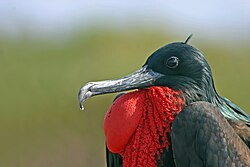
- Distinctive Feature: Males possess a bright red gular sac (a throat pouch) used for courtship.
- Diet: Primarily flying fish and squid, occasionally obtained through kleptoparasitism.
- Parental Care: Boasts the longest post-fledging parental care of any bird species.
- Lifespan: Long-lived, with some individuals recorded at over 44 years of age.
Physical Characteristics and Sexual Dimorphism
The great frigatebird is a lightly built bird, reaching lengths of 85 to 105 cm with an impressive wingspan ranging from 205 to 230 cm. While predominantly black, the species exhibits sexual dimorphism, meaning males and females differ in appearance.
Females are generally larger and heavier than males, weighing between 1,215 and 1,590 g, and are distinguished by a white throat and breast. Males, weighing between 1,000 and 1,450 g, feature scapular feathers with a purple-green sheen. The most striking difference appears during the breeding season, when males inflate their red gular sac to attract mates.
Distribution and Habitat
These birds are widely distributed across tropical seas. Major nesting populations are found in the Pacific Ocean, particularly in Hawaii and the Galápagos Islands. In the Indian Ocean, they colonize Mauritius and the Seychelles (specifically Aride and Aldabra Islands). A much smaller population exists in the South Atlantic around Ascension Island (Boatswain Bird Island) and St. Helena.
Great frigatebirds are known for their philopatry, a tendency to return to their natal colony to breed, even if they have traveled thousands of kilometers. They are highly migratory; for example, one male was tracked traveling 4,400 km from Europa Island to the Maldives to exploit rich fishing grounds.
Feeding Behavior and Diet
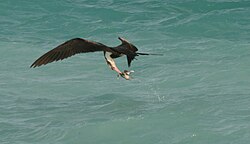
Foraging typically occurs in pelagic waters within 80 km of their roosting or breeding sites. Their primary diet consists of fish from the family Exocoetidae (flying fish) and squid, which they snatch from the air or the ocean's surface while in flight. They often follow pods of dolphins or schools of tuna, which drive smaller fish toward the surface.
The great frigatebird is also known for kleptoparasitism—the act of stealing food from other birds. They frequently harass boobies, tropicbirds, and gadfly petrels to force them to regurgitate their catch. However, research suggests this is a supplement rather than a primary food source; on average, they obtain only about 5% of their nutritional needs through this method.
Breeding and Life Cycle
Courtship and Nesting
Courtship is a dramatic affair. Males gather in trees or bushes and spend up to 20 minutes inflating their red gular sacs into large balloons. To attract passing females, they waggle their heads and shake their wings. Once a pair bond is formed, they establish and defend a nesting territory.
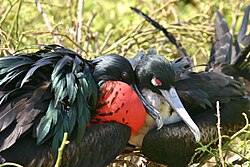
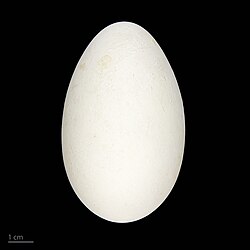
The female lays a single chalky-white egg. Both parents share incubation duties in shifts lasting 3 to 6 days. This process is physically taxing, with some birds losing up to 33% of their body mass during a single shift.
Raising the Young
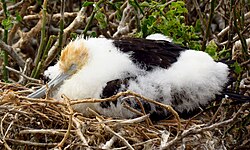
After an incubation period of approximately 55 days, the altricial (helpless and naked) chicks hatch. They are brooded for two weeks before developing white down. Feeding is done via regurgitation, where the chick places its head inside the parent's mouth.
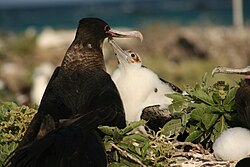
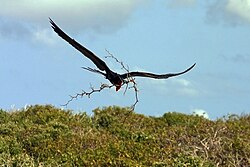
Fledging occurs between four and six months, but the parental bond remains strong long after the young leave the nest. Great frigatebirds provide the longest post-fledging care of any bird, lasting between 150 and 428 days. During this time, juveniles engage in social play, such as chasing sticks, to hone the aerial skills necessary for hunting.
Taxonomy and Subspecies
Formally described in 1789 by Johann Friedrich Gmelin, the species was originally placed in the genus Pelecanus. Despite its common name "Great," the species name minor (Latin for "smaller") was retained due to taxonomic rules, creating a linguistic discrepancy. It is closely related to the Christmas Island frigatebird (Fregata andrewsi).
| Subspecies | Primary Range |
|---|---|
| F. m. aldabrensis | West Indian Ocean (Aldabra, Comoros, Europa Island) |
| F. m. minor | Central/East Indian Ocean to South China Sea |
| F. m. palmerstoni | West and Central Pacific Ocean (Hawaii, Marshall Islands, etc.) |
| F. m. ridgwayi | East Pacific Ocean (Galápagos, Cocos, Revillagigedo Islands) |
| F. m. nicolli | South Atlantic (Trindade and Martim Vaz) |
Conservation Status
Globally, the great frigatebird is listed as Least Concern by the IUCN due to its wide range and large population. However, regional populations face severe threats. In Brazil, the subspecies F. m. nicolli is considered critically endangered. On Trindade Island, habitat destruction and overgrazing by introduced goats previously devastated the population, though eradication programs for feral cats and goats have since been implemented to aid recovery.
Frequently Asked Questions
Why is it called the "Great" frigatebird if its scientific name means "smaller"?
This is a result of taxonomic history. When the bird was first described as Pelecanus minor in 1789, the name was based on earlier descriptions. According to the rules of taxonomy, the original species name (minor) must be retained even after the bird was moved to the genus Fregata and recognized as a large species.
Can great frigatebirds swim or float on water?
No. Unlike many other seabirds, great frigatebirds lack the waterproof oils in their plumage necessary for floating. If they land on the water, they often become trapped and are usually unable to take off again.
What is the purpose of the red throat pouch?
The red gular sac is used exclusively by males for courtship. By inflating the sac into a large, bright red balloon and performing a rhythmic dance, the male attempts to attract a female flying overhead.
How do great frigatebirds steal food from other birds?
They practice kleptoparasitism by chasing other seabirds, such as boobies or tropicbirds, in mid-air. The harassment is intended to stress the other bird into regurgitating its meal, which the frigatebird then catches in flight.
How long do the chicks stay with their parents?
Great frigatebirds have the longest post-fledging parental care of any bird species. After leaving the nest, chicks may continue to receive food and care from their parents for 150 to 428 days, depending on food availability and oceanic conditions.