South Equatorial Current: Dynamics of Global Ocean Circulation
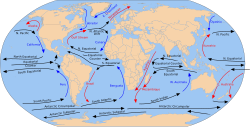
The South Equatorial Current represents a critical component of the Earth's oceanic conveyor belt. These massive bodies of water flow from east to west across the Pacific, Atlantic, and Indian Oceans, serving as a primary mechanism for transporting heat and nutrients across the globe.
Geographically, these currents are positioned between the equator and approximately 20 degrees south. In the Atlantic and Pacific Oceans, their reach is even broader, extending across the equator to roughly 5 degrees north.
Key Facts
- Direction: Flows primarily from east to west.
- Location: Found in the Pacific, Atlantic, and Indian Oceans.
- Latitudinal Range: Generally between the equator and 20° south.
- Primary Driver: Driven by trade winds and large-scale subtropical gyres.
- Indian Ocean Variation: Subject to seasonal reversals due to monsoons.
The Mechanics of Ocean Movement
The movement of the South Equatorial Current is not accidental but is the result of complex atmospheric and oceanic interactions. In the southern hemisphere, this current acts as the westward limb of subtropical gyres—large systems of circulating ocean currents.
Wind Patterns and Gyres
These gyres are powered by a combination of tropical trade winds and westerly winds located south of 30 degrees south. The process is further complicated by western boundary current intensification, a phenomenon where currents on the western side of an ocean basin become narrower, deeper, and faster.
Direct Wind Influence
While gyres manage the larger scale, the current directly on the equator is driven by the trade winds, which blow consistently from east to west, pushing the surface waters in the same direction.
Regional Variations
While the general flow is westward, the South Equatorial Current behaves differently depending on the ocean basin.
The Pacific and Atlantic Oceans
In these two basins, the current is relatively stable and extends slightly into the northern hemisphere, reaching up to 5 degrees north of the equator.
The Indian Ocean
The Indian Ocean presents a unique case. Here, the westward-flowing current is well-developed only south of the equator. Because the monsoons (seasonal wind shifts) cause winds to reverse twice a year directly on the equator, the surface current in this region can flow either eastward or westward depending on the season.
| Feature | Pacific & Atlantic Oceans | Indian Ocean |
|---|---|---|
| Primary Direction | East to West | East to West (South of Equator) |
| Northern Reach | Up to 5° North | Variable/Limited |
| Stability | Consistent westward flow | Seasonal reversals on the equator |
| Driving Force | Trade winds & Gyres | Trade winds & Monsoons |
Frequently Asked Questions
What is the primary direction of the South Equatorial Current?
The South Equatorial Current flows from east to west across the Pacific, Atlantic, and Indian Oceans.
What drives the movement of these currents?
They are driven by a combination of the tropical trade winds and the larger subtropical gyres, which are influenced by westerly winds south of 30 degrees south.
How does the Indian Ocean differ from the others?
In the Indian Ocean, the current is only well-developed south of the equator; on the equator itself, the current can reverse direction twice a year due to the monsoons.
What is the latitudinal range of the South Equatorial Current?
It generally flows between the equator and about 20 degrees south, though in the Atlantic and Pacific, it can extend to 5 degrees north.
What are subtropical gyres?
Subtropical gyres are large-scale systems of circulating ocean currents driven by global wind patterns and the rotation of the Earth.