Great Blue Heron
The Great Blue Heron (Ardea herodias) is a majestic wading bird and the largest heron species native to North America. Known for its striking stature and patient hunting style, it is a common sight across diverse wetlands, from the salt marshes of the Caribbean to the freshwater lakes of Canada. While it shares a close evolutionary relationship with the Old World grey heron and the South American Cocoi heron, the Great Blue Heron is uniquely adapted to its New World environment.
Key Facts
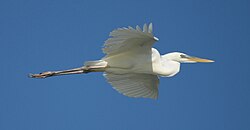
- Size: The largest heron in North America, reaching up to 138 cm in height.
- Diet: Primarily piscivorous (fish-eating), but highly opportunistic.
- Social Structure: Breeds in colonies known as heronries.
- Conservation Status: Listed as Least Concern by the IUCN.
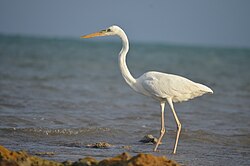
- Distinct Morph: The A. h. occidentalis subspecies includes a rare all-white form.
Physical Characteristics
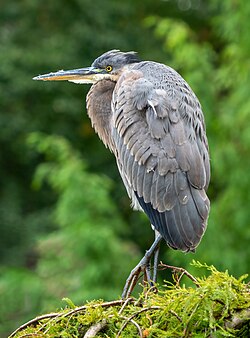
The Great Blue Heron is a massive bird, surpassed in size globally only by the Goliath and White-bellied herons. Adults typically range from 91 to 137 cm in length with a wingspan that can reach up to 201 cm. While males are slightly larger than females, they are not easily distinguished by sight alone.
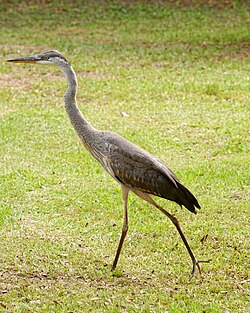
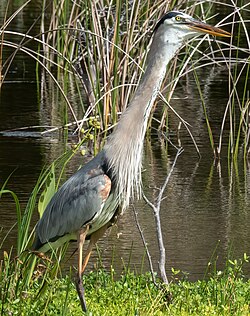
Their plumage is characterized by slaty blue-gray flight feathers and a rusty-gray neck with black and white streaking. During the breeding season, they develop long, plume-like feathers on the lower neck and back. Their bills are typically dull yellowish, turning orange during mating periods.
Subspecies and Variations
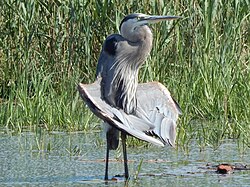
There are five recognized subspecies of the Great Blue Heron, distributed across North America, the Caribbean, and the Galápagos Islands. Most differ only slightly in size and tone, but A. h. occidentalis (found in South Florida and the Caribbean) is notable for its white morph, formerly classified as a separate species called the Great White Heron. This morph lacks all pigment in its plumage and is generally larger than other races.
Diet and Hunting Behavior
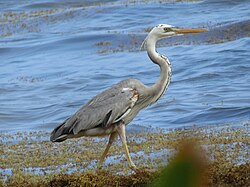
While fish are the primary food source, the Great Blue Heron is an opportunistic predator. They prefer small to medium-sized fish (10–20 cm), though they are capable of swallowing fish up to 60 cm in length. Depending on the region, their primary prey varies; for example, herons in Nova Scotia rely heavily on flounder, while those in British Columbia target sticklebacks and perch.
Beyond fish, these birds hunt a wide array of prey, including:
- Amphibians and Reptiles: Frogs, toads, salamanders, lizards, and snakes (including water snakes over 100 cm long).
- Mammals: Shrews, rats, ground squirrels, moles, and voles. There are even reports of them preying on eastern cottontail rabbits.
- Insects and Crustaceans: Crayfish, shrimp, crabs, and dragonflies.
- Other Birds: Occasionally, they take small birds such as black rails or marsh tern chicks.
Breeding and Life Cycle
Great Blue Herons are socially monogamous for a single season, though they typically choose new partners each year. They breed in heronries—colonies of five to 500 nests usually located in trees near wetlands. These colonies are strategically placed within 4 to 5 km of prime feeding grounds.
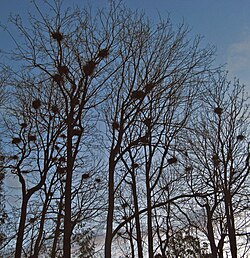
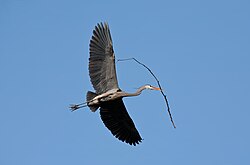
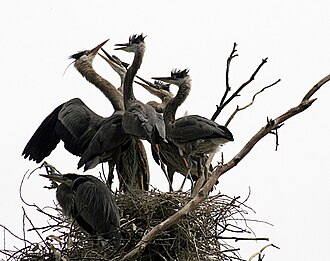
The nests are bulky structures made of sticks, often reused for years, growing from an initial 50 cm width to over 120 cm. A female typically lays three to six pale blue eggs. Both parents share incubation duties, with the male taking over for about 10.5 hours a day. Once hatched, parents feed their young by regurgitating food, significantly increasing their own caloric intake to support the chicks.
Species Summary Table
| Subspecies | Primary Distribution | Notable Features |
|---|---|---|
| A. h. herodias | Most of North America | Nominate subspecies |
| A. h. fannini | Pacific Northwest (Alaska to Washington) | Coastal distribution |
| A. h. wardi | Central US (Kansas/Oklahoma to Florida) | Intermediate size |
| A. h. occidentalis | South Florida and Caribbean | Includes the all-white morph |
| A. h. cognata | Galápagos Islands | Isolated island population |
Frequently Asked Questions
What is the difference between a Great Blue Heron and a Great Egret?
While both are large wading birds, the Great Blue Heron is roughly twice as heavy as the Great Egret and features blue-gray plumage, whereas the Great Egret is entirely white. They also differ in bill morphology and size.
What is a "heronry"?
A heronry is a specific term for a colony where Great Blue Herons nest. These colonies can range from a few nests to several hundred, usually located in trees near a reliable food source.
Do Great Blue Herons eat animals other than fish?
Yes. They are opportunistic hunters that eat amphibians, reptiles, crustaceans, insects, and small mammals like voles and rats. They have even been known to prey on small birds and rabbits.
What is Würdemann's heron?
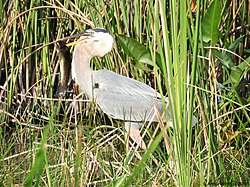
Würdemann's heron is not a separate species, but an intermediate form between the standard blue-gray morph and the all-white morph of the A. h. occidentalis subspecies, typically appearing as a blue heron with a white head.
How do Great Blue Herons care for their young?
Both parents participate in incubating the eggs and feeding the chicks. They provide nourishment by regurgitating food, and the parents' food consumption increases up to four times during the chick-rearing phase.