Government of Turkey: Structure, Powers, and Political System
The Government of Turkey (Turkish: Türkiye Cumhuriyeti Hükûmeti) serves as the national governing authority of the Republic of Turkey. Established on October 29, 1923, the state operates as a unitary state under a constitutional republic. Its political framework is defined as a presidential representative democracy within a pluriform multi-party system.
Depending on the context, the term "government" may refer to the collective set of state institutions—comprising the executive, legislative, and judicial branches—or specifically to the Cabinet, which represents the executive arm of the state.
In recent years, the political landscape underwent a significant shift. Following a constitutional referendum in 2017, the previous parliamentary system was abolished in favor of a Presidential system. This transition occurred during the tenure of the AK Party, the longest-governing party in the multi-party era, led by President Recep Tayyip Erdoğan.
However, this transition and the state of democracy in Turkey have drawn international scrutiny. As of 2026, the European Union has indefinitely paused membership talks due to concerns regarding the Copenhagen criteria (the set of conditions agreed upon for EU membership). Additionally, Freedom House has categorized Turkey as "not free" since at least 2017. These geopolitical tensions contributed to the removal of the Ministry of the EU from the cabinet, alongside other reshuffles following a 2013 corruption scandal.
Key Facts
- Founded: October 29, 1923.
- System: Unitary state, Presidential representative democracy.
- Legislature: Grand National Assembly (600 members).
- Executive Leader: President of Turkey.
- Judicial Seat: Ankara.
- Election Cycle: Presidential and parliamentary elections held every five years.
The Executive Branch
The executive power is vested in the President of Turkey, who serves as both the Head of State and the Head of Government. The President is responsible for ensuring the implementation of the Constitution and the harmonious functioning of state organs.
The President appoints the cabinet, which consists of the president and various cabinet ministers. To maintain a strict separation of powers, members of the cabinet are prohibited from serving in parliament during their ministry. The daily administration of federal laws is managed by executive ministries focusing on specific national and international affairs.
Beyond the ministries, the Executive Office of the President oversees several critical staff organizations, including:
- National Security Council
- National Intelligence Organization
- Directorate of Communications
- Disaster and Emergency Management Presidency
- Presidency of Strategy and Budget
- State Supervisory Council
Additionally, the government manages state-owned enterprises, such as the Turkish Electricity Transmission Corporation.
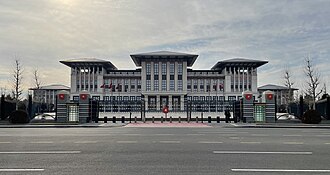
Presidential Powers and Budgeting
The President holds significant legislative influence, possessing the power to sign bills into law or veto them. A veto can only be overridden by a simple majority vote in Parliament. Once approved, laws are published in the Official Gazette to take effect.
Regarding fiscal policy, the President proposes the annual budget to Parliament, covering the fiscal year from January 1 to December 31. The central government is also responsible for levying the majority of taxes.
The Legislative Branch
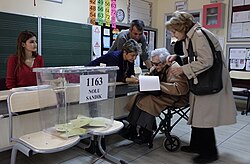
Legislative power is held by the Grand National Assembly of Turkey, a single-chamber parliament consisting of 600 members. These deputies are elected every five years using the D'Hondt method—a party-list proportional representation system—across 87 electoral districts.
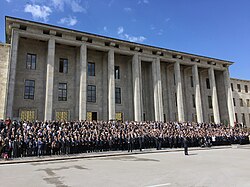
Any citizen over the age of 18 is eligible to be a deputy. To prevent conflicts of interest, members of the Assembly cannot hold office in state departments or public corporate bodies. Deputies may represent a political party or serve as independents.
The Assembly's primary duties include:
- Enacting, amending, and repealing laws.
- Debating and adopting budget and final account bills.
- Deciding on declarations of war.
- Ratifying international treaties.
- Proclaiming amnesty or pardons (requiring a three-fifths majority).
While a simple majority is sufficient to amend a law, amending the Constitution requires a three-fifths majority.
The Judicial Branch
The judiciary operates under a civil law framework, with power exercised by independent and impartial courts. The supreme judicial bodies include the Constitutional Court, the Court of Cassation, the Council of State, and the Court of Jurisdictional Disputes.
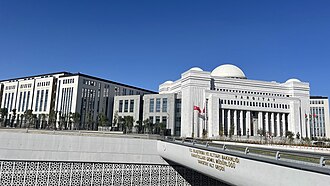
The Constitutional Court plays a pivotal role by reviewing whether laws align with the Constitution. Since 2005, it has also assessed laws against international human rights treaties. The President may appeal to this court to annul laws deemed unconstitutional, and such decisions are final.
Turkey also employs specialized courts for specific legal domains, such as:
- Commercial and Labour courts.
- Consumer and Cadastral courts.
- Intellectual and Industrial Property courts.
In certain disputes, quasi-legal authorities—such as the Turkish Football Federation Arbitration Committee—must be consulted before a case can proceed to court.
Local Administration
Turkey's local government is structured around municipalities, special provincial administrations, and villages, operating on the principle of devolution of powers. The Constitution guarantees the budgetary and regulatory autonomy of these local bodies.
At the provincial level, a governor represents the central government and serves as the executive organ of the special provincial administration and chairman of the provincial executive committee.

Summary of Government Structure
| Branch | Primary Body | Key Leadership/Composition | Primary Function |
|---|---|---|---|
| Executive | Presidential Complex | President & Cabinet | Enforcement of laws and state administration |
| Legislative | Grand National Assembly | 600 Members of Parliament | Lawmaking, budgeting, and treaty ratification |
| Judicial | Supreme Courts | Constitutional Court, Court of Cassation, etc. | Legal interpretation and constitutional review |
Frequently Asked Questions
How are members of the Turkish Parliament elected?
Members are elected every five years using the D'Hondt method, which is a party-list proportional representation system. A total of 600 MPs are elected from 87 different electoral districts.
What is the role of the Constitutional Court?
The Constitutional Court ensures that laws are in accordance with the Constitution and, since 2005, international human rights treaties. Its decisions regarding the unconstitutionality of laws are final.
Can a cabinet minister also be a member of parliament?
No. To maintain the separation of powers between the executive and legislative branches, members of the cabinet cannot hold a seat in parliament during their term of ministry.
How does the presidential election process work?
Turkey uses a two-round system. If no candidate receives at least 50% plus one of the popular vote in the first round, a run-off election is held two weeks later between the top two candidates.
What is the D'Hondt method?
The D'Hondt method is the specific proportional representation system used in Turkish parliamentary elections to allocate seats to political parties based on their share of the vote.