Apportionment and the Mechanics of Electoral Representation
At its core, apportionment is the mathematical process of distributing seats in a legislative body. Whether these seats are allocated among geographical constituencies during a redistribution operation or among political parties in a proportional election, the underlying goal is to translate votes into representative power. While the process seems straightforward, it involves a complex balance between mathematical precision and political stability.
The most fundamental principle of apportionment is that every vote should carry equal weight. This concept, often summarized as "one person, one vote," is a cornerstone of democratic fairness and is explicitly protected in legal frameworks such as the Equal Protection Clause of the Fourteenth Amendment to the United States Constitution.
Key Facts
- Apportionment is the distribution of legislative seats among constituencies or political parties.
- Malapportionment occurs when districts have divergent ratios of voters to representatives, creating unequal voting power.
- Bicameral systems often use deliberate malapportionment to balance population-based representation (lower house) with regional representation (upper house).
- Proportional representation uses specific mathematical formulas (like D'Hondt or Sainte-Laguë) to allocate seats based on vote shares.
- Demographic shifts necessitate periodic redistricting, usually tied to a census, as real-time adjustments during a term are impractical.
The Challenges of Exact Representation
Representing millions of citizens through a manageable governing body inherently involves arithmetic that cannot be perfectly exact. While it is theoretically possible to weigh a representative's vote based on their number of constituents, most systems grant each representative a single vote to ensure governance remains efficient and uncomplicated.
Furthermore, populations are dynamic; people migrate and birth rates fluctuate. Because legislatures serve fixed terms, adjustments to reflect these demographic changes typically only occur at the next scheduled census or election, rather than in real-time.
Apportionment Among Constituencies
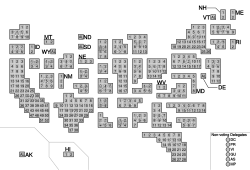
In many systems, representatives are tied to geographical districts. These can be single-member districts, which are usually drawn to maintain equal populations, or multi-member districts, where borders remain static but the number of seats allocated to the district changes.
However, strict population equality is not always the goal. In federations such as the United States, Germany, Brazil, and Nigeria, or regional states like Spain and Indonesia, regions are treated as distinct political entities. In these cases, districts must remain within regional boundaries to protect local institutional interests.
Some nations employ deliberate malapportionment to protect remote or sparsely populated areas from being overshadowed by urban centers. For example, Denmark guarantees seats for Greenland and the Faroe Islands, while Norway uses a formula that counts both population and land area (1.8 points per square kilometer) to determine seat distribution. In some instances, such as in India, seat distribution may be frozen for decades to prevent family planning successes from penalizing states by reducing their representation.
Apportionment Among Party Lists
In party-list proportional representation, seats are awarded based on the total percentage of votes a party receives. This often involves an electoral threshold—a minimum percentage of the vote a party must achieve to qualify for any seats—which serves to eliminate extreme or fringe parties.
Different mathematical methods are used to calculate these seats, each favoring different party sizes:
- Sainte-Laguë method: Aims for an optimal seats-to-votes ratio.
- D'Hondt method: Tends to provide a higher seats-to-votes ratio for larger parties.
- Hare and Droop quotas: Alternative methods for calculating the cost of a seat in votes.
- Huntington-Hill method: A method used specifically for certain types of apportionment.
Understanding Malapportionment
Malapportionment occurs when there is a significant disparity in the ratio of voters to representatives across different districts. For instance, if one district has 10,000 voters per seat and another has 100,000, the voters in the smaller district possess ten times the relative influence.
Experts measure this inequality using several metrics:
- Population Ratios: Comparing the most populous district to the least populous. (e.g., a 10:1 ratio).
- Standard Deviation: Measuring the variance of electorate sizes across all districts.
- Seats-to-Votes Ratios: Analyzing the discrepancy in how many votes are required to secure a seat.
- Majority Thresholds: Calculating the smallest percentage of total voters required to win a majority of seats.
Comparative Summary of Apportionment Systems
| System Type | Primary Goal | Common Mechanism | Potential Drawback |
|---|---|---|---|
| Population-Based | Individual Equality | Single-member districts | Urban dominance |
| Regional-Based | Territorial Balance | Fixed seats per region | Voter inequality |
| Proportional | Ideological Mirroring | Party lists & quotas | Fragmentation |
Historical and Global Examples
Many countries have struggled with or intentionally utilized malapportionment for political ends:
- United States: The Senate grants two seats to every state regardless of size. This means Wyoming's residents have significantly more per-capita influence than those in California.
- Australia: The "Bjelkemander" in Queensland and the "Playmander" in South Australia were historical systems designed to favor rural conservative parties over urban Labor parties.
- Canada: Significant disparities exist in the House of Commons, where some ridings have vastly fewer people than others.
- Japan: Malapportionment has historically benefited the Liberal Democratic Party, leading to multiple Supreme Court challenges.
- United Kingdom: Before the Reform Act of 1832, "rotten boroughs" allowed patrons to control seats with almost no actual electorate.
Frequently Asked Questions
What is the difference between apportionment and malapportionment?
Apportionment is the general process of distributing seats. Malapportionment is a specific condition where that distribution results in unequal representation, meaning some voters have more influence than others due to differing district sizes.
Why would a country deliberately choose malapportionment?
It is often used to ensure that sparsely populated rural areas or remote territories are not ignored by a central government dominated by high-population urban centers, which can help prevent regional instability or secession.
How does the D'Hondt method differ from the Sainte-Laguë method?
The D'Hondt method generally favors larger political parties by providing them a slightly better seats-to-votes ratio, whereas the Sainte-Laguë method is designed to be more neutral and fair to mid-sized and smaller parties.
What is an electoral threshold?
An electoral threshold is a minimum percentage of the total vote a party must receive to be eligible for seat apportionment. This is used to prevent extreme parties from entering the legislature and to avoid excessive political fragmentation.
How is malapportionment corrected?
Correction typically occurs through redistricting or reapportionment, where district boundaries are redrawn or seat allocations are updated based on the most recent census data to restore a more equal voter-to-representative ratio.