Government House New York: The Mansion That Never Housed a President
In the early days of the American Republic, New York City was the center of political ambition and architectural transition. One of the most intriguing structures of this era was the Government House, a grand residence designed for the highest office in the land, yet one that never served its primary purpose.
The story begins on March 16, 1790, when the New York state legislature authorized the demolition of Fort George to make way for a government house. This building was intended for the temporary use and accommodation of the President of the United States while Congress held sessions in New York City.
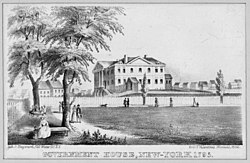
Architectural Origins and Design
Following the authorization, proposals for the building were requested on March 24. While architect John McComb, Jr. submitted plans, they were ultimately not used, as the final structure differed from his designs. Instead, James Robinson became the architect, designing a mansion in the Georgian style—a symmetrical architectural movement characterized by proportion and classical detail.
Construction began with the removal of the defensive walls and buildings of Fort George, with some of the original stones being reused in the new foundation. The cornerstone was officially laid on May 21, 1790.
A Change in Destiny
Despite the rapid progress of construction, the building's purpose shifted before it was even completed. On July 16, 1790, Congress passed the Residence Act. This legislation designated Philadelphia as the temporary national capital for ten years while the permanent capital was constructed in what is now Washington, D.C. Consequently, President George Washington never resided in the building intended as his executive mansion.
Despite this political shift, the building remained a symbol of elegance. In 1791, Rev. Garret Abeel described it as an elegant two-story brick building of an oblong square form, featuring a prominent pediment supported by four large pillars. The rooms offered expansive views of the East River, the Narrows, and the North River.
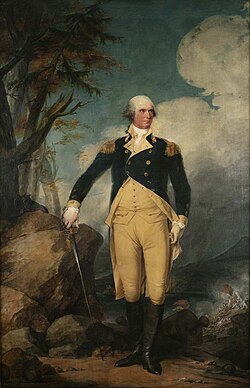
From Governor's Residence to Public Tavern
While the President never moved in, the building served as the residence for New York's state governors. Governor George Clinton moved into the mansion in 1791, followed by Governor John Jay, who resided there from 1795 to 1797. John Jay was the final governor to live in the house, as the state capital moved to Albany in 1797.
Following the departure of the governors, the building entered a more commercial phase. In May 1798, the state leased the property to John Avery, who converted the mansion into the Elysian Boarding and Lodging House, which was also referred to as a tavern.
The Custom House Era and Cultural Hub
The building's function shifted again due to the Customs Administration Act of March 2, 1799, an act inspired by Alexander Hamilton to regulate the collection of duties on imports and tonnage. On May 1, 1799, the Government House was converted into the Custom House in New York, replacing the previous facility located at 5 Mill Street (opposite Mill Lane). It served this purpose until 1815.
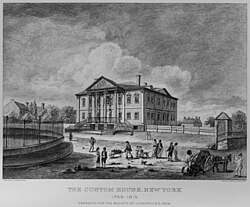
During its tenure as the Custom House, the building also became a center for the arts and history. On April 11, 1808, the upper room was reserved for the American Academy of Arts (formerly the New York Academy of Fine Arts). By 1809, the academy invited the New-York Historical Society to utilize a second-floor room for its collection.
Demolition and Legacy
The end of the Government House came in the early 19th century. On May 26, 1812, the state legislature authorized the sale of the building and grounds to the city for private development. The purchase was finalized on August 2, 1813.
On May 1, 1815, the city began selling the property to the public. Seven lots facing Bowling Green were auctioned off on May 25, and by June 1, the building was being demolished. Before the eventual construction of the Alexander Hamilton U.S. Custom House, the site was occupied by rowhouse residences and a dead-end alley known as Whitney Street.
Key Facts
- Original Purpose: Intended as the temporary executive mansion for the President of the United States.
- Architect: Designed by James Robinson in the Georgian style.
- Presidential Status: President Washington never lived there due to the Residence Act of 1790.
- Notable Residents: Governors George Clinton and John Jay.
- Diverse Uses: Served as a governor's mansion, a boarding house/tavern (The Elysian), and the New York Custom House.
- Cultural Impact: Housed the American Academy of Arts and the New-York Historical Society.
- Demolition: Torn down in 1815 to make way for private buildings.
| Year | Event/Function |
|---|---|
| 1790 | Authorized for construction; cornerstone laid May 21. |
| 1791 | Governor George Clinton moves in. |
| 1795–1797 | Residence of Governor John Jay. |
| 1798 | Leased to John Avery as the Elysian Boarding and Lodging House. |
| 1799–1815 | Served as the New York Custom House. |
| 1808–1809 | Housed the American Academy of Arts and New-York Historical Society. |
| 1815 | Demolished for private development. |
Frequently Asked Questions
Why didn't President Washington live in Government House?
Although the building was designed for him, the Residence Act of July 16, 1790, moved the temporary national capital to Philadelphia for ten years, meaning Washington never resided there.
Who were the primary residents of the house?
The building served as the state governors' house, with Governor George Clinton moving in in 1791 and Governor John Jay residing there from 1795 to 1797.
What was the Elysian Boarding and Lodging House?
It was a tavern and boarding house operated by John Avery, who leased the building from the state starting in May 1798.
How did Alexander Hamilton influence the building's history?
Hamilton inspired the Customs Administration Act of 1799, which led to the building being converted into the New York Custom House on May 1, 1799.
What happened to the site after the building was demolished?
After demolition in 1815, the site contained rowhouse residences and a dead-end alley called Whitney Street before the later construction of the Alexander Hamilton U.S. Custom House.