Goldberg's Tenure as U.S. Ambassador to the United Nations
In 1965, a significant shift occurred in the American judicial and diplomatic landscape when Goldberg resigned from the Supreme Court. Persuaded by President Lyndon B. Johnson, Goldberg stepped down to replace the late Adlai Stevenson II as the U.S. ambassador to the United Nations (UN), an international organization designed to facilitate cooperation in international law and security.
The transition was driven by complex political motivations. President Johnson sought to appoint his friend, Abe Fortas, to the Supreme Court, believing Fortas would provide advance notice if any of the president's "Great Society" reforms were likely to be ruled unconstitutional. Goldberg, who had previously declined a role as Secretary of Health, Education and Welfare, accepted the ambassadorship after a discussion with Johnson on Air Force One while traveling to Illinois for Stevenson's funeral.
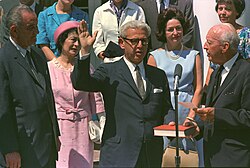
The Terms of Appointment
Goldberg's decision to leave the court was influenced by several promises and personal ambitions. Johnson assured him that he would be a member of the president's cabinet and would be actively involved in all decisions regarding the conclusion of the Vietnam War. Additionally, professor Bruce Allen Murphy notes that Johnson suggested he might consider Goldberg as a running mate for the vice presidency in the 1968 election.
Goldberg later reflected that he resigned to exert influence in maintaining peace in Vietnam, hoping that once the crisis subsided, he would be reappointed to the Supreme Court to replace the retiring Chief Justice Earl Warren. He admitted to having an "exaggerated opinion" of his own capacity to persuade Johnson to withdraw from the conflict.
Political Dynamics and Motivations
While Goldberg cited peace efforts, his biographer, David Stebenne, suggests that Johnson's influence over Goldberg may have been more complex. Some point to a 1962 incident reported by Time, where a Goldberg aide, Jerry Holleman, solicited contributions from wealthy supporters of Johnson, including Billy Sol Estes. Although Holleman took full responsibility and the public remained unaware of any direct involvement by Goldberg or Johnson, it highlights the intricate ties between the two men.
In later-released audio tapes, Johnson praised Goldberg's toughness and background, noting his "bulldog face" and his history of "slugging it out" by selling newspapers and shining shoes. Johnson believed Goldberg's identity and capability would effectively counter Soviet arguments and disarm critics in the media.
Diplomatic Achievements and Challenges
Upon taking office, Goldberg streamlined his staff, retaining only Charles W. Yost, a career Foreign Service Officer. Yost provided essential guidance on the intricacies of UN procedures and the debates within the Security Council, the UN body responsible for maintaining international peace and security.
During his tenure, Goldberg achieved several notable diplomatic successes:
- The Cyprus Crisis (1967): Successfully brokered peace between Greece and Turkey.
- The Pueblo Incident (1968): Helped diplomatically resolve a conflict between the United States and North Korea.
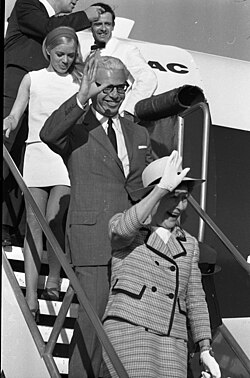
Resolution 242 and the Six-Day War
One of Goldberg's most enduring legacies was his role as a key drafter of Resolution 242, issued following the 1967 Six-Day War between Israel and various Arab states. The resolution's language regarding the withdrawal of Israeli forces has been a subject of long-standing controversy.
Goldberg maintained that the English text—which was the version voted on by the Security Council—did not obligate Israel to withdraw from all captured territories. He pointed out the absence of the words "the," "all," and "the June 5, 1967, lines." According to Goldberg, the resolution stipulated withdrawal from "occupied territories" without defining the exact extent, implying that territorial adjustments could result in a less-than-complete withdrawal to ensure secure and recognized boundaries.
The intensity of these geopolitical tensions was such that Sirhan Sirhan, the assassin of Robert F. Kennedy, reportedly also targeted Goldberg due to his role during the Six-Day War.
Key Facts
- Appointment: Goldberg replaced Adlai Stevenson II as UN Ambassador in 1965.
- Sacrifice: He resigned his seat on the U.S. Supreme Court to take the position.
- Key Diplomatic Wins: Brokered peace in the 1967 Cyprus crisis and resolved the 1968 Pueblo incident.
- Resolution 242: Goldberg argued the English text did not require a total Israeli withdrawal from occupied territories.
- Political Ties: Appointed by Lyndon B. Johnson, who valued Goldberg's resilience and "bulldog" demeanor.
| Category | Details |
|---|---|
| Preceding Role | U.S. Supreme Court Justice |
| Appointing President | Lyndon B. Johnson |
| Key Aide | Charles W. Yost |
| Major Resolution | Resolution 242 (Post-Six-Day War) |
| Conflict Resolutions | Cyprus Crisis (1967), Pueblo Incident (1968) |
Frequently Asked Questions
Why did Goldberg resign from the Supreme Court?
Goldberg resigned to serve as the U.S. ambassador to the UN, motivated by a desire to influence the end of the Vietnam War and a promise from President Johnson that he would be part of the president's cabinet.
What was the significance of Resolution 242?
Resolution 242 was a framework for peace following the 1967 Six-Day War. Goldberg argued that the specific English wording did not mandate a full Israeli withdrawal from all occupied territories, allowing for secure and recognized boundaries.
Who was Charles W. Yost?
Charles W. Yost was a career Foreign Service Officer and the only aide from the previous ambassador, Adlai Stevenson II, whom Goldberg chose to retain to help navigate UN procedures.
What did President Johnson think of Goldberg?
Johnson viewed Goldberg as the ablest man in Kennedy's Cabinet and admired his grit, comparing Goldberg's history of selling newspapers and shining shoes to his own humble beginnings.
Was Goldberg ever targeted for assassination?
Yes, it is believed that Sirhan Sirhan, who assassinated Robert F. Kennedy, also intended to assassinate Goldberg due to his diplomatic role during the Six-Day War.