Gobi Desert: Geography, Climate, and the Struggle Against Desertification
Spanning vast stretches of Central Asia, the Gobi Desert is one of the most significant and formidable arid regions on Earth. Stretching approximately 1,500 km (930 mi) from southwest to northeast and 800 km (500 mi) from north to south, this massive landscape covers an area of roughly 1,295,000 km² (500,000 sq mi). It serves as a critical geographical feature shared between Mongolia and China.
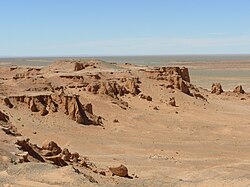
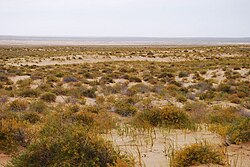
The desert is characterized by its diverse terrain, ranging from high-altitude plateaus to deep depressions. While often associated with endless sand, the Gobi is a complex mosaic of rocky outcrops, salt pans, and vast steppes.
Key Facts
- Total Area: Approximately 1,295,000 km² (500,000 sq mi).
- Primary Countries: Mongolia and China.
- Climate Type: Cold desert with extreme temperature fluctuations.
- Annual Rainfall: Average of 194 mm (7.6 in).
- Major Environmental Challenge: Rapid desertification and increasing dust storms.
Geography and Ecoregions
The Gobi's geography is far from uniform. It is widest in the west, situated along the line connecting Lake Bosten and Lop Nor. The region is divided into several distinct ecoregions, each with unique topographical features.
Eastern Gobi Desert Steppe
The Eastern Gobi desert steppe covers 281,800 km² and extends from the Inner Mongolian Plateau in China northward into Mongolia. This area includes the Yin Mountains and is marked by low-lying areas containing salt pans and small ponds. The surface is highly eroded, featuring broad flat depressions and basins separated by flat-topped mountains that rise between 150 and 180 m (490 to 590 ft).
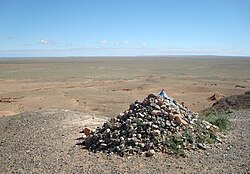
Further south, the landscape transitions into broad tablelands and flat plains. In some areas, the terrain rises steadily toward the Hyangan range, reaching altitudes of up to 1,630 m (5,350 ft). While water is scarce, small lakes occasionally fill depressions, though they are typically salty or brackish (slightly salty).
Other Major Regions
The southwestern portion of the Gobi, known as the Alashan Plateau semi-desert (or the "Little Gobi"), lies between the Yellow River and the Qilian Mountains. Additionally, the Dzungarian Basin semi-desert features complex mountain ranges like the Chol-tagh and Kuruk-tagh, which enclose valleys and "salt deserts" known to locals as Ghashuun-Gobi.
Extreme Climate Conditions
The Gobi is classified as a cold desert. Its high elevation—ranging from 910 to 1,520 m (2,990 to 4,990 ft) above sea level—and its northern latitude contribute to significantly low temperatures. The climate is defined by extreme seasonality and volatility.
In winter, winds from the Siberian Steppes can bring snow and drive temperatures down to as low as −40 °C (−40 °F). Conversely, summer temperatures can soar to 45 °C (113 °F). This creates a massive thermal range, with recorded extremes spanning from −47 °C to 34 °C in some sectors.
| Metric | Value/Range |
|---|---|
| Average Annual Rainfall | 194 mm (7.6 in) |
| Typical Winter Mean | −26.5 °C (−15.7 °F) |
| Typical July Mean | 17.5 °C (63.5 °F) |
| Extreme Temperature Range | −47 °C to 45 °C |
Ecology and the Threat of Desertification
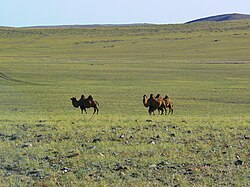
Despite the harsh conditions, the Gobi supports specialized flora and fauna. Vegetation includes saxaul, wormwood, and various grasses like Lasiagrostis splendens. These plants are vital for the local ecosystem and the animals that depend on them, such as the Khulan (Mongolian wild ass) and various camel species.
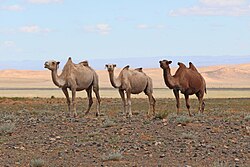
However, the Gobi is currently facing a major environmental crisis: desertification. This process, where fertile land becomes desert, is occurring most rapidly on the southern edge in China, where approximately 3,600 km² of grassland is lost annually. This expansion has led to more frequent dust storms, impacting regional agriculture and economies.
Conservation Efforts: The Green Great Wall
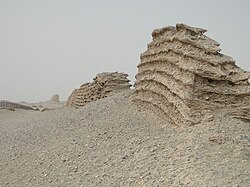
To combat this expansion, the Chinese government initiated the Three-North Shelter Forest Program, often called the "Green Great Wall," in 1978. This massive tree-planting project aims to plant aspen and other fast-growing trees across 36.5 million hectares to stabilize the soil and reverse the desert's advance. The program is scheduled to continue through 2050.
Historical Significance
The Gobi has been a site of human activity for millennia. Archaeological evidence from the Bronze Age (approximately 5000 to 3000 cal BP) reveals that prehistoric inhabitants used micro blades, grinding stones, and copper tools. While increasing aridity led to a decline in habitation between 3500 and 3000 cal BP, the region remains rich in history, including ancient trade routes connecting Kalgan to Ulaanbaatar and Hami to Beijing.
Frequently Asked Questions
Is the Gobi Desert only made of sand?
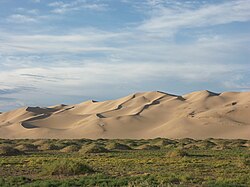
No. While the Gobi contains sand dunes, much of its landscape consists of bare rock, gravel plains, and high-altitude steppes.
Why is the Gobi considered a cold desert?
Its high elevation and northern latitude result in low average temperatures, with frost and snow being common, even on sand dunes.
What is the Green Great Wall?
It is the Three-North Shelter Forest Program, a large-scale Chinese project started in 1978 to plant trees and combat desertification.
What animals live in the Gobi?
The desert is home to specialized wildlife, including Bactrian camels, the Khulan (Mongolian wild ass), and various desert-adapted plants and insects.
How large is the Gobi Desert?
The Gobi covers an area of approximately 1,295,000 square kilometers (500,000 square miles).