Understanding the World's Forests: Ecology, Distribution, and Conservation
Forests are far more than just collections of trees; they are the largest terrestrial ecosystems on Earth. These complex biological communities play a critical role in maintaining the planet's health, acting as massive reservoirs for carbon and supporting the vast majority of land-based biodiversity. From the frozen reaches of the subarctic to the humid depths of the tropics, forests shape the global climate and provide essential services that sustain human life.
What Defines a Forest?
While we often think of a forest simply as a wooded area, scientific definitions are more precise. The United Nations' Food and Agriculture Organization (FAO) defines a forest as land spanning more than 0.5 hectares with trees higher than 5 meters and a canopy cover—the layer of leaves and branches that covers the ground—of more than 10 percent. This definition includes trees capable of reaching these thresholds in situ (in their original place) but excludes land used primarily for urban or agricultural purposes.
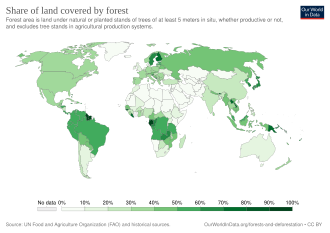
According to the Global Forest Resources Assessment 2025, forests covered approximately 4.14 billion hectares (10.2 billion acres), representing about 31 percent of the world's total land area.
Global Distribution and Diversity
Forests are distributed across various climatic zones, with the tropical latitudes holding the largest share at 45 percent. These are followed by subarctic (boreal), temperate, and subtropical zones.
![Proportion and distribution of global forest area by climatic domain, 2020[1]](/images/8b/36/8b36b09cfc75a029f109c6b8b53c30fd791a321649890a836b3268d53a28509d.webp)
Tropical and Subtropical Forests
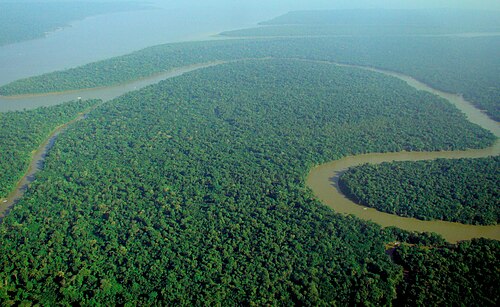
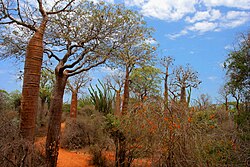
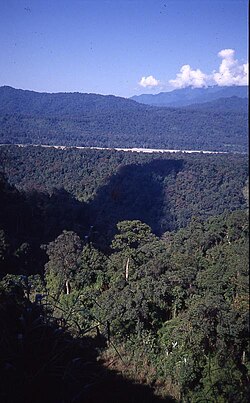
Tropical forests are the most biodiverse and productive ecosystems on the planet. They range from moist rainforests to dry forests. In some regions, such as Madagascar, unique spiny forests feature baobab species and other specialized vegetation.
Boreal and Temperate Forests
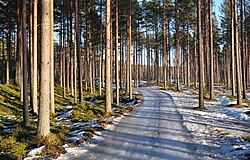
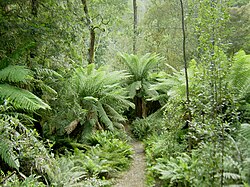
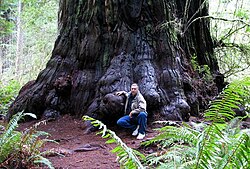
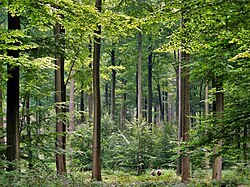
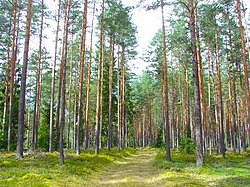
Boreal forests, found in subarctic climates like those in Finland, are characterized by coniferous trees. Temperate forests, which include both broadleaf and needleleaf varieties, are found in more moderate climates. Examples include the temperate rainforests of Tasmania or the redwood forests of northern California, where some trees are managed specifically for longevity rather than timber production.
The Biological Powerhouse: Biomass and Carbon
Forests are essential to the Earth's biosphere, accounting for 75% of its gross primary production (the total energy captured by plants) and containing 80% of all plant biomass. A significant portion of this biomass exists underground in root systems and decomposed organic matter.
The structural integrity of forests is provided by lignin, a complex organic polymer that is slower to decompose than cellulose. As of 2025, global forest biomass is estimated at 709 gigatonnes, averaging 171 tonnes per hectare. These forests also serve as a massive carbon sink, with a total carbon stock of 714 gigatonnes. This carbon is distributed as follows:
- Soil: 46%
- Living biomass: 44%
- Litter and deadwood: 10%
In terms of sheer numbers, a 2015 estimate suggests there are approximately 3 trillion trees worldwide. The highest concentrations are in the tropics and subtropics (1.4 trillion), followed by boreal forests (0.7 trillion) and temperate zones (0.6 trillion).
Deforestation and Ecosystem Fragmentation
Despite their importance, many forest ecosystems are under threat. Deforestation—the removal of trees via cutting or burning—is primarily driven by the production of four commodities: beef, soy, palm oil, and wood.
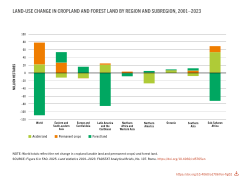
The impact of human activity is evident in historical data. Over the last 2,000 years, Europe's forest cover dropped from 80% to 34%. Similarly, large areas in China and the eastern United States were cleared, leaving as little as 0.1% of land undisturbed in some regions.
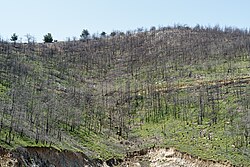
This loss has led to fragmentation. While 49% of Earth's forest area remains relatively intact, 9% exists in fragments with little connectivity. While 80% of the world's forests are in patches larger than 1 million hectares, the remaining 20% is split into over 34 million small patches, most of which are smaller than 1,000 hectares.
The Path to Recovery: The Forest Transition
The "forest transition" occurs when a region shifts from a state of forest loss to a net gain in forested land. This can happen through the establishment of commercial plantations, the use of agroforestry (integrating trees into farming), or spontaneous regeneration on abandoned agricultural land.
Global trends show that the annual net loss of forest area has decreased. In the 1990s, the loss was 7.8 million hectares per year; by 2010–2020, this dropped to 4.7 million hectares. Some countries have seen significant gains; for example, China instituted a logging ban in 1998 to combat erosion and flooding, and both China and Russia have contributed to an overall gain in global biomass through reforestation.
The Intergovernmental Panel on Climate Change (IPCC) has noted that to limit global temperature rise to 1.5°C above pre-industrial levels, the world would need to increase forest cover by an area equal to the size of Canada (10 million square kilometres) by 2050.
Global Forest Management and Protection
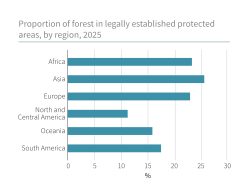
Efforts to protect forests have increased significantly. By 2025, approximately 813 million hectares of forest—about 20% of the global total—were located within legally established protected areas. Asia currently holds the largest share of protected forests at 26%.
Regional Examples of Management
- Canada: With 4 million square kilometres of forest, Canada manages over 90% of its forest land publicly. While 50% is allocated for harvesting under sustainable management principles, about 8% is legally protected from resource development.
- Latvia: Forest land covers 50.5% of Latvia's total area. The country has seen a steady increase in forest cover due to the forestation of non-agricultural land. Birch is the most common tree species at 28.2%.
- United States: The U.S. has seen a net loss of about 2 million hectares between 1997 and 2020. Current management challenges include balancing the prevention of urban sprawl with the need for forest thinning to prevent large-scale wildfires.
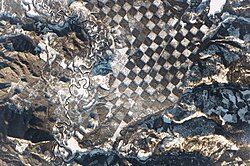
![Since the 13th century, the Niepołomice Forest in Poland has had special use and protection. In this view from space, different coloration can indicate different functions.[24]](/images/02/5a/025ab0a0ba65ba7a7da2265dc9d4186e4d9cdac7a340b453827155d67a0c4361.jpg)
Summary of Global Forest Statistics
| Metric | Value/Detail |
|---|---|
| Total Forest Area | 4.14 billion hectares (~31% of global land) |
| Largest Forest Domain | Tropical (45% of forest land) |
| Top 5 Forest-Rich Countries | Russia, Brazil, Canada, USA, China |
| Total Living Biomass (2025) | 709 gigatonnes |
| Total Carbon Stock | 714 gigatonnes |
| Protected Forest Area (2025) | 813 million hectares (~20% of total) |
Key Facts
- Global Coverage: Forests cover roughly 31% of the Earth's land area.
- Carbon Storage: Nearly half (46%) of forest carbon is stored in the soil.
- Tree Population: There are an estimated 3 trillion trees on Earth.
- Primary Drivers of Loss: Wood, beef, soy, and palm oil production are the main causes of deforestation.
- Climate Goal: An increase in forest cover equal to the size of Canada is needed by 2050 to help limit warming to 1.5°C.
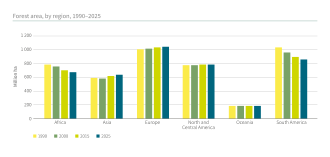
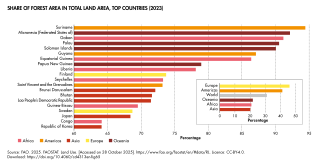
- Regional Leaders: South America has the highest proportion of forest cover relative to its land area (49%).
Frequently Asked Questions
What is the official definition of a forest?
According to the FAO, a forest is land larger than 0.5 hectares with trees taller than 5 meters and a canopy cover exceeding 10%, provided the land is not primarily used for urban or agricultural purposes.
Why is forest biomass important for the environment?
Forests contain 80% of the Earth's plant biomass and 75% of its gross primary production. They act as critical carbon sinks, storing 714 gigatonnes of carbon, which helps regulate the global climate.
What is the "forest transition"?
The forest transition is the process where a region moves from losing forest cover to gaining it. This occurs through reforestation, the adoption of agroforestry, or the natural regeneration of abandoned farmland.
Which countries have the most forest area?
More than half of the world's forests are located in just five countries: Russia, Brazil, Canada, the United States, and China.
How much of the world's forests are protected?
As of 2025, approximately 20% of the world's total forest area (813 million hectares) is located within legally established protected areas.