Gil-Robles and His Influence on the European Parliament
The trajectory of European governance has been shaped by key figures who navigated the complexities of integration and institutional reform. Among these, Gil-Robles stands out for his extensive tenure within the European Parliament, where he rose from a newly elected member to one of the institution's highest offices.
Early Political Ascent and the European People's Party
Gil-Robles entered the European political arena in 1989. Following the re-foundation of the People's Party, he was invited by Marcelino Oreja to join the candidacy for the European Parliament elections. This move proved successful, as he was elected as a Member of the European Parliament (MEP) in July 1989.
His influence grew quickly within the European People's Party (EPP), a center-right transnational political party. Between 1990 and 1992, he served as the vice-president of the EPP, establishing a foundation of leadership that would define his subsequent decade in Brussels and Strasbourg.
Leadership of the European Parliament
After securing re-election as an MEP in 1994, Gil-Robles was appointed Vice-President of the European Parliament, a role he maintained until 1997. His ascent culminated in January 1997, when he was elected President of the European Parliament with a substantial majority of 338 votes.
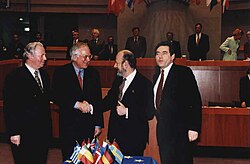
During his presidency, which lasted until 1999, Gil-Robles was instrumental in several landmark developments. He played a pivotal role in negotiating the Treaty of Amsterdam (1997), a significant agreement that expanded the legislative and supervisory powers of the European Parliament.
Key Institutional Milestones
Beyond the Treaty of Amsterdam, Gil-Robles presided over several critical transitions for the European Union (EU):
- EU Expansion: He oversaw the initial negotiations for the accession of new member states to the Union.
- Agenda 2000: He managed the approval of Agenda 2000, a strategic plan designed to reform the EU's budget and policies for the new millennium.
- Crisis Management: He navigated the institutional instability following the resignation of the Santer Commission.
Later Career and Academic Contribution
Gil-Robles continued his service as an MEP after being re-elected in 1999, though he transitioned from the presidency on July 20, 1999, when he was succeeded by Nicole Fontaine. He eventually stepped away from electoral politics, choosing not to stand for the 2004 elections.
Following his parliamentary career, he shifted his focus toward European intellectual and political thought. From 2009 to 2014, he served as the president of the Jean Monnet Foundation for Europe, an organization dedicated to the study and promotion of European integration.
Key Facts
- First Elected: July 1989 as an MEP.
- EPP Leadership: Vice-president of the European People's Party (1990–1992).
- Parliamentary Presidency: President of the European Parliament from 1997 to 1999.
- Election Margin: Won the presidency with 338 votes.
- Major Treaty: Key negotiator for the 1997 Treaty of Amsterdam.
- Foundation Leadership: President of the Jean Monnet Foundation for Europe (2009–2014).
| Period | Role/Position | Key Achievement/Event |
|---|---|---|
| 1989–1999+ | Member of the European Parliament (MEP) | Multiple re-elections |
| 1990–1992 | Vice-President, European People's Party | Party leadership |
| 1994–1997 | Vice-President, European Parliament | Institutional leadership |
| 1997–1999 | President, European Parliament | Treaty of Amsterdam & Agenda 2000 |
| 2009–2014 | President, Jean Monnet Foundation for Europe | Academic and political research |
Frequently Asked Questions
When did Gil-Robles become President of the European Parliament?
He was elected President in January 1997, receiving 338 votes, and held the office until 1999.
What was Gil-Robles' role in the Treaty of Amsterdam?
He played a key role in the negotiations of the 1997 treaty, which resulted in the expansion of the powers held by the European Parliament.
Which political party did Gil-Robles represent?
He was part of the People's Party and served as the vice-president of the European People's Party between 1990 and 1992.
What happened after his presidency of the European Parliament?
He remained an MEP after the 1999 elections until he decided not to run in the 2004 elections. Later, he led the Jean Monnet Foundation for Europe from 2009 to 2014.
What institutional crisis did he manage as President?
He was responsible for managing the institutional crisis that occurred following the resignation of the Santer Commission.