Germany's Large Cities: Population and Urban Demographics
In the landscape of German urban planning, the term Großstadt (large city) carries a specific technical meaning. According to the German Federal Institute for Research on Building, Urban Affairs and Spatial Development, a city is officially classified as a Großstadt if it has a population exceeding 100,000 inhabitants.
It is important to note that these figures refer strictly to the population of individual municipalities within their defined administrative limits. This means the data does not include surrounding suburban areas or broader metropolitan agglomerations, focusing instead on the core municipal boundaries.
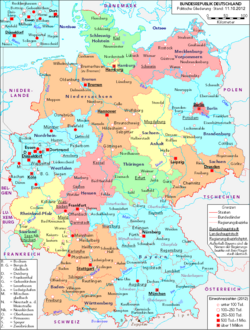
Key Facts
- Threshold: A city must have over 100,000 residents to be classified as a Großstadt.
- Total Count: As of the latest data, 80 cities in Germany meet this criterion.
- Largest City: Berlin remains the most populous city by a significant margin.
- State Capitals: Most state capitals are Großstädte, with Schwerin being the only exception.
- Data Source: Population estimates are provided by the Federal Statistical Office of Germany.
Analyzing Urban Growth and Density
Between December 31, 2015, and December 31, 2021, Germany's urban centers experienced varying degrees of demographic shifts. While many cities saw steady growth, others experienced slight declines. For instance, Leipzig showed significant growth (+7.39%), while others like Recklinghausen saw a decrease (-3.16%).
Population density—the number of residents per unit of land area—varies wildly across these 80 cities. High-density hubs like Berlin and Munich contrast sharply with more sprawling municipalities, reflecting different urban planning histories and geographic constraints.
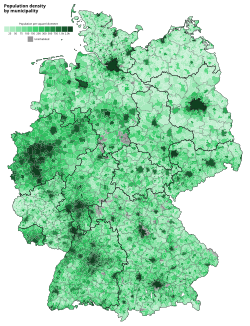
Top 10 Largest Cities in Germany
The following table provides a detailed snapshot of the ten most populous cities as of December 31, 2021. This list highlights the dominant urban centers that drive the nation's economy and culture.
| Rank | City | State | Population (2021) | Growth (since 2015) | Density (per km²) |
|---|---|---|---|---|---|
| 1 | Berlin | Berlin | 3,677,472 | +4.47% | 4,126 |
| 2 | Hamburg | Hamburg | 1,906,411 | +6.66% | 2,524 |
| 3 | Munich | Bavaria | 1,487,708 | +2.57% | 4,788 |
| 4 | Cologne | North Rhine-Westphalia | 1,073,096 | +1.18% | 2,648 |
| 5 | Frankfurt am Main | Hesse | 759,224 | +3.62% | 3,057 |
| 6 | Stuttgart | Baden-Württemberg | 626,275 | +0.41% | 3,020 |
| 7 | Düsseldorf | North Rhine-Westphalia | 619,477 | +1.19% | 2,849 |
| 8 | Leipzig | Saxony | 601,866 | +7.39% | 2,024 |
| 9 | Dortmund | North Rhine-Westphalia | 586,852 | +0.11% | 2,091 |
| 10 | Essen | North Rhine-Westphalia | 579,432 | -0.55% | 2,755 |
Frequently Asked Questions
What is the definition of a Großstadt in Germany?
A Großstadt is defined by the German Federal Institute for Research on Building, Urban Affairs and Spatial Development as any city with a population of more than 100,000 inhabitants.
How many cities in Germany are classified as Großstädte?
As of the data provided, there are 80 cities in Germany that fulfill the population requirement of at least 100,000 residents.
Does the population count include suburban areas?
No. The population figures refer only to individual municipalities within their defined administrative limits and do not include other municipalities or suburban areas within larger metropolitan regions.
Which state capital is not considered a Großstadt?
Schwerin is the only state capital in Germany that is not listed among the cities with a population of 100,000 or more.
Which city has seen significant growth recently?
Among the top cities, Leipzig showed a notable population increase of 7.39% between 2015 and 2021, and Potsdam saw a growth of 9.19%.