Germanic Languages: History, Distribution, and Linguistic Evolution
The Germanic languages represent a major branch of the Indo-European language family, spoken by approximately 515 million native speakers worldwide. While their origins are rooted in Northern and Central Europe, the expansion of global trade, colonization, and migration has spread these languages across the Americas, Africa, Asia, and Oceania.
From the global dominance of English to the regional importance of German and Dutch, the Germanic family is characterized by a shared ancestral root known as Proto-Germanic. This linguistic lineage has diverged over millennia into distinct branches, each contributing to the cultural and political landscape of the modern world.
Key Facts
- Total Native Speakers: Approximately 515 million.
- Primary Branches: West Germanic, North Germanic, and the extinct East Germanic.
- Most Spoken Language: English (360–400 million native speakers).
- Linguistic Root: A sub-branch of the Indo-European family.
- Geographic Reach: Principally Europe, but with significant presence in the Americas, Africa, and Oceania.
Classification and Distribution
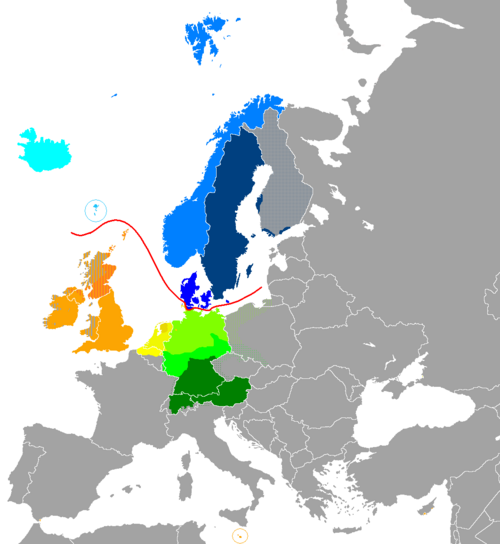
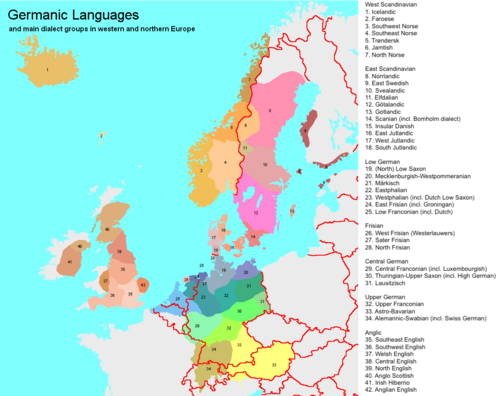
The Germanic family is divided into three primary subdivisions. The West Germanic branch is the most populous, encompassing English, German, and Dutch. The North Germanic branch includes the Scandinavian languages, while the East Germanic branch, which included Gothic, is now extinct.
West Germanic Languages
This group contains the most widely spoken members of the family. English leads with 360–400 million native speakers, followed by German (over 100 million) and Dutch (24 million). Other notable languages include Afrikaans, an offshoot of Dutch spoken in South Africa, and Yiddish, which historically served millions of Jews in Europe.
North Germanic Languages
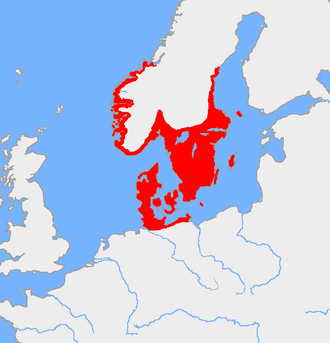
Primarily spoken in Northern Europe, this branch includes Swedish, Danish, Norwegian, Icelandic, and Faroese. These languages evolved from Old Norse, which was the lingua franca of the Viking Age.
Historical Evolution
The history of Germanic languages is traced back to Proto-Germanic. The earliest preserved coherent text is the 4th-century Gothic translation of the New Testament by Ulfilas. Early evidence of West Germanic appears in the 5th-century Bergakker inscription (Old Frankish/Old Dutch), while Old English texts began appearing around 650 AD.
The expansion of Germanic tribes significantly altered the linguistic map of Europe. Early migrations saw these groups move into Central Europe, areas previously dominated by Celtic populations.
![Expansion of early Germanic tribes into previously mostly Celtic Central Europe:[40] Settlements before 750 BC New settlements by 500 BC New settlements by 250 BC New settlements by AD 1 Some sources also give a date of 750 BC for the earliest expansion out of southern Scandinavia and northern Germany along the North Sea coast towards the mouth of the Rhine.[41]](/images/a4/45/a4458246d4f8131cd514f52e37d993ff9eb28a1ebceae928434f532f6ff02463.png)
By the early 10th century, the distribution of these languages had solidified across Northern and Western Europe, creating a distinct border between Germanic and Romance languages.
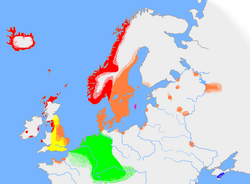
![Germanic – Romance language border:[73] • Early Middle Ages • Early Twentieth Century](/images/16/4a/164ab67ed1a7190bd7bbebb5d6981141459d8d0b4b11e1d472b4ca0bc452fed2.webp)
Linguistic Characteristics
Germanic languages are noted for their complex phonology, particularly their large inventories of vowel qualities. For example, Standard Swedish utilizes 17 pure vowels (monophthongs), while Standard German and Dutch use 14. Some dialects, such as the Amstetten dialect of Bavarian German, possess one of the world's largest inventories of long vowel distinctions.
The i-umlaut Process
A defining innovation for nearly all Germanic languages (except Gothic) is the i-umlaut. This is a sound change where back vowels become fronted, or front vowels are raised, when followed by /i/, /iː/, or /j/ in the subsequent syllable. This process occurred at different times across the family; Old English was among the earliest and most affected, while Old High German was among the last.
Morphological Development
The evolution of nouns and adjectives in Germanic languages is often categorized by "strong" and "weak" declensions. This system influenced how words were modified to indicate grammatical case, number, and gender across the various branches.
Comparative Statistics
The following table provides a snapshot of the most prominent Germanic languages and their estimated native speaker populations.
| Language | Native Speakers (Millions) | Branch |
|---|---|---|
| English | 360–400 | West Germanic |
| German | 100 | West Germanic |
| Dutch | 24 | West Germanic |
| Swedish | 11.1 | North Germanic |
| Afrikaans | 8.1 | West Germanic |
| Danish | 5.5 | North Germanic |
| Norwegian | 5.3 | North Germanic |
| Low German | 3.8 | West Germanic |
Frequently Asked Questions
What is Proto-Germanic?
Proto-Germanic is the reconstructed common ancestor of all Germanic languages. While not recorded in writing, linguists reconstruct it by comparing the earliest known Germanic languages.
Which Germanic languages are still spoken today?
The surviving languages belong to the West Germanic branch (e.g., English, German, Dutch, Afrikaans) and the North Germanic branch (e.g., Swedish, Danish, Norwegian, Icelandic, Faroese).
What happened to the East Germanic languages?
The East Germanic branch, which included languages such as Gothic, Burgundian, and Vandalic, is now extinct. Gothic is the most well-documented of these due to 4th-century biblical translations.
What is the i-umlaut in linguistics?
The i-umlaut is a vowel shift common to Northwest Germanic languages where a vowel changes its quality to more closely match a following /i/ or /j/ sound in the next syllable.
How many people speak Germanic languages natively?
It is estimated that approximately 515 million people are native speakers of a Germanic language, with English accounting for the vast majority of this total.