Gerald Ford: The 38th President of the United States
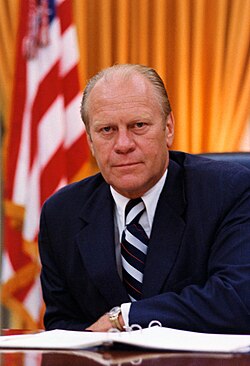
Gerald Ford holds a unique place in American history as the only person to serve as president without being elected to either the presidency or the vice presidency. A Republican from Michigan, Ford ascended to the highest office in the land during one of the most turbulent eras of the 20th century, tasked with healing a nation fractured by political scandal.
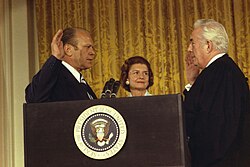
Ford's journey to the White House began on December 6, 1973, when he was appointed vice president following the resignation of Spiro Agnew. His tenure as president officially began on August 9, 1974, immediately following the resignation of Richard Nixon. He served for 895 days, making his term the shortest of any U.S. president who did not die in office.
Key Facts
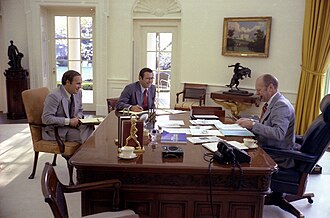
- Term of Office: August 9, 1974 – January 20, 1977.
- Unique Status: Only U.S. president never elected to the presidency or vice presidency.
- Major Action: Granted a full pardon to Richard Nixon.
- Foreign Policy: Signed the Helsinki Accords and maintained Cold War diplomacy.
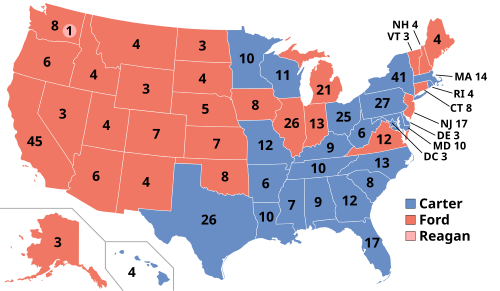
- Election Result: Narrowly defeated by Jimmy Carter in 1976.
The Ford Administration
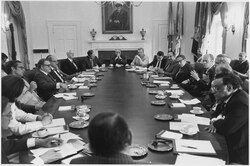
President Ford's administration was characterized by a transition from the chaos of the Watergate era toward stability. He assembled a cabinet of experienced officials, including Henry Kissinger as Secretary of State and Nelson Rockefeller as Vice President.
Domestic Challenges and the Nixon Pardon
The most controversial moment of Ford's presidency was his decision to grant a full and unconditional pardon to Richard Nixon. While Ford viewed this as a necessary step to move the country past the Watergate scandal, it sparked significant public backlash and led to House Judiciary Subcommittee hearings.
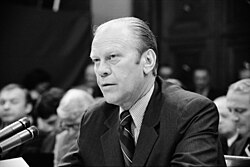
Beyond the pardon, Ford dealt with complex domestic issues, including the economy and the social upheaval of court-ordered busing to desegregate public schools. On the issue of abortion, Ford initially opposed Roe v. Wade (the 1973 Supreme Court case legalizing abortion), supporting a constitutional amendment that would allow individual states to decide. However, in his later years, he identified as pro-choice.
Economic Performance
The mid-1970s were marked by economic instability. The Ford administration faced significant deficits and fluctuating GDP growth. Below is a summary of the fiscal data during his tenure:
| Fiscal Year | Receipts (Billion $) | Outlays (Billion $) | Deficit (Billion $) | GDP (Billion $) | Debt as % of GDP |
|---|---|---|---|---|---|
| 1975 | 279.1 | 332.3 | –53.2 | 1,606.9 | 24.6% |
| 1976 | 298.1 | 371.8 | –73.7 | 1,786.1 | 26.7% |
| 1977 | 355.6 | 409.2 | –53.7 | 2,024.3 | 27.1% |
Foreign Affairs and Global Diplomacy
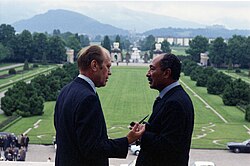
Ford was an active diplomat, making seven international trips to eighteen different countries. His foreign policy focused on managing the Cold War and navigating the end of U.S. involvement in Vietnam.
![Ford made seven international trips to eighteen different countries during his presidency.[136]](/images/2a/cf/2acf9d01150ae67cc9f74bc651060d8fbb7bf9555ec5b706a87a9697c77a3b8d.png)
Cold War and Asia
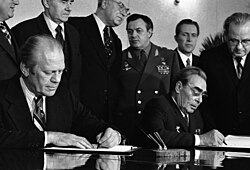
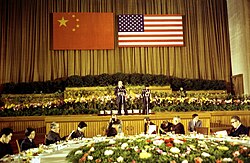
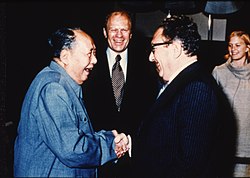
Ford continued the policy of détente (the easing of strained relations) with the Soviet Union, meeting with leader Leonid Brezhnev to sign a joint communiqué on the SALT (Strategic Arms Limitation Talks) treaty. He also strengthened ties with China, visiting Peking in 1975.
The End of the Vietnam War
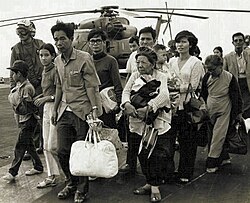
One of the most poignant moments of Ford's presidency was the final evacuation of South Vietnam. Operation Frequent Wind saw the arrival of South Vietnamese refugees on U.S. Navy vessels as the conflict reached its conclusion.
The Path to 1977
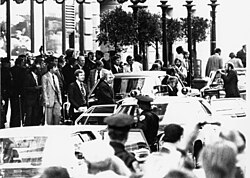
Ford's presidency was not without physical danger; he survived assassination attempts, including one in San Francisco where he exited the St. Francis Hotel seconds before a shooter attempted to fire.
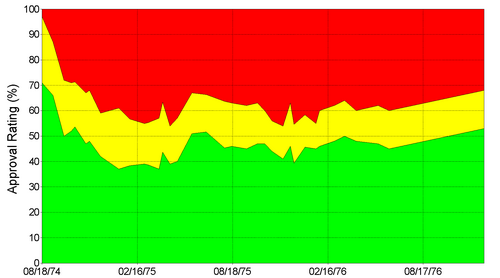
Despite his efforts to stabilize the nation, Ford faced a challenging 1976 election. His approval ratings fluctuated, and he was ultimately defeated in a narrow race by Democrat Jimmy Carter.
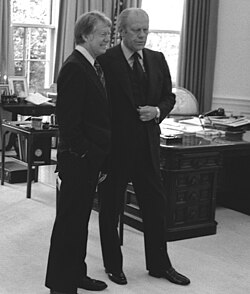
The transition of power took place on January 20, 1977, marking the end of Ford's 895-day tenure.
Frequently Asked Questions
How did Gerald Ford become president?
Gerald Ford became president on August 9, 1974, following the resignation of Richard Nixon. He had previously been appointed as vice president in 1973 after Spiro Agnew resigned.
Why is Gerald Ford's presidency unique?
He is the only person in U.S. history to serve as president without being elected to either the presidency or the vice presidency.
What was the most controversial act of Ford's presidency?
The most controversial act was his decision to grant a full pardon to Richard Nixon, which Ford believed was necessary to heal the nation but which many critics viewed as an injustice.
Who defeated Gerald Ford in the 1976 election?
Democrat Jimmy Carter defeated President Ford in a narrow victory in the 1976 presidential election.
What were some of Ford's major foreign policy achievements?
Ford signed the Helsinki Accords, continued SALT treaty negotiations with the Soviet Union, and managed the final evacuation of refugees from South Vietnam during Operation Frequent Wind.