Gaspard Bauhin: The Swiss Pioneer of Botanical Classification
Long before the modern systems of biological naming became standard, Gaspard Bauhin (also known as Caspar Bauhin) laid the groundwork for how we categorize the natural world. A Swiss botanist and physician of the early 17th century, Bauhin transformed the University of Basel into a global hub for botanical science, bridging the gap between ancient herbalism and the rigorous taxonomic systems that would follow.
Key Facts
- Full Name: Gaspard Bauhin (Latin: Casparus Bauhinus).
- Lifespan: January 17, 1560 – December 5, 1624.
- Major Work: Pinax theatri botanici (1623), describing approximately 6,000 plant species.
- Medical Contribution: Described the ileocecal valve, now known as Bauhin's Valve.
- Academic Legacy: Served as rector of the University of Basel three times (1592, 1611, 1619).
- Scientific Influence: His concise naming style prefigured the binomial nomenclature later popularized by Carl Linnaeus.
Early Life and Academic Journey
Born in Basel, Switzerland, Gaspard was the son of Jean Bauhin, a French surgeon to the King who relocated after converting to Protestantism. Gaspard's education was expansive and international; he studied in Basel, Padua, Bologna, Montpellier, Paris, and Tübingen. He earned his medical doctorate from the University of Basel in 1581.
Bauhin's academic rise was rapid. He began by giving private lectures in anatomy and botany, eventually securing a Greek professorship in 1582 and a chair of anatomy and botany in 1589. By 1614, he became the city physician (Stadtarzt) and professor of the practice of medicine. His influence extended beyond the classroom, as he systematically trained a generation of scholars, establishing botany as an independent scientific discipline.
Contributions to Botany and Taxonomy
Bauhin was a master of empirical research. He maintained one of the most extensive herbaria (collections of preserved plant specimens) of his era, containing over 4,000 species. To expand his knowledge, he cultivated a vast network of correspondents, leaving behind more than 2,500 preserved letters—a corpus larger than that of his contemporary, Carolus Clusius.
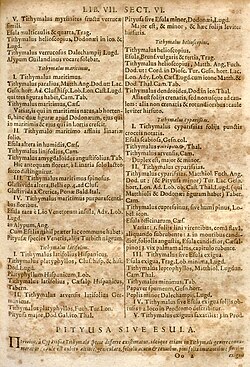
His most significant achievement was the 1623 publication of Pinax theatri botanici (Illustrated exposition of plants). In this landmark work, Bauhin described and classified roughly 6,000 species. While he used traditional groupings—such as "trees," "shrubs," and "herbs," or the Aromata for spices—he correctly grouped legumes and grasses by modern standards.
Most notably, Bauhin streamlined plant descriptions. By reducing descriptions to a few diagnostic words, he created a naming style that resembled a two-part name. While these were still descriptions rather than arbitrary names, this approach heavily influenced the binomial nomenclature (the two-term naming system) later adopted by Linnaeus.
Other Botanical and Anatomical Works
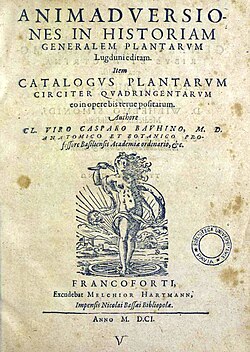
Beyond the Pinax, Bauhin authored the Phytopinax (1596) and worked on a massive twelve-part Theatrum Botanicum, though only one part was published posthumously in 1658. He also contributed significantly to human anatomy. In 1588, in the preface of De corporis humani partibus externis tractatus, hactenus non editus, he described the ileocecal valve—the junction between the small and large intestines—which is still referred to as the Valve of Bauhin.
Summary of Bauhin's Legacy
| Category | Key Contribution | Impact |
|---|---|---|
| Botany | Pinax theatri botanici | Classified 6,000 species; influenced Linnaean nomenclature. |
| Anatomy | Ileocecal Valve description | Established the "Valve of Bauhin." |
| Education | University of Basel Chair | Made Basel a center for botanical science in the German-speaking world. |
| Research | 4,000+ species herbarium | Provided an empirical foundation for a "general history" of plants. |
Frequently Asked Questions
How did Gaspard Bauhin influence Carl Linnaeus?
Bauhin's practice of pruning species descriptions down to a few diagnostic words gave the appearance of a two-part name. This concise approach served as a precursor to the formal binomial nomenclature system later developed by Linnaeus.
What is Bauhin's Valve?
Bauhin's Valve, or the ileocecal valve, is the anatomical structure that separates the small intestine from the large intestine. Gaspard Bauhin first described it in 1588.
What was the significance of the Pinax theatri botanici?
Published in 1623, it was a landmark of botanical history that described and classified approximately 6,000 plant species, helping to organize botanical knowledge systematically.
How did Bauhin obtain so many exotic plant samples?
Bauhin built an extensive international network of correspondents, which allowed him to receive and study foreign and exotic botanical samples from around the world.
What is the genus Bauhinia?
The genus Bauhinia was named by Carl Linnaeus to honor the Bauhin brothers, Gaspard and Jean.