Garry Davis: The Man Who Renounced His Nationality for World Citizenship
In an era defined by rigid national borders and the aftermath of global conflict, one man decided that the only way to ensure lasting peace was to belong to everyone and no one at the same time. Garry Davis was an American-born activist who became a global symbol of peace and world citizenship after renouncing his U.S. nationality to advocate for a unified world government.
From the stages of Broadway to the cockpits of World War II bombers, Davis's life was a journey of dramatic transitions. His ultimate mission was to dismantle the nationalistic divisions he believed led humanity toward the abyss of total war.
Key Facts
- Identity: Renounced U.S. citizenship in 1948 to become a stateless "citizen of the world."
- Major Achievement: Created the World Passport, a travel document based on the Universal Declaration of Human Rights.
- Organizations: Founded the World Service Authority (WSA) and the International Registry of World Citizens.
- Military Service: Served as a B-17 bomber pilot during World War II.
- Environmental Innovation: Introduced "kilowatt dollars," an early form of emissions reduction currency.
Early Life and Diverse Career
Born Sol Gareth Davis on July 27, 1921, in Bar Harbor, Maine, to parents of Jewish and Irish descent, Davis pursued a varied education. He graduated from The Episcopal Academy in 1940 and attended the Carnegie Institute of Technology, known today as Carnegie Mellon University.
Before his life as an activist, Davis experienced the heights of American entertainment. He worked as a Broadway actor, appearing in the hit Three to Make Ready and serving as an understudy for the legendary Danny Kaye in the musical Let's Face It!
However, his life took a pivotal turn during World War II. Davis served as a B-17 bomber pilot in the U.S. Army. The trauma of the war—specifically the death of his own brother and the civilian casualties he caused while bombing Brandenburg an der Havel—deeply scarred him and fueled his lifelong commitment to pacifism.
The Quest for World Government
Driven by the fear that nuclear weapons could terminate humanity, Davis renounced his United States citizenship at the American Embassy in Paris in May 1948. He declared himself a citizen of the world, inspired in part by Henry Martyn Noel, who had taken a similar step.
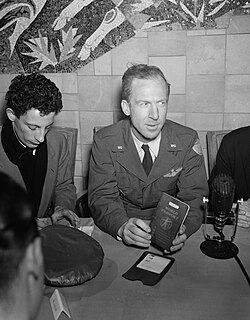
Davis's activism was characterized by bold, public gestures. On November 19, 1948, he interrupted a United Nations General Assembly session, proclaiming that sovereign states divide humanity and that only a world government could provide true peace. While he rallied over 15,000 supporters in Paris, his efforts were not without critics; Eleanor Roosevelt famously dismissed his actions as "flash-in-the-pan publicity."
Institutionalizing World Citizenship
To give structure to his vision, Davis founded several organizations:
- International Registry of World Citizens (1949): A registry that eventually signed up over 750,000 individuals.
- World Government of World Citizens (1953): An organization aimed at furthering fundamental human rights.
- World Service Authority (1954): The administrative agency that issued "world government documents."
The most famous of these documents was the World Passport. Based on Davis's interpretation of Article 13(2) of the Universal Declaration of Human Rights, this fantasy travel document was intended to facilitate movement across borders. Davis first used the passport for a trip to India in 1956 and claimed it granted him entry into several countries.
Later Years and Legacy
Davis remained a provocative figure throughout his life. In 1986, he ran for mayor of Washington, D.C., and later declared himself a presidential candidate in 1988 under the "World Citizen Party" banner.
His interests eventually expanded into environmental economics. At the 1992 Earth Summit in Rio de Janeiro, he distributed "kilowatt dollars," a currency based on solar power production proposed by Buckminster Fuller. This is recognized as one of the earliest documented emissions reduction currencies.
In his final years, Davis continued to support those he viewed as victims of nationalistic law. In 2012, he sent World Passports to WikiLeaks founder Julian Assange and whistleblower Edward Snowden. He began hosting a weekly radio show, "World Citizen Radio," at the age of 90.
Garry Davis passed away on July 24, 2013, in South Burlington, Vermont, at the age of 91.
| Category | Details |
|---|---|
| Lifespan | July 27, 1921 – July 24, 2013 |
| Citizenship Status | U.S. (1921–1948); Stateless (1948–2013) |
| Key Document | World Passport |
| Primary Goal | Establishment of a World Government to end war |
| Notable Allies | Albert Camus, André Breton, Abbé Pierre |
Frequently Asked Questions
What is a World Passport?
The World Passport is a travel document issued by the World Service Authority. It is based on the concept of world citizenship and the Universal Declaration of Human Rights, though it is generally considered a fantasy document rather than a legally recognized passport by most sovereign nations.
Why did Garry Davis renounce his U.S. citizenship?
Davis renounced his citizenship in 1948 because he believed that national loyalty fueled war. His experiences as a B-17 bomber pilot in World War II and the loss of his brother led him to believe that only a world government could prevent nuclear annihilation and nationalistic conflict.
What were "kilowatt dollars"?
Kilowatt dollars were a form of currency introduced by Davis at the 1992 Earth Summit. Based on an idea by Buckminster Fuller, the currency was backed by kilowatt-hours of solar power produced, serving as an early example of an emissions reduction currency.
Did the United Nations support Garry Davis?
No. While Davis interrupted a UN General Assembly session to demand the recognition of the rights of humanity, the organization did not adopt his proposals. Some prominent figures, including Eleanor Roosevelt, were critical of his methods.
Who were some of Garry Davis's supporters?
Davis was supported by several influential intellectuals and activists in France, including writers Albert Camus and André Breton, as well as Abbé Pierre, the founder of the Emmaus movement.