Ganjifa Playing Cards: A History of Art and Gaming Across Asia and Europe
The story of Ganjifa is a fascinating journey of cultural exchange, tracing the evolution of playing cards from the courts of Persia and the Mughal Empire to the coffee houses of the Arab world and the gaming tables of Europe. These cards, often recognized by their distinct circular shape and intricate artistry, represent more than just a game; they are a historical record of trade, diplomacy, and artistic adaptation.
Key Facts
- Origins: Believed to have originated in Persia, with potential influences from Chinese money-suited cards.
- Etymology: The name likely derives from the Persian word ganj, meaning "treasure."
- Mamluk Influence: 15th-century Egyptian Mamluk cards are seen as a critical link between Chinese cards and European Latin suits.
- Indian Innovation: While Persian cards were rectangular, the iconic circular shape of Ganjifa is an Indian innovation.
- Deck Variety: Decks varied from 52 cards (Mamluk) to 96 cards (Safavid/Mughal) and even specialized 10-suited Hindu decks.
Etymology and Early Origins
The precise origins of Ganjifa remain a subject of scholarly debate, though Persia is widely cited as the birthplace of the cards as they are known today. The term Ganjifa likely begins with the Persian word ganj ("treasure"). Some theorists suggest the latter syllables may stem from the Chinese chi-p'ai (紙牌), meaning "playing cards," or ya-pae (牙牌), meaning "bone ticket."
Historical accounts support the movement of these cards across borders. In the 18th century, traveler Carsten Niebuhr observed Arabian merchants in Bombay playing with Chinese cards, and 19th-century accounts by Jean Louis Burckhardt noted the prevalence of small Chinese cards in Mecca's coffee houses.
The Mamluk Connection and European Influence
Playing cards were present in Egypt by the 12th century. The Mamluk Egyptian decks, some dating to the 15th century, provide a vital missing link in the history of gaming. These decks consisted of 52 cards divided into four suits: Coins, Polo-sticks, Cups, and Swords.
Many historians believe Mamluk cards entered Italy and Spain during the 1370s, influencing the development of European "Latin" suits. For instance, the Mamluk "Polo-sticks" (derived from the Chinese "Strings of Coins") were converted into cudgels or batons in Europe, as polo was unknown there. Similarly, the "Cups" suit likely evolved from the Chinese character for "myriads" (万).
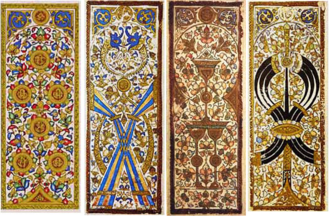
The structural similarities extend to the gameplay. In Mamluk cards, certain suits follow a reverse numerical order (King, Vizier, 1, 2... 10), a feature mirrored in early European games like Tarot, Ombre, and Maw, as well as the Chinese game Madiao.
Persian and Mughal Evolution
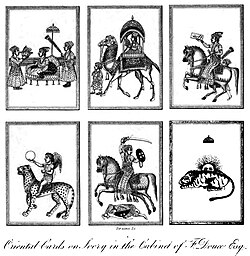
In Persia, Ganjifa evolved into a more complex form. By the time of the Safavid dynasty, decks often contained 96 cards across eight suits. The poet Ahli Shirazi (d. 1535) even wrote a verse for each of the 96 cards in his Rubaiyat-e-Ganjifa. However, the game faced setbacks, such as a ban by Shah Abbas II in the mid-17th century, which led to a decline in its popularity in Persia.
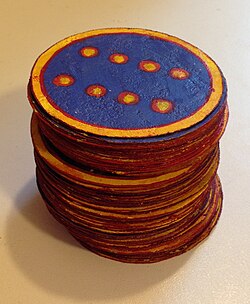
The game flourished in India under the Mughal emperors in the 16th century. The Baburnama records that in 1527, Babur, the founder of the Mughal dynasty, sent a pack of Ganjifa cards to Shah Hassan. While Persian cards remained rectangular, Indian artisans innovated the circular shape that defines the medium today.
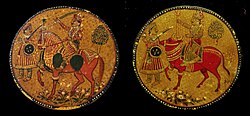
To appeal to local populations, the Dashavatara Ganjifa was created in the 17th century, featuring ten suits based on the ten avatars of Vishnu. Some historical Indian decks were even more elaborate, featuring over 30 suits.
The Decline of Traditional Ganjifa
The transition from handmade Ganjifa to mass-produced Western cards was driven by several industrial and political factors:
- Industrialization: The rise of steam-powered printing, lithography, and offset printing in Europe (notably in Turnhout, Belgium) allowed for cheaper, faster production.
- Game Compatibility: Western cards were better suited for the emerging popularity of games like Bridge, Poker, and Rummy.
- State Control: The introduction of card taxes (such as in the Ottoman Empire in 1904) and state monopolies (such as Iran's 1931 Foreign Trade Monopoly Act) favored large-scale manufacturers over traditional artisans.
By the 20th century, Western-style cards dominated the market. In Iran, the game of As-Nas faded by 1945, and in the Gulf region, the French game Belote (known locally as Baloot) became more popular.
Summary of Ganjifa Variations
| Tradition | Typical Shape | Common Suit Count | Key Characteristics |
|---|---|---|---|
| Mamluk (Egyptian) | Rectangular | 4 | Link between Chinese and European suits. |
| Safavid (Persian) | Rectangular | 8 | High card count; influenced Mughal style. |
| Mughal (Indian) | Circular | 8 | Introduced the circular format. |
| Dashavatara (Hindu) | Circular | 10 | Based on the avatars of Vishnu. |
| Ganjapa (Odisha) | Circular | Variable | Abstract, stylized symbols; still practiced. |
Frequently Asked Questions
Where is Ganjifa still played today?
Significant communities of Ganjifa makers and players still exist in India, specifically in Odisha (where it is called Ganjapa), Mysore, Nirmal, Sawantwadi, Rajasthan, Kashmir, Bishnupur, and Sheopur.
What is the difference between Mamluk and Safavid cards?
Mamluk cards typically used a 4-suit system and were more conservative in their suit designs, whereas Safavid cards expanded to 8 suits and added new ranks to make the game more challenging.
How did Ganjifa influence modern playing cards?
The Mamluk version of Ganjifa likely introduced the concept of suits and reverse numerical ordering to Italy and Spain, which eventually evolved into the French suits (hearts, diamonds, clubs, spades) used globally today.
Why did Ganjifa cards change from rectangular to circular?
While Persian Ganjifa was always rectangular, the circular shape was an innovation introduced in India, likely to distinguish the local style and enhance the aesthetic appeal of the decks.
What caused the decline of handmade Ganjifa cards?
The decline was caused by the rise of European industrial printing, the popularity of Western card games like Poker and Bridge, and government taxes and monopolies that disadvantaged small-scale artisans.