The Peacock Throne: The Lost Masterpiece of the Mughal Empire
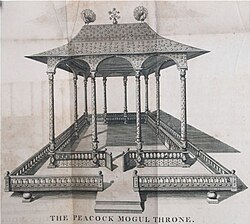
The Peacock Throne (known as Mayūrāsana in Sanskrit and Takht-i Tāvūs in Persian) was the legendary imperial seat of the Mughal emperors. These Sunni Muslim rulers of the Timurid dynasty, of Turco-Mongol origin, utilized the throne as the ultimate symbol of their power and divine right to rule. Named for the two magnificent peacocks with displaying tails mounted on its canopy, the throne represented the pinnacle of Mughal artistry and wealth.
Commissioned in the early 17th century by Emperor Shah Jahan, the throne was housed in the Diwan-i-Khas (the Hall of Private Audiences) within the Red Fort of Delhi. It served as the center of the empire's political and ceremonial life until it was seized as a war trophy during a devastating invasion in 1739.
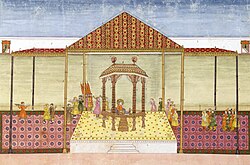
Key Facts
- Commissioned by: Emperor Shah Jahan in the early 17th century.
- Location: Diwan-i-Khas, Red Fort, Delhi.
- Cost: Approximately 100 lakhs (10 million) of rupees.
- Key Gems: Included the Koh-i-Noor, Akbar Shah, and Shah diamonds, and the Timur Ruby.
- Fate: Looted by Nader Shah of Persia in 1739; later dismantled or destroyed.
The Rise and Splendor of the Throne
The Peacock Throne was a radical departure from the previous imperial seat used by Shah Jahan's father, Jahangir, which was a simple rectangular slab of engraved black basalt. The new throne was designed to be an overwhelming display of opulence.
It was officially inaugurated on March 22, 1635, marking the seventh anniversary of Shah Jahan's accession. This date was carefully selected by astrologers to coincide with two major celebrations: Eid al-Fitr (the end of Ramadan) and Nowruz (the Persian New Year), ensuring the emperor's entry into the capital was seen as doubly auspicious.
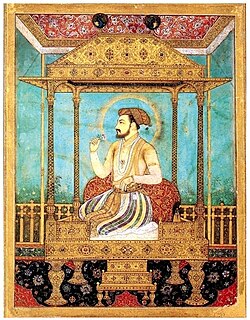
Imperial Succession and Decline
Following Shah Jahan, the throne was ascended by his son Aurangzeb (Alamgir), the last of the strong Mughal emperors. After Aurangzeb's death in 1707, the empire entered a period of instability. While Bahadur Shah I maintained temporary stability through relaxed religious policies, his successors—including Jahandar Shah, Farrukhsiyar, and Muhammad Shah—struggled with court intrigues and military defeats.
Despite the political decline, the court of Muhammad Shah remained a center for arts and culture. However, the ongoing Mughal-Maratha Wars exhausted the empire's resources, leaving it vulnerable to external threats from Persia.
The Invasion of Nader Shah and the Loss of the Throne
The fate of the Peacock Throne was sealed on February 13, 1739, at the Battle of Karnal, where the Persian ruler Nader Shah defeated Muhammad Shah. Nader Shah subsequently sacked Delhi, resulting in the massacre of tens of thousands of residents and the looting of the city's vast treasures.
The Peacock Throne was taken to Persia as a war trophy. Along with the throne, Nader Shah seized some of the world's most famous gemstones, many of which were embedded in the throne itself. These included the Koh-i-Noor and Akbar Shah diamonds (said to form the eyes of the peacocks), the Shah diamond, the Samarian spinel, and the Timur Ruby.
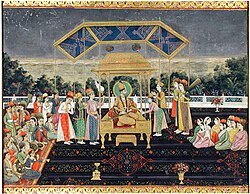
After Nader Shah was assassinated in 1747, the throne vanished. It is widely believed that the structure was dismantled and its precious stones stripped during the ensuing chaos. While some rumors suggest it was gifted to the Ottoman Sultan, most historians believe it was destroyed for its valuables.
Detailed Descriptions and Historical Accounts
Because the original throne no longer exists, historians rely on contemporary accounts to reconstruct its appearance. Two primary sources provide detailed, though slightly conflicting, descriptions.
The Account of Abdul Hamid Lahori
Writing in the Padshahnama, Lahori describes a massive project that took seven years to complete. He notes that the throne featured eleven jeweled recesses for cushions, with the central seat for the Emperor costing ten lakhs of rupees alone. Lahori's account emphasizes the inclusion of the most famous imperial diamonds and the 352.50-carat Timur Ruby.
The Account of Jean-Baptiste Tavernier
Jean-Baptiste Tavernier, a French jeweler who visited the court in 1665, provided an eyewitness account in Les Six Voyages. He described the throne as having four legs and a canopy supported by 12 columns embedded with pearls weighing 6 to 10 carats each.
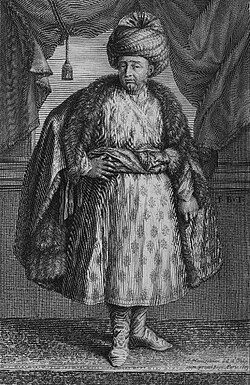
Tavernier's description focuses on the intricate arrangement of 108 large cabochon-cut balas rubies and 116 large emeralds. He noted a large diamond of 80 to 90 carats suspended on the side facing the court, which remained in the Emperor's view while he sat.
Comparing the Records
| Feature | Abdul Hamid Lahori | Jean-Baptiste Tavernier |
|---|---|---|
| Dimensions | 9 ft length x 7.5 ft breadth | 6 ft length x 4 ft breadth |
| Height | 15 feet | Not specified (legs approx. 2 ft) |
| Canopy Columns | 12 emerald columns | 12 pearl-embedded columns |
| Key Gems | Koh-i-Noor, Timur Ruby, etc. | 108 rubies, 116 emeralds |
Legacy and Aftermath
The loss of the original throne led to the creation of replacements, though none matched the original's splendor. A later version of the throne disappeared during or shortly after the Indian Rebellion of 1857. Fragments of the original's pedestal have surfaced in museums; the Metropolitan Museum of Art and the Victoria and Albert Museum both hold marble legs purported to be from the throne, though their authenticity remains unconfirmed.
The legend of the throne continued to inspire others, most notably King Ludwig II of Bavaria, who built a romanticized version of the Peacock Throne in the Moorish Kiosk at his Linderhof Palace in the 1860s.
Frequently Asked Questions
What happened to the original Peacock Throne?
The original throne was looted by Nader Shah of Persia in 1739 following the Battle of Karnal. After Nader Shah's assassination in 1747, the throne likely disappeared, having been dismantled for its precious gemstones.
Which famous diamonds were part of the throne?
The throne featured several world-renowned stones, including the Koh-i-Noor and Akbar Shah diamonds, which reportedly served as the eyes of the peacocks, as well as the Shah diamond and the Timur Ruby.
Where was the throne located in Delhi?
The throne was situated in the Diwan-i-Khas, also known as the Hall of Private Audiences or the Ministers' Room, located within the Red Fort of Delhi.
Why are the descriptions by Lahori and Tavernier different?
Historians suggest that Lahori may have been describing the projected design of the throne, while Tavernier provided an eyewitness account from 1665. Additionally, some of the most precious gems may have been removed by Shah Jahan during his house arrest in Agra before Tavernier's visit.
Is there any part of the throne still in existence?
While the throne itself is gone, the Metropolitan Museum of Art and the Victoria and Albert Museum possess marble legs claimed to be from the pedestal, though these have not been independently corroborated by scientists.