Mughal Empire: The Rise and Fall of a South Asian Superpower
The Mughal Empire was a formidable early modern power that dominated the Indian subcontinent from 1526 to 1857. Emerging from the remnants of the Delhi Sultanate and regional sultanates, the Mughals created a centralized state known for its immense wealth, sophisticated administration, and a breathtaking fusion of Persian, Islamic, and Indian cultural elements.
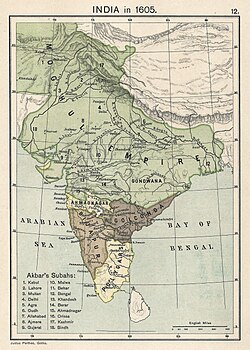
At its zenith around 1700, the empire spanned approximately 4,000,000 square kilometers, governing a population of over 158 million people. This vast territory encompassed much of modern-day India, Pakistan, Bangladesh, and Afghanistan.
Key Facts
- Duration: 1526–1857.
- Greatest Extent: Reached under Emperor Aurangzeb c. 1700.
- Official Language: Persian.
- Major Capitals: Agra, Delhi, Fatehpur Sikri, and Lahore.
- State Religion: Islam, with a period of Din-i Ilahi (a syncretic faith) under Akbar from 1582 to 1605.
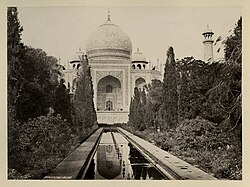
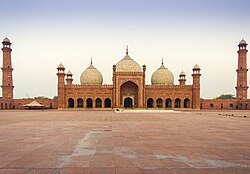
- Legacy: Renowned for architectural marvels like the Taj Mahal and the Badshahi Mosque.
The Imperial Timeline: From Foundation to Decline
The Era of Foundation: Babur and Humayun (1526–1556)
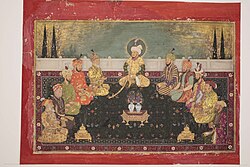
The empire was established by Babur, who won the First Battle of Panipat on April 21, 1526. Babur brought Central Asian military tactics and a love for Persian culture to India. His successor, Humayun, faced significant instability, including a period known as the Mughal Interregnum (1540–1555) during which the empire was temporarily displaced before he could reclaim the throne.
The Golden Age: Akbar to Aurangzeb (1556–1707)
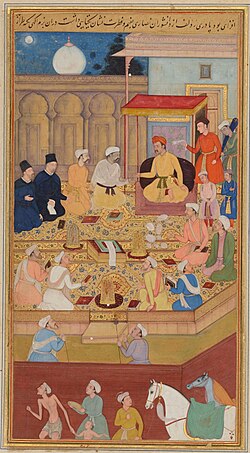
The empire reached its cultural and political peak under Akbar, who expanded the borders and implemented a policy of religious tolerance. He established the Ibadat Khana, a house of worship where scholars of different faiths could debate.
Following Akbar, Jahangir and Shah Jahan continued the empire's prosperity. Shah Jahan is most famous for his architectural contributions, most notably the Taj Mahal. The era of expansion culminated with Aurangzeb, who pushed the empire to its maximum territorial extent but also faced prolonged conflicts, such as the Deccan wars (1680–1707).
The Long Decline (1707–1857)
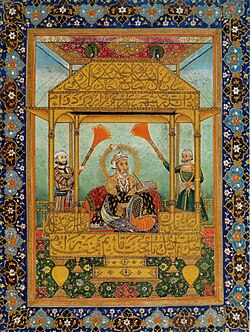
After the death of Aurangzeb in 1707, the empire entered a period of steady decay. Power shifted toward regional governors and puppet emperors. For example, during the reign of Farrukhsiyar, effective power was held by the Sayyid Brothers.
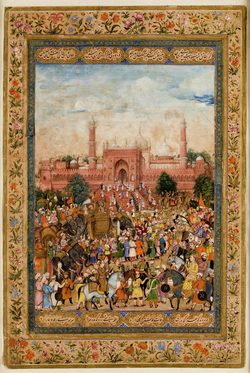
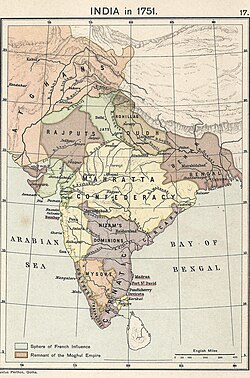
By the mid-18th century, the empire was ravaged by internal strife and external shocks, including Nader Shah's invasion (1738–1740). By 1751, only remnants of the empire remained. The final blow came in 1857 during the Siege of Delhi, leading to the exile of the last emperor, Bahadur Shah II (Zafar), to British Burma in 1858, marking the transition to the British Raj.
Administration, Economy, and Society
State Governance and Law
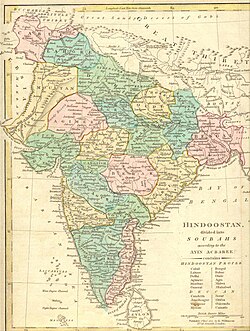
The Mughal government was a monarchy led by the Emperor, supported by a Grand Vizier and a Vicegerent. The empire was divided into administrative provinces called subahs. The legal system was based on Islamic jurisprudence, specifically the Hanafi school.
Economic Powerhouse
The Mughal economy was primarily agrarian, with land revenue serving as the primary resource base. However, the empire was a global leader in industrial manufacturing, particularly in the textile industry. The Bengal Subah was a critical hub for both textiles and shipbuilding.
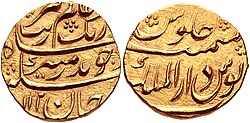
The empire utilized a sophisticated coinage system featuring the Rupee, Taka, and dam.
Cultural and Scientific Achievements
Architecture and Art
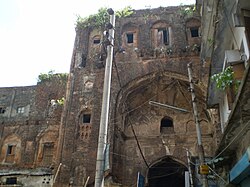
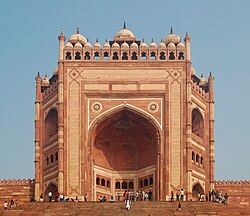
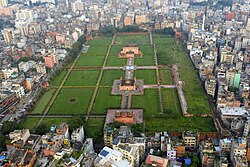
Mughal architecture is characterized by grand domes, slender minarets, and intricate carvings. Key sites include the Red Fort in Delhi, the Buland Darwaza in Fatehpur Sikri, and the Lalbagh Fort in Dhaka.
Language and Literature
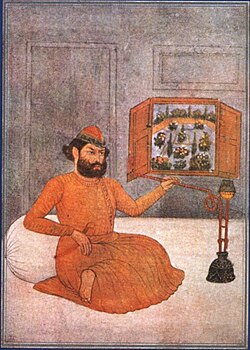
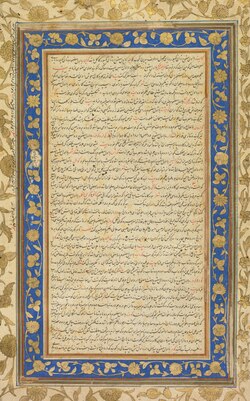
While Persian was the language of the court, the era saw the birth of Urdu, a language that emerged from a multiplicity of names and was refined by poets like Mir Taqi Mir and Ghulam Hamdani Mushafi.
![Ghulam Hamdani Mushafi, the poet first believed to have coined the name "Urdu" around 1780 AD for a language that went by a multiplicity of names before his time[151]](/images/df/aa/dfaaf35cf0b5a471a8c96ad7a6c9ba7abce26dbc691e87d7d6b553846677120c.png)
Science and Military Technology
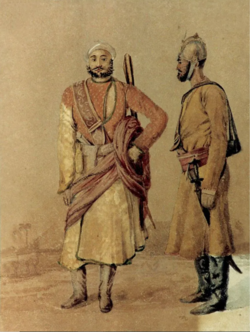
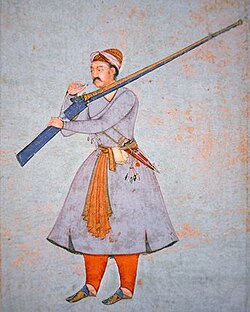
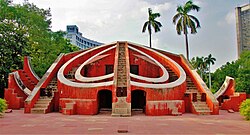
The Mughals were pioneers in gunpowder warfare, utilizing matchlock rifles and advanced rocketry. In science, they made strides in astronomy and metallurgy, exemplified by the Jantar Mantar observatories built by Jai Singh II and the creation of complex celestial globes.
![Celestial Globe by Muhammad Saleh Thattvi, c. 1663[194]](/images/83/0a/830ad024f715e5e8d711d7716b70e18ab5afd05bc9ed7cb15f0efd83e1ffb8b2.jpg)
Summary of the Mughal Empire
| Category | Details |
|---|---|
| Founding Emperor | Babur (1526) |
| Last Emperor | Bahadur Shah II (1857) |
| Peak Population | c. 158.4 million (1700) |
| Peak Area | c. 4,000,000 km² |
| Official Language | Persian |
| Key Industries | Textiles, Shipbuilding, Agriculture |
| Successor State | British Raj |
Frequently Asked Questions
Who was the most successful Mughal emperor?
Akbar is often cited as the most successful due to his administrative reforms, territorial expansion, and promotion of religious tolerance through the creation of Din-i Ilahi.
What was the role of the Persian language in the empire?
Persian served as the official language of the Mughal court, administration, and high culture, influencing the development of local languages and the eventual emergence of Urdu.
How did the Mughal Empire eventually collapse?
The collapse was caused by a combination of internal instability, the rise of regional powers, devastating invasions (such as that of Nader Shah), and the gradual encroachment of the British East India Company.
What are the most famous architectural legacies of the Mughals?
The most iconic legacies include the Taj Mahal in Agra, the Red Fort and Jama Masjid in Delhi, and the Badshahi Mosque in Lahore.
What was the Mughal contribution to military technology?
The Mughals integrated gunpowder warfare into the Indian subcontinent, utilizing matchlock rifles, explosives, and early forms of rocketry to maintain control over their vast territories.