Forty Martyrs Armenian Cathedral: A Historic Pillar of Aleppo
Standing as a testament to resilience and faith, the Forty Martyrs Armenian Cathedral is one of the oldest active Armenian churches in both the city of Aleppo and the wider Armenian diaspora. Located in the historic Al-Jdayde (Jdeydeh) Christian quarter of Syria, this 15th-century sanctuary serves as the seat of the Armenian Diocese of Beroea. Its architecture and history mirror the long-standing presence of the Armenian people in the Levant, evolving from a small chapel into a significant spiritual and cultural complex.
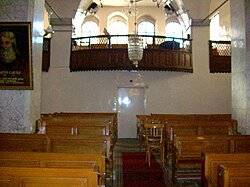
The cathedral is designed as a three-nave basilica—a traditional church layout with a central nave and two side aisles—and is notable for having no dome. While the main structure dates back centuries, its striking bell tower, added in 1912, is recognized as a unique example of baroque architecture within Aleppo.
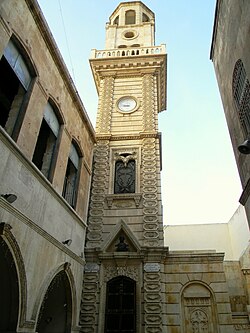
Key Facts
- Consecrated: 1491
- Location: Al-Jdayde quarter, Aleppo, Syria
- Affiliation: Armenian Apostolic Church, Diocese of Beroea
- Architectural Style: Three-nave basilica with a Baroque bell tower (1912)
- Significance: One of the oldest functioning Armenian churches in the diaspora
The Armenian Presence in Aleppo
The history of Armenians in Aleppo is deeply intertwined with the city's growth. The first significant presence dates back to the 1st century BC under Tigranes the Great. Following the adoption of Christianity as Armenia's state religion in 301 AD, Aleppo became a vital stop for pilgrims traveling to Jerusalem.
By the 11th century, during the era of the Armenian Kingdom of Cilicia, a structured community of merchants and families established businesses and residences. By the 14th century, this community was well-organized, boasting its own schools, churches, and a prelacy (the office of a high-ranking member of the clergy).
The population grew further under the Ottoman Empire, particularly after 1915, when Aleppo became a sanctuary for over 100,000 survivors of the Armenian genocide. By the mid-20th century, Armenians comprised approximately one-quarter of Aleppo's population. Despite later emigration in the 1970s and 1980s and the disruptions of the Syrian Civil War, the city remains a critical center for the global Armenian diaspora.
History of the Cathedral
The site was first mentioned in 1476 in a work by Father Melikseth. The current building was completed in 1491, replacing a small chapel in the Jdeydeh cemetery. It was named after the Forty Martyrs of Sebaste, a group of Roman soldiers who faced martyrdom in Lesser Armenia.
Initially seating only 100 people, the church underwent major expansions between 1499 and 1500, funded by the elite Reyis Baron Yesayi. This period also saw the construction of the prelacy building. Over the centuries, the cathedral served as a temporary seat for various Armenian catholicoi (the highest ranking bishops) of the Holy See of Cilicia.
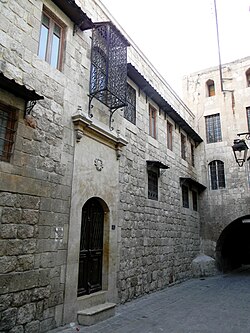
In 1624, to accommodate the influx of pilgrims, the community established Hokedoun (Spiritual House), a rest-house featuring 23 large rooms. By 1625, Italian explorer Pietro Della Valle noted that the cathedral was one of four churches sharing a single yard in the Jdeydeh quarter.
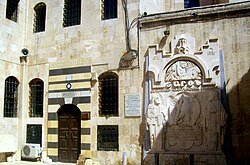
Modern additions include an upper story built in 1874, a baptismal font from 1888, and a 1991 khachkar (a traditional Armenian cross-stone) memorial dedicated to the victims of the Armenian genocide.
Art and Icons
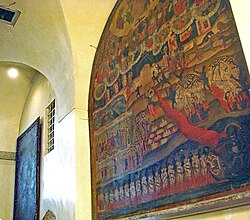
The cathedral houses a rich collection of over 30 icons, blending ancient and modern styles. These works represent the Aleppine school of art and were largely renovated between 1993 and 1996 by expert Andranik Antonyan.
Among the most notable works are:
- The Last Judgement (1703): A massive 400x600cm canvas by Nehmatallah Hovsep, considered one of the most famous icons of the Aleppine school.
- The Mother of God (1663): A canvas work by Der-Megerdich.
- Works by Kevork Anania: Including depictions of Saint John the Baptist and Saint Joseph (1720), and the Baptism of Jesus Christ (1756).
The Zarehian Treasury
Adjacent to the cathedral is the Church of the Holy Mother of God, built before 1429. After serving as a church for centuries, it was converted into a library in the early 20th century. In 1991, it became the Zarehian Treasury, a museum named in honor of Catholicos Zareh I, who previously served as the archbishop of the Aleppo diocese.
Current Status and Restoration
Today, the cathedral complex is a hub of Armenian life, housing the Haygazian Armenian School, the Avetis Aharonian theatre hall, and the Nikol Aghbalian branch of the Hamazkayin Educational and Cultural Society.
The site suffered damage on April 28, 2015, due to a suspected bombing or artillery attack. While the main church and bell tower survived, other parts of the compound were destroyed. Following the end of conflict in the city, reconstruction began in July 2017 and was completed on March 31, 2019, after which the church was reconsecrated by Catholicos Aram I.
| Feature | Details |
|---|---|
| Consecration Year | 1491 |
| Architectural Type | Three-nave basilica (no dome) |
| Key Landmark | Baroque Bell Tower (1912) |
| Associated Museum | Zarehian Treasury |
| Notable Artwork | The Last Judgement (1703) |
| Recent Milestone | Reconsecrated March 31, 2019 |
Frequently Asked Questions
Who are the Forty Martyrs the cathedral is named after?
The cathedral is named in honor of the Forty Martyrs of Sebaste, a group of Roman soldiers from Lesser Armenia who were venerated in Christianity after facing martyrdom.
What is the Zarehian Treasury?
The Zarehian Treasury is a museum located in the former Church of the Holy Mother of God. It was established in 1991 to honor Catholicos Zareh I.
What is the significance of the Hokedoun?
Built in 1624, the Hokedoun (meaning "Spiritual House") served as a rest-house with 23 rooms for Armenian pilgrims traveling to Jerusalem.
Was the cathedral damaged during the Syrian Civil War?
Yes, parts of the church compound were destroyed in an attack on April 28, 2015. However, the main cathedral and its bell tower survived, and the compound was fully reconstructed by March 2019.
What makes the bell tower unique?
Erected in 1912 through a donation from Rizkallah Tahhan, the bell tower is considered one of the few and most unique examples of baroque architecture in Aleppo.